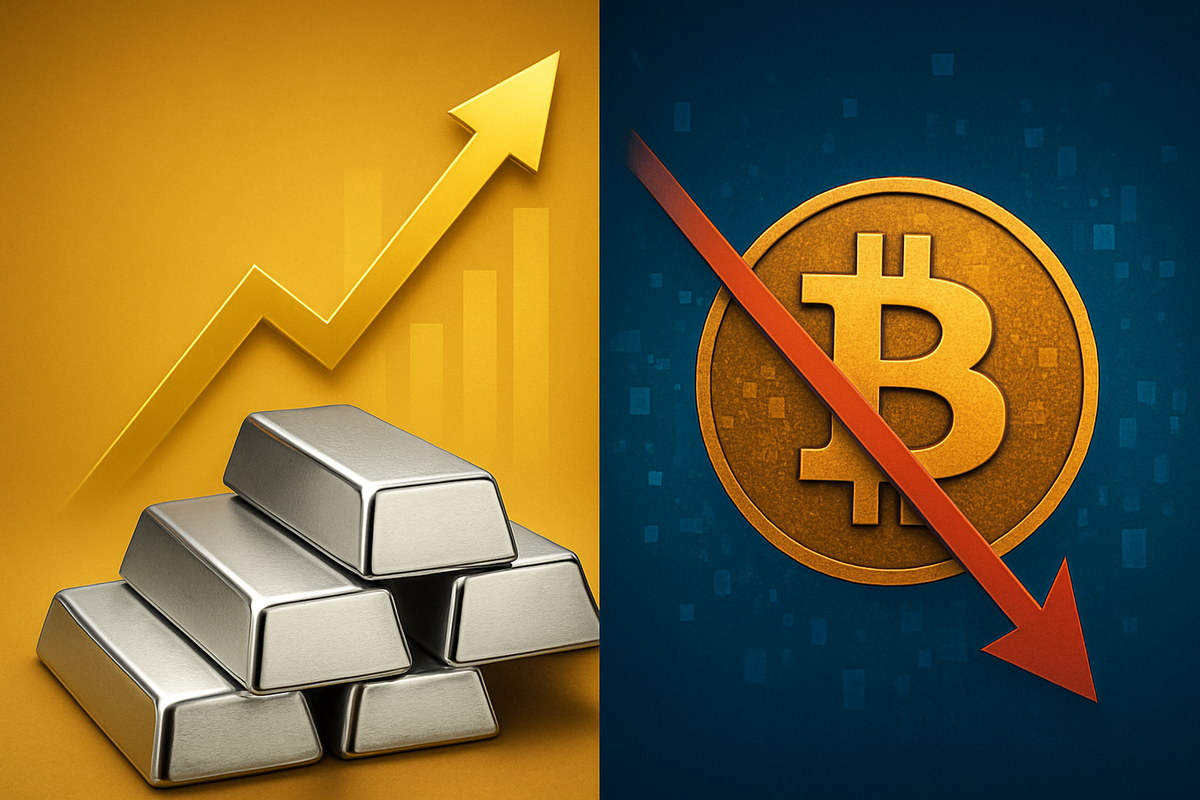
As December 2, 2025 dawns, the financial world is witnessing a striking dichotomy in asset performance: silver, the often-overlooked precious metal, has surged to unprecedented levels, while the once-unstoppable Bitcoin (BTC) is experiencing a significant slump. This stark divergence underscores a profound shift in investor sentiment, driven by a complex interplay of macroeconomic forces, supply-demand dynamics, and evolving risk appetites. The immediate implications suggest a market increasingly favoring tangible assets and inflation hedges amid global uncertainty, while speculative digital assets face a renewed period of scrutiny and consolidation.
A Deep Dive into Divergent Fortunes
Silver's meteoric rise has captivated market participants, with prices hovering near an all-time high of $58-$59 USD per troy ounce as of December 1st and 2nd, 2025. This remarkable rally caps a year where silver has more than doubled in value, significantly outperforming its glittering counterpart, gold. The impetus behind this surge is multifaceted. Expectations of imminent US Federal Reserve rate cuts, with an 88% probability priced in for a 25 basis point reduction in December 2025, have weakened the US dollar and reduced the opportunity cost of holding non-yielding assets. Crucially, silver is facing a persistent structural supply deficit, now in its fifth consecutive year, exacerbated by dwindling inventories in key markets like China. This supply crunch is meeting explosive industrial demand from the burgeoning "green energy" sectors, particularly solar panel manufacturing, electric vehicles, and AI electronics, making 2025 another record year for photovoltaic consumption. Furthermore, silver's designation on the US Critical Minerals List in 2025 has created a "geographic bottleneck," pulling supply from the global market and amplifying its safe-haven appeal amidst ongoing geopolitical tensions and economic uncertainty.
In stark contrast, Bitcoin has endured a challenging period, dipping below $85,000 on December 1st and stabilizing around $87,010 on December 2nd, representing a roughly 33% decline from its October peak of approximately $126,210.50. This slump is primarily attributed to a "risk-off" market sentiment, where investors are retreating from speculative assets, mirroring a broader sell-off in technology stocks. Institutional investors have notably engaged in profit-taking, with US spot Bitcoin ETFs recording substantial net outflows of $3.48 billion in November. Initial concerns over monetary policy uncertainty were somewhat alleviated by the Federal Reserve's recent announcement of an end to Quantitative Tightening (QT), which could inject dollar liquidity into the market. However, this has yet to reverse the immediate bearish trend. Regulatory uncertainty continues to cast a long shadow over the crypto market, while technical indicators, including a "death cross" on higher timeframes, signal a bearish momentum shift, triggering liquidations of overleveraged long positions.
The immediate market reactions have been pronounced. Silver's robust performance highlights a growing appetite for hard assets and commodities, suggesting a market bracing for inflationary pressures and seeking tangible value. Conversely, Bitcoin's decline has sent ripples through the crypto ecosystem, leading to sharp declines in crypto-linked equities and contributing to a cautious start to December for Wall Street, underscoring Bitcoin's increasing correlation with broader risk assets.
Corporate Winners and Losers in the Shifting Sands
The divergent paths of silver and Bitcoin are creating distinct sets of winners and losers across various industries. On the winning side, silver mining companies are poised to benefit immensely from surging prices. Companies like Pan American Silver Corp. (NASDAQ: PAAS), First Majestic Silver Corp. (NYSE: AG), and Wheaton Precious Metals Corp. (NYSE: WPM) are likely seeing increased revenues and profit margins, provided their production costs remain stable. The robust demand from the green energy sector also benefits solar panel manufacturers and electric vehicle component suppliers, many of whom rely on silver for their products. These companies, while not direct silver plays, find their underlying demand strengthened by the very factors driving silver's ascent. Furthermore, precious metals ETFs and funds focused on silver, such as the iShares Silver Trust (NYSEARCA: SLV), are experiencing significant inflows and appreciation, benefiting their investors.
Conversely, the slump in Bitcoin is putting pressure on cryptocurrency exchanges like Coinbase Global Inc. (NASDAQ: COIN), crypto mining companies such as Marathon Digital Holdings Inc. (NASDAQ: MARA) and Riot Platforms Inc. (NASDAQ: RIOT), and other blockchain technology firms. These companies often see their valuations closely tied to the price of Bitcoin, and a sustained downturn can lead to reduced trading volumes, lower mining profitability, and diminished investor confidence. Additionally, companies that hold significant amounts of Bitcoin on their balance sheets, like MicroStrategy Incorporated (NASDAQ: MSTR), will see a decrease in the value of their digital assets, potentially impacting their overall financial health and investor perception. The "risk-off" sentiment affecting Bitcoin also tends to spill over into broader technology stocks, particularly those with high growth potential but unproven profitability, leading to a more challenging fundraising and operational environment for them.
Wider Significance and Market Implications
This tale of two markets—silver's ascendancy and Bitcoin's retreat—carries broader implications for global financial trends. Silver's surge underscores a growing recognition of its dual role as both a monetary metal and a critical industrial commodity, particularly in the context of the global energy transition. The "green energy" push, coupled with persistent supply deficits, positions silver as a strategic asset, intertwining its fate with the future of renewable technology. This trend highlights a broader industry shift towards real assets and commodities, often seen as hedges against inflation and geopolitical instability, especially as central banks signal a pivot towards more accommodative monetary policies.
Bitcoin's slump, on the other hand, reflects a recalibration of risk in the digital asset space. While proponents tout its decentralized nature and potential as "digital gold," its recent performance demonstrates its continued sensitivity to broader market liquidity, institutional flows, and regulatory headwinds. The increasing correlation between Bitcoin and traditional equities, particularly tech stocks, challenges its narrative as a completely uncorrelated asset, suggesting it's still largely perceived as a risk-on investment. Regulatory uncertainty, with stalled progress on comprehensive crypto frameworks, continues to undermine confidence and hinder mainstream adoption. Historically, commodity booms often coincide with periods of inflation or supply shocks, while speculative assets like early-stage technology stocks or cryptocurrencies can experience sharper corrections during "risk-off" phases. The current scenario echoes past cycles where tangible assets gained favor during economic transitions or periods of heightened uncertainty, drawing parallels to commodity supercycles of decades past.
What Comes Next: Navigating the Crossroads
Looking ahead, the short-term trajectory for both silver and Bitcoin presents a mixed bag of possibilities. For silver, while technical indicators suggest it may be overbought, the fundamental drivers—dovish Fed policy, structural supply deficits, and robust industrial demand—are expected to provide strong underlying support. Any short-term corrections could be viewed as buying opportunities by investors seeking exposure to green energy themes and inflation hedges. The long-term outlook appears robust, with continued demand from solar, EVs, and AI likely to sustain elevated prices, potentially leading to further outperformance against gold. Strategic adaptations for industrial users might include exploring alternative materials or securing long-term supply contracts, while miners will likely accelerate exploration and production efforts.
For Bitcoin, the immediate future hinges on its ability to hold critical support levels, particularly in the $80,400-$85,000 range. A failure to do so could trigger further declines. However, the recent end of Quantitative Tightening by the Federal Reserve could eventually lead to increased dollar liquidity, which historically has been a positive catalyst for risk assets, including Bitcoin. This might pave the way for a year-end rally towards $100,000, resetting leverage in the market. Long-term, Bitcoin's trajectory will depend on a clearer regulatory environment, renewed institutional interest, and its ability to demonstrate its utility beyond speculative trading. Potential strategic pivots for crypto companies might involve greater focus on real-world applications of blockchain technology, enhanced compliance measures, and diversification of revenue streams away from pure trading volumes. Market opportunities could emerge for investors willing to weather volatility and accumulate at lower price points, while challenges include ongoing regulatory scrutiny and competition from traditional financial instruments.
A Comprehensive Wrap-Up: Shifting Tides
In summary, the current financial landscape, as of December 2, 2025, is defined by a significant divergence: silver's impressive surge to record highs, driven by industrial demand, supply shortages, and anticipated monetary easing, contrasting sharply with Bitcoin's notable slump, influenced by risk-off sentiment, institutional profit-taking, and regulatory uncertainty. Key takeaways include the increasing importance of tangible assets as inflation hedges and critical components for the green energy transition, alongside the continued volatility and sensitivity of digital assets to broader market sentiment and regulatory developments.
Moving forward, the market will likely continue to grapple with the implications of central bank policies, geopolitical events, and the accelerating demand for critical minerals. Investors should closely monitor silver's supply-demand dynamics and any shifts in green energy policy, while for Bitcoin, the focus will be on institutional flows, regulatory clarity, and its ability to decouple from traditional risk assets. The contrasting fortunes of these two assets serve as a potent reminder of the dynamic nature of financial markets and the importance of diversification and informed decision-making in an ever-evolving global economy.
This content is intended for informational purposes only and is not financial advice