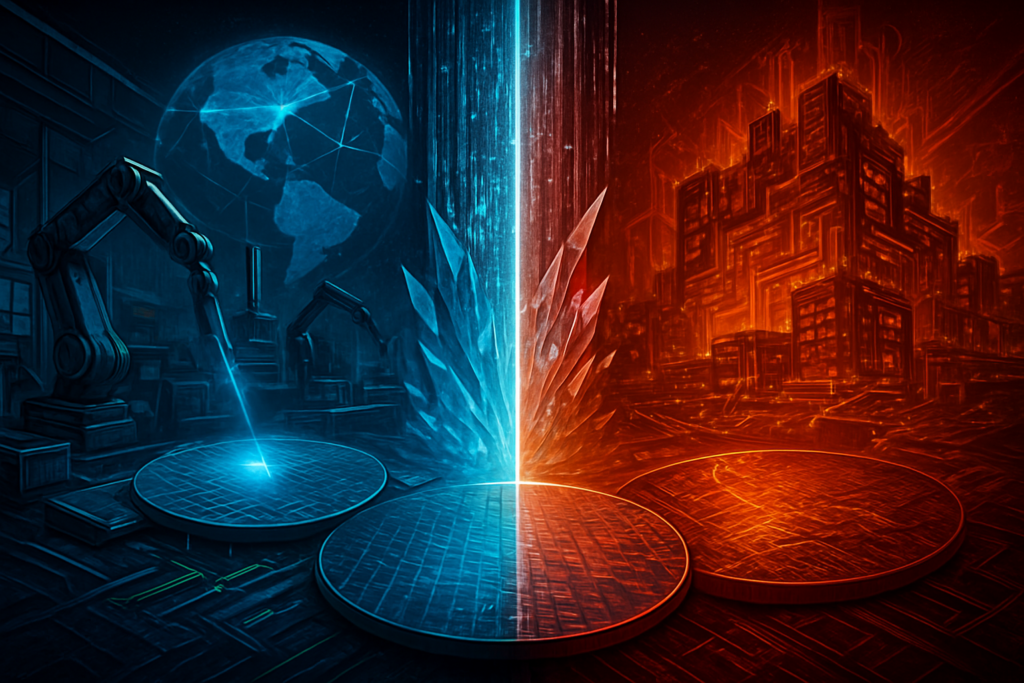
As of January 7, 2026, the global semiconductor industry has entered a precarious new era defined by a "Silicon Curtain" that is bifurcating the world’s most critical supply chain. Following a landmark determination by the Office of the U.S. Trade Representative (USTR) on December 23, 2025, a new phase of Section 301 tariffs has been implemented, specifically targeting Chinese-made semiconductors. While the initial tariff rate is set at 0% to avoid immediate inflationary shocks to the automotive and consumer electronics sectors, this "grace period" is a calculated tactical move, with a massive, yet-to-be-specified rate hike already scheduled for June 23, 2027.
This policy shift, combined with a tightening trilateral equipment blockade between the U.S., Japan, and the Netherlands, has forced a dramatic realignment of global chip manufacturing. While Washington aims to incentivize a migration of the supply chain away from Chinese foundries, Beijing has responded by doubling down on its "whole-of-nation" push for self-sufficiency. However, as the new year begins, the technical reality on the ground for Chinese champions like Semiconductor Manufacturing International Corp. (SMIC) (HKG: 0981) and Hua Hong Semiconductor (HKG: 1347) remains one of significant yield challenges and operational friction.
The technical backbone of the current trade friction lies in the sophisticated layering of fiscal and export controls. The U.S. government’s decision to start the new Section 301 tariffs at 0% serves as a "ticking clock" for Western companies to find alternative sourcing for legacy chips—the 28nm to 90nm components that power everything from washing machines to F-150 trucks. By 2027, these duties will be added to the existing 50% tariffs already in place, effectively pricing Chinese-made general-purpose chips out of the American market. This is not merely a tax; it is a forced migration of the global electronics ecosystem.
Simultaneously, the "Trilateral Blockade" involving the U.S., Japan, and the Netherlands has moved beyond restricting the sale of new machines to targeting the maintenance of existing ones. As of April 2025, ASML (NASDAQ: ASML) has been required to seek direct licenses from the Dutch government to service immersion Deep Ultraviolet (DUV) lithography systems already installed in China. Japan has followed suit, with Tokyo Electron (TYO: 8035) and Nikon (TYO: 7731) expanding their export controls to include over 23 types of advanced equipment and, crucially, the spare parts and software updates required to keep them running. This "service choke" is causing an estimated 15% to 20% annual attrition rate in the precision of Chinese fab lines, as machines fall out of calibration without factory-authorized support.
The immediate beneficiaries of this geopolitical tension are non-Chinese foundries capable of producing legacy and mid-range nodes. Taiwan Semiconductor Manufacturing Company (TSMC) (NYSE: TSM) and Intel (NASDAQ: INTC) are seeing a surge in "China-plus-one" orders as global OEMs seek to de-risk their 2027 exposure. Conversely, Chinese firms are facing a brutal financial squeeze. Hua Hong Semiconductor (HKG: 1347) recently reported a profit decline of over 50%, a result of massive capital expenditures required to pivot toward domestic equipment that—while politically favored—is currently less efficient than Western counterparts.
In the high-end AI chip space, the impact is even more acute. SMIC’s push into 7nm and 5nm nodes to support domestic AI champions like Huawei has hit a technical ceiling. Without access to Extreme Ultraviolet (EUV) lithography, SMIC is forced to use Self-Aligned Quadruple Patterning (SAQP) with older DUV machines. This process is incredibly complex and error-prone; industry reports suggest that SMIC’s yields for its advanced N+2 nodes are hovering between 60% and 70%, far below the 85%+ yields achieved by TSMC. This "yield gap" means that for every ten AI chips SMIC produces, three or four are discarded, leading to massive operating losses that must be subsidized by the state.
This trade war is not just about silicon; it is about the future of artificial intelligence. The U.S. strategy aims to deny China the compute power necessary to train next-generation Large Language Models (LLMs). By restricting both the chips and the tools to make them, the U.S. is attempting to freeze China’s AI capabilities at the 2024-2025 level. This has led to a bifurcated AI landscape: a "Western Stack" led by NVIDIA (NASDAQ: NVDA) and high-end TSMC-made silicon, and a "Sovereign Chinese Stack" built on less efficient, domestically produced hardware.
The broader significance of the 2026 trade environment is the end of the "Globalized Fab" model. For three decades, the semiconductor industry relied on a seamless flow of tools from Europe, designs from the U.S., and manufacturing in Asia. That model is now dead. In its place is a system of "Fortress Fabs." China’s new "50% Domestic Mandate"—which requires local chipmakers to prove half of their equipment spending goes to domestic firms like Naura Technology Group (SHE: 002371) and Advanced Micro-Fabrication Equipment Inc. (AMEC) (SHA: 688012)—is a defensive wall designed to ensure that even if the West cuts off all support, a baseline of manufacturing capability remains.
Looking toward the late 2020s, the industry is bracing for the "2027 Tariff Cliff." As the 0% rate expires, we expect a massive inflationary spike in consumer electronics unless alternative capacity in India, Vietnam, or the U.S. comes online in time. Furthermore, the technical battle will shift toward "back-end" technologies. With lithography restricted, China is expected to pour billions into advanced packaging and "chiplet" technology—a way to combine multiple less-advanced chips to mimic the performance of a single high-end processor.
However, the path to self-sufficiency is fraught with "debugging" delays. Domestic Chinese equipment currently requires significantly more downtime for calibration than Western tools, leading to a 20% to 30% drop in overall fab efficiency. The next 18 months will be a race: can Chinese equipment manufacturers like Naura and AMEC close the precision gap before the "service choke" from ASML and Tokyo Electron renders China's existing Western-made fleets obsolete?
The events of early 2026 mark a point of no return for the semiconductor industry. The U.S. Section 301 tariffs have created a clear deadline for the decoupling of the legacy chip supply chain, while the trilateral equipment restrictions are actively degrading China’s advanced manufacturing capabilities. While SMIC and Hua Hong are consolidating and fighting for every percentage point of yield, the cost of their "sovereign" silicon is becoming prohibitively high.
For the global tech industry, the takeaway is clear: the era of cheap, reliable, and politically neutral silicon is over. In the coming months, watch for the official announcement of the 2027 tariff rates and any potential retaliatory moves from Beijing regarding critical minerals like gallium and germanium. The "Silicon Curtain" has been drawn, and the world is now waiting to see which side of the divide will innovate faster under pressure.
This content is intended for informational purposes only and represents analysis of current AI and semiconductor developments as of January 2026.
TokenRing AI delivers enterprise-grade solutions for multi-agent AI workflow orchestration, AI-powered development tools, and seamless remote collaboration platforms.
For more information, visit https://www.tokenring.ai/.