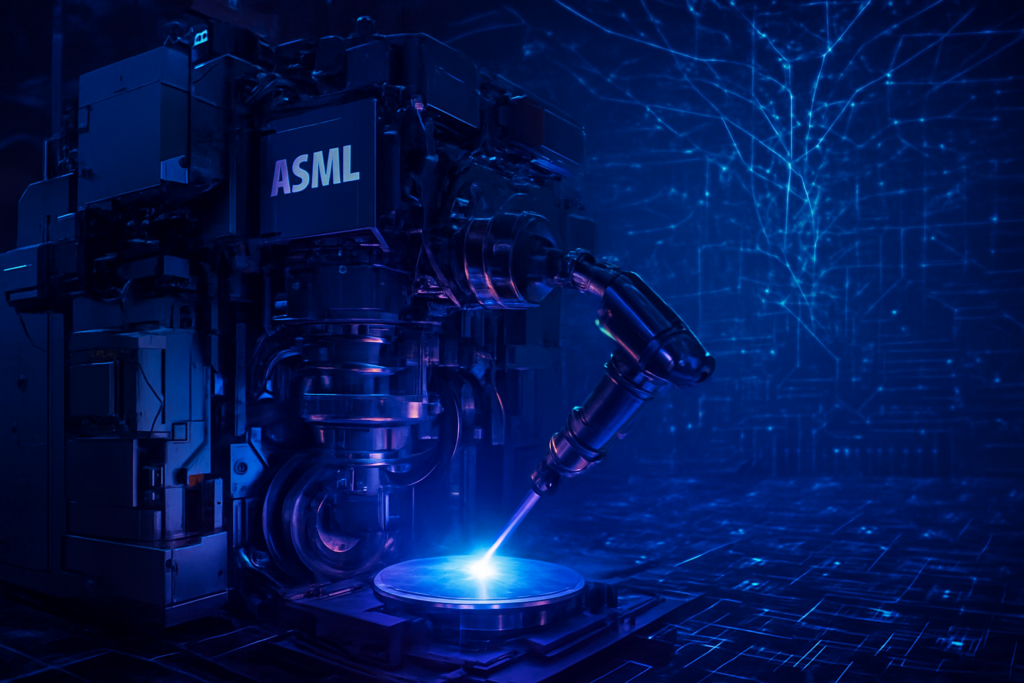
The dawn of 2026 marks a historic inflection point in the semiconductor industry as the "mass production era" of High-Numerical Aperture (High-NA) Extreme Ultraviolet (EUV) lithography officially moves from laboratory speculation to the factory floor. Leading the charge, Intel (NASDAQ: INTC) has confirmed the completion of acceptance testing for its latest fleet of ASML (NASDAQ: ASML) Twinscan EXE:5200 systems, signaling the start of a multi-year transition toward the 1.4nm (14A) node. With each machine carrying a price tag exceeding $380 million, this development represents one of the most expensive and technically demanding gambles in industrial history, aimed squarely at sustaining the hardware requirements of the generative AI revolution.
The significance of this transition cannot be overstated for the future of artificial intelligence. As transformer models grow in complexity, the demand for processors with higher transistor densities and lower power profiles has hit a physical wall with traditional EUV technology. By deploying High-NA tools, chipmakers are now able to print features with a resolution of approximately 8nm—nearly doubling the precision of previous generations. This shift is not merely an incremental upgrade; it is a fundamental reconfiguration of the economics of scaling, moving the industry toward a future where 1nm processors will eventually power the next decade of autonomous systems and trillion-parameter AI models.
The Physics of 0.55 NA: A New Blueprint for Transistors
At the heart of this revolution is ASML’s Twinscan EXE series, which increases the Numerical Aperture (NA) from 0.33 to 0.55. In practical terms, this allows the lithography machine to focus light more sharply, enabling the printing of significantly smaller features on a silicon wafer. While standard EUV tools required "multi-patterning"—a process of printing a single layer multiple times to achieve higher resolution—High-NA EUV enables single-exposure patterning for the most critical layers of a chip. This reduction in process complexity is expected to improve yields and shorten the time-to-market for cutting-edge AI accelerators, which have historically been plagued by the intricate manufacturing requirements of sub-3nm nodes.
Technically, the transition to High-NA introduces an "anamorphic" optical system, which magnifies the X and Y axes differently. This design results in a "half-field" exposure, meaning the reticle size is effectively halved compared to standard EUV. To manufacture the massive dies required for high-end AI GPUs, such as those produced by NVIDIA (NASDAQ: NVDA), manufacturers must now employ "stitching" techniques to join two exposure fields into a single seamless pattern. This architectural shift has sparked intense discussion among AI researchers and hardware engineers, as it necessitates a move toward "chiplet" designs where multiple smaller dies are interconnected, rather than relying on a single monolithic slab of silicon.
Intel’s primary vehicle for this technology is the 14A node, the world’s first process built from the ground up to be "High-NA native." Initial reports from Intel’s D1X facility in Oregon suggest that the EXE:5200B tools are achieving throughputs of over 220 wafers per hour, a critical metric for high-volume manufacturing. Industry experts note that while the $380 million capital expenditure per tool is staggering, the ability to eliminate multiple mask steps in the production cycle could eventually offset these costs, provided the volume of AI-specific silicon remains high.
A High-Stakes Rivalry: Intel vs. Samsung and the "Lithography Divide"
The deployment of High-NA EUV has created a strategic divide among the world’s three leading foundries. Intel’s aggressive "first-mover" advantage is a calculated attempt to regain process leadership after losing ground to competitors over the last decade. By securing the earliest shipments of the EXE:5200 series, Intel is positioning itself as the premier destination for custom AI silicon from tech giants like Microsoft (NASDAQ: MSFT) and Amazon (NASDAQ: AMZN), who are increasingly looking to design their own proprietary chips to optimize AI workloads.
Samsung (KRX: 005930), meanwhile, has taken a dual-track approach. Having received its first High-NA units in 2025, the South Korean giant is integrating the technology into both its logic foundry and its advanced memory production. For Samsung, High-NA is essential for the development of HBM4 (High Bandwidth Memory), the specialized memory that feeds data to AI processors. The precision of High-NA is vital for the extreme vertical stacking required in next-generation HBM, making Samsung a formidable competitor in the AI hardware supply chain.
In contrast, Taiwan Semiconductor Manufacturing Company (NYSE: TSM) has maintained a more conservative stance, opting to refine its existing 0.33 NA EUV processes for its 2nm (N2) node. This has created a "lithography divide" where Intel and Samsung are betting on the raw resolution of High-NA, while TSMC relies on its proven manufacturing excellence and cost-efficiency. The competitive implication is clear: if High-NA enables Intel to hit the 1.4nm milestone ahead of schedule, the balance of power in the global semiconductor market could shift back toward American and Korean soil for the first time in years.
Moore’s Law and the Energy Crisis of AI
The broader significance of the High-NA era lies in its role as a "lifeline" for Moore’s Law. For years, critics have predicted the end of transistor scaling, arguing that the heat and physical limitations of sub-atomically small components would eventually halt progress. High-NA EUV, combined with new transistor architectures like Gate-All-Around (GAA) and backside power delivery, provides a roadmap for another decade of scaling. This is particularly vital as the AI landscape shifts from "training" large models to "inference" at the edge, where energy efficiency is the primary constraint.
Processors manufactured on the 1.4nm and 1nm nodes are expected to deliver up to a 30% reduction in power consumption compared to current 3nm chips. In an era where AI data centers are consuming an ever-larger share of the global power grid, these efficiency gains are not just an economic advantage—they are a geopolitical and environmental necessity. Without the scaling enabled by High-NA, the projected growth of generative AI would likely be throttled by the sheer energy requirements of the hardware needed to support it.
However, the transition is not without its concerns. The extreme cost of High-NA tools threatens to centralize chip manufacturing even further, as only a handful of companies can afford the multi-billion dollar investment required to build a High-NA-capable "mega-fab." This concentration of advanced manufacturing capabilities raises questions about supply chain resilience and the accessibility of cutting-edge hardware for smaller AI startups. Furthermore, the technical challenges of "stitching" half-field exposures could lead to initial yield issues, potentially keeping prices high for the very AI chips the technology is meant to proliferate.
The Road to 1.4nm and Beyond
Looking ahead, the next 24 to 36 months will be focused on perfecting the transition from pilot production to High-Volume Manufacturing (HVM). Intel is targeting 2027 for the full commercialization of its 14A node, with Samsung likely following closely behind with its SF1.4 process. Beyond that, the industry is already eyeing the 1nm milestone—often referred to as the "Angstrom era"—where features will be measured at the scale of individual atoms.
Future developments will likely involve the integration of High-NA with even more exotic materials and architectures. We can expect to see the rise of "2D semiconductors" and "carbon nanotube" components that take advantage of the extreme resolution provided by ASML’s optics. Additionally, as the physical limits of light-based lithography are reached, researchers are already exploring "Hyper-NA" systems with even higher apertures, though such technology remains in the early R&D phase.
The immediate challenge remains the optimization of the photoresist chemicals and mask technology used within the High-NA machines. At such small scales, "stochastic effects"—random variations in the way light interacts with matter—become a major source of defects. Solving these material science puzzles will be the primary focus of the engineering community throughout 2026, as they strive to make the 1.4nm roadmap a reality for the mass market.
A Watershed Moment for AI Infrastructure
The arrival of the High-NA EUV mass production era is a watershed moment for the technology industry. It represents the successful navigation of one of the most difficult engineering hurdles in human history, ensuring that the physical hardware of the AI age can continue to evolve alongside the software. For Intel, it is a "do-or-die" moment to reclaim its crown; for Samsung, it is an opportunity to dominate both the brain (logic) and the memory of future AI systems.
In summary, the transition to 0.55 NA lithography marks the end of the "low-resolution" era of semiconductor manufacturing. While the $380 million price tag per machine is a barrier to entry, the potential for 2.9x increases in transistor density offers a clear path toward the 1.4nm and 1nm chips that will define the late 2020s. The industry has effectively doubled down on hardware scaling to meet the insatiable appetite of AI.
In the coming months, watchers should keep a close eye on the first "test chips" emerging from Intel’s 14A pilot lines. The success or failure of these early runs will dictate the pace of AI hardware advancement for the rest of the decade. As the first High-NA-powered processors begin to power the next generation of data centers, the true impact of this $380 million gamble will finally be revealed in the speed and efficiency of the AI models we use every day.
This content is intended for informational purposes only and represents analysis of current AI developments.
TokenRing AI delivers enterprise-grade solutions for multi-agent AI workflow orchestration, AI-powered development tools, and seamless remote collaboration platforms.
For more information, visit https://www.tokenring.ai/.