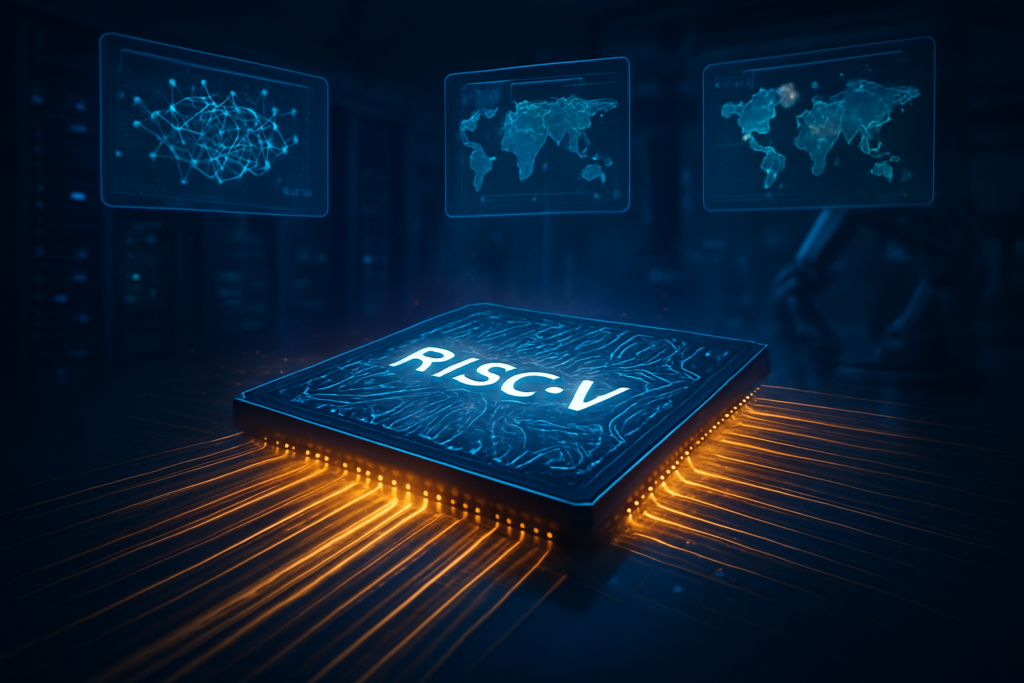
The long-heralded "third pillar" of computing has officially arrived. As of January 2026, the semiconductor industry is witnessing a seismic shift as RISC-V, the open-source instruction set architecture (ISA), transitions from a niche academic project to a dominant force in the global AI infrastructure. Driven by a desire for "technological sovereignty" and the need to bypass increasingly expensive proprietary licenses, the world's largest tech entities and geopolitical blocs are betting their silicon futures on open standards.
The numbers tell a story of rapid, uncompromising adoption. NVIDIA (NASDAQ: NVDA) recently confirmed it has surpassed a cumulative milestone of shipping over one billion RISC-V cores across its product stack, while the European Union has doubled down on its commitment to independence with a fresh €270 million investment into the RISC-V ecosystem. This surge represents more than just a change in technical specifications; it marks a fundamental redistribution of power in the global tech economy, challenging the decades-long duopoly of x86 and ARM (NASDAQ: ARM).
The Technical Ascent: From Microcontrollers to Exascale Engines
The technical narrative of RISC-V in early 2026 is defined by its graduation from simple management tasks to high-performance AI orchestration. While NVIDIA has historically used RISC-V for its internal "Falcon" microcontrollers, the latest Rubin GPU architecture, unveiled this month, utilizes custom NV-RISCV cores to manage everything from secure boot and power regulation to complex NVLink-C2C (Chip-to-Chip) memory coherency. By integrating up to 40 RISC-V cores per chip, NVIDIA has essentially created a "shadow" processing layer that handles the administrative heavy lifting, freeing up its proprietary CUDA cores for pure AI computation.
Perhaps the most significant technical breakthrough of the year is the integration of NVIDIA NVLink Fusion into SiFive’s high-performance compute platforms. For the first time, a non-proprietary RISC-V CPU can connect directly to NVIDIA’s state-of-the-art GPUs with 3.6 TB/s of bandwidth. This level of hardware interoperability was previously reserved for NVIDIA’s own ARM-based Grace and Vera CPUs. Meanwhile, Jim Keller’s Tenstorrent has successfully productized its TT-Ascalon RISC-V core, which benchmarks from January 2026 show achieving performance parity with Intel’s (NASDAQ: INTC) Zen 5 and ARM’s Neoverse V3 in integer workloads.
This modularity is RISC-V's "secret weapon." Unlike the rigid, licensed designs of x86 or ARM, RISC-V allows architects to add custom "extensions" specifically designed for AI math—such as matrix multiplication or vector processing—without seeking permission from a central authority. This flexibility has allowed startups like Axelera AI and MIPS to launch specialized Neural Processing Units (NPUs) that offer a 30% to 40% improvement in Performance-Power-Area (PPA) compared to traditional, general-purpose chips.
The Business of Sovereignty: Tech Giants and Geopolitics
The shift toward RISC-V is as much about balance sheets as it is about transistors. For companies like NVIDIA and Qualcomm (NASDAQ: QCOM), the adoption of RISC-V serves as a strategic hedge against the "ARM tax"—the rising licensing fees and restrictive terms that have defined the ARM ecosystem in recent years. Qualcomm’s pivot toward RISC-V for its "Snapdragon Data Center" platforms, following its acquisition of RISC-V assets in late 2025, signals a clear move to reclaim control over its long-term roadmap.
In the cloud, the impact is even more pronounced. Hyperscalers such as Meta (NASDAQ: META) and Alphabet (NASDAQ: GOOGL) are increasingly utilizing RISC-V for the control logic within their custom AI accelerators (MTIA and TPU). By treating the instruction set as a "shared public utility" rather than a proprietary product, these companies can collaborate on foundational software—like Linux kernels and compilers—while competing on the proprietary hardware logic they build on top. This "co-opetition" model has accelerated the maturity of the RISC-V software stack, which was once considered its greatest weakness.
Furthermore, the recent acquisition of Synopsys’ ARC-V processor line by GlobalFoundries (NASDAQ: GFS) highlights a consolidation of the ecosystem. Foundries are no longer just manufacturing chips; they are providing the open-source IP necessary for their customers to design them. This vertical integration is making it easier for smaller AI startups to bring custom silicon to market, disrupting the traditional "one-size-fits-all" hardware model that dominated the previous decade.
A Geopolitical Fortress: Europe’s Quest for Digital Autonomy
The surge in RISC-V adoption is inextricably linked to the global drive for "technological sovereignty." Nowhere is this more apparent than in the European Union, where the DARE (Digital Autonomy for RISC-V in Europe) project has received a massive €270 million boost. Coordinated by the Barcelona Supercomputing Center, DARE aims to ensure that the next generation of European exascale supercomputers and automotive systems are built on homegrown hardware, free from the export controls and geopolitical whims of foreign powers.
By January 2026, the DARE project has reached a critical milestone: the successful tape-out of three specialized chiplets: a Vector Accelerator (VEC), an AI Processing Unit (AIPU), and a General-Purpose Processor (GPP). These chiplets are designed to be "Lego-like" components that European manufacturers can mix and match to build everything from autonomous vehicle controllers to energy-efficient data centers. This "silicon-to-software" independence is viewed by EU regulators as essential for economic security in an era where AI compute has become the world’s most valuable resource.
The broader significance of this movement cannot be overstated. Much like how Linux democratized the world of software and the internet, RISC-V is democratizing the world of hardware. It represents a shift from a world of "black box" processors to a transparent, auditable architecture. For industries like defense, aerospace, and finance, the ability to verify every instruction at the hardware level is a massive security advantage over proprietary designs that may contain undocumented features or vulnerabilities.
The Road Ahead: Consumer Integration and Challenges
Looking toward the remainder of 2026 and beyond, the next frontier for RISC-V is the consumer market. At CES 2026, Tenstorrent and Razer announced a modular AI accelerator for laptops that connects via Thunderbolt, allowing developers to run massive Large Language Models (LLMs) locally. This is just the beginning; as the software ecosystem continues to stabilize, experts predict that RISC-V will begin appearing as the primary processor in high-end smartphones and AI PCs by 2027.
However, challenges remain. While the hardware is ready, the "software gap" is still being bridged. While Linux and major AI frameworks like PyTorch and TensorFlow run well on RISC-V, thousands of legacy enterprise applications still require x86 or ARM. Bridging this gap through high-performance binary translation—similar to Apple's Rosetta 2—will be a key focus for the developer community in the coming months. Additionally, as more companies add their own custom extensions to the base RISC-V ISA, the risk of "fragmentation"—where chips become too specialized to share common software—is a concern that the RISC-V International foundation is working hard to mitigate.
The Dawn of the Open Silicon Era
The events of early 2026 mark a definitive turning point in computing history. NVIDIA’s shipment of one billion cores and the EU’s strategic multi-million euro investments have proven that RISC-V is no longer a "future" technology—it is the architecture of the present. By decoupling the hardware instruction set from the corporate interests of a single entity, the industry has unlocked a new level of innovation and competition.
As we move through 2026, the industry will be watching closely for the first "pure" RISC-V data center deployments and the further expansion of open-source hardware into the automotive sector. The "proprietary tax" that once governed the tech world is being dismantled, replaced by a collaborative, open-standard model that promises to accelerate AI development for everyone. The RISC-V revolution isn't just about faster chips; it's about who owns the future of intelligence.
This content is intended for informational purposes only and represents analysis of current AI developments.
TokenRing AI delivers enterprise-grade solutions for multi-agent AI workflow orchestration, AI-powered development tools, and seamless remote collaboration platforms.
For more information, visit https://www.tokenring.ai/.