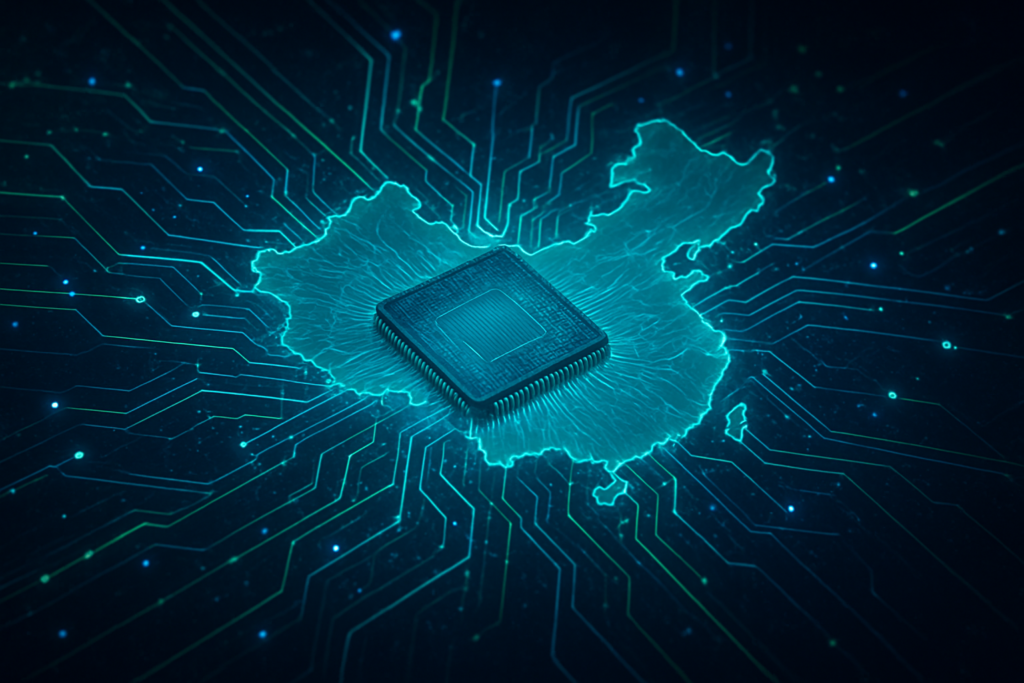
Shenzhen, China – December 15, 2025 – In a defiant move against stringent US export restrictions, Huawei Technologies Co. Ltd. (SHE:002502) has officially launched its Kirin 9030 series chipsets, powering its latest Mate 80 series smartphones and the Mate X7 foldable phone. This landmark achievement is made possible by Semiconductor Manufacturing International Corporation (SMIC) (HKG:0981), which has successfully entered volume production of its N+3 process node, considered a 5nm-class technology. This development marks a significant stride for China's technological self-reliance, demonstrating an incremental yet meaningful advancement in advanced semiconductor production capabilities that challenges the established global order in chip manufacturing.
The introduction of the Kirin 9030, fabricated entirely within China, underscores the nation's unwavering commitment to building an indigenous chip ecosystem. While the chip's initial performance benchmarks position it in the mid-range category, comparable to a Snapdragon 7 Gen 4, its existence is a powerful statement. It signifies China's growing ability to circumvent foreign technological blockades and sustain its domestic tech giants, particularly Huawei, in critical consumer electronics markets. This breakthrough not only has profound implications for the future of the global semiconductor industry but also reshapes the geopolitical landscape of technological competition, highlighting the resilience and resourcefulness employed to overcome significant international barriers.
Technical Deep Dive: Unpacking the Kirin 9030 and SMIC's N+3 Process
The Huawei Kirin 9030 chipset, unveiled in November 2025, represents a pinnacle of domestic engineering under duress. At its core, the Kirin 9030 features a sophisticated nine-core CPU configured in a 1+4+4 architecture. This includes a prime core clocked at 2.75 GHz, four performance cores at 2.27 GHz, and four efficiency cores at 1.72 GHz. Complementing the CPU is the integrated Maleoon 935 GPU, designed to handle graphics processing for Huawei’s new lineup of flagship devices. Initial Geekbench scores reveal single-core results of 1131 and multi-core scores of 4277, placing its raw computational power roughly on par with Qualcomm's Snapdragon 7 Gen 4. Its transistor density is estimated at approximately 125 Mtr/mm², akin to Samsung’s 5LPE node.
What truly distinguishes this advancement is the manufacturing prowess of SMIC. The Kirin 9030 is produced using SMIC's N+3 process node, which the company has successfully brought into volume production. This is a critical technical achievement, as SMIC has accomplished a 5nm-class process without the aid of Extreme Ultraviolet (EUV) lithography tools, which are essential for leading-edge chip manufacturing and are currently restricted from export to China by the US. Instead, SMIC has ingeniously leveraged Deep Ultraviolet (DUV) lithography in conjunction with complex multi-patterning techniques. This intricate approach allows for the creation of smaller features and denser transistor layouts, effectively pushing the limits of DUV technology.
However, this reliance on DUV multi-patterning introduces significant technical hurdles, particularly concerning yield rates and manufacturing costs. Industry analyses suggest that while the N+3 node is technically capable, the aggressive scaling of metal pitches using DUV leads to considerable yield challenges, potentially as low as 20% for advanced AI chips. This is dramatically lower than the over 70% typically required for commercial viability in the global semiconductor industry. Despite these challenges, the N+3 process signifies a tangible scaling improvement over SMIC's previous N+2 (7nm-class) node. Nevertheless, it remains considerably less advanced than the true 3nm and 4nm nodes offered by global leaders like Taiwan Semiconductor Manufacturing Company (TSMC) (NYSE: TSM) and Samsung Electronics Co. Ltd. (KRX:005930), which benefit from full EUV capabilities.
Initial reactions from the AI research community and industry experts are a mix of awe and caution. While acknowledging the remarkable engineering feat under sanctions, many point to the persistent performance gap and the high cost of production as indicators that China still faces a steep climb to truly match global leaders in high-volume, cost-effective, cutting-edge chip manufacturing. The ability to produce such a chip, however, is seen as a significant symbolic and strategic victory, proving that complete technological isolation remains an elusive goal for external powers.
Impact on AI Companies, Tech Giants, and Startups
The emergence of Huawei's Kirin 9030, powered by SMIC's N+3 process, sends ripples across the global technology landscape, significantly affecting AI companies, established tech giants, and nascent startups alike. For Chinese companies, particularly Huawei, this development is a lifeline. It enables Huawei to continue designing and producing advanced smartphones and other devices with domestically sourced chips, thereby reducing its vulnerability to foreign supply chain disruptions and sustaining its competitive edge in key markets. This fosters a more robust domestic ecosystem, benefiting other Chinese AI companies and hardware manufacturers who might eventually leverage SMIC's growing capabilities for their own specialized AI accelerators or edge computing devices.
The competitive implications for major AI labs and international tech companies are substantial. While the Kirin 9030 may not immediately challenge the performance of flagship chips from Qualcomm (NASDAQ: QCOM), Apple Inc. (NASDAQ: AAPL), or Nvidia Corporation (NASDAQ: NVDA) in raw computational power for high-end AI training, it signals a long-term strategic shift. Chinese tech giants can now build more secure and independent supply chains for their AI hardware, potentially leading to a "two-track AI world" where one ecosystem is largely independent of Western technology. This could disrupt existing market dynamics, particularly for companies that heavily rely on the Chinese market but are subject to US export controls.
For startups, especially those in China focusing on AI applications, this development offers new opportunities. A stable, domestically controlled chip supply could accelerate innovation in areas like edge AI, smart manufacturing, and autonomous systems within China, free from the uncertainties of geopolitical tensions. However, for startups outside China, it might introduce complexities, as they could face increased competition from Chinese counterparts operating with a protected domestic supply chain. Existing products or services that rely on a globally integrated semiconductor supply chain might need to re-evaluate their strategies, considering the potential for bifurcated technological standards and markets.
Strategically, this positions China with a stronger hand in the ongoing technological race. The ability to produce 5nm-class chips, even with DUV, enhances its market positioning in critical sectors and strengthens its bargaining power in international trade and technology negotiations. While the cost and yield challenges remain, the sheer fact of production provides a strategic advantage, demonstrating resilience and a pathway to further advancements, potentially inspiring other nations to pursue greater semiconductor independence.
Wider Significance: Reshaping the Global Tech Landscape
The successful production of the Kirin 9030 by SMIC's N+3 node is more than just a technical achievement; it is a profound geopolitical statement that significantly impacts the broader AI landscape and global technological trends. This development fits squarely into China's overarching national strategy to achieve technological self-sufficiency, particularly in critical sectors like semiconductors and artificial intelligence. It underscores a global trend towards technological decoupling, where major powers are increasingly seeking to reduce reliance on foreign supply chains and develop indigenous capabilities in strategic technologies. This move signals a significant step towards creating a parallel AI ecosystem, distinct from the Western-dominated one.
The immediate impacts are multi-faceted. First, it demonstrates the limitations of export controls as a complete deterrent to technological progress. While US sanctions have undoubtedly slowed China's advancement in cutting-edge chip manufacturing, they have also spurred intense domestic innovation and investment, pushing companies like SMIC to find alternative pathways. Second, it shifts the balance of power in the global semiconductor industry. While SMIC is still behind TSMC and Samsung in terms of raw capability and efficiency, its ability to produce 5nm-class chips provides a credible domestic alternative for Chinese companies, thereby reducing the leverage of foreign chip suppliers.
Potential concerns arising from this development include the acceleration of a "tech iron curtain," where different regions operate on distinct technological standards and supply chains. This could lead to inefficiencies, increased costs, and fragmentation in global R&D efforts. There are also concerns about the implications for intellectual property and international collaboration, as nations prioritize domestic development over global partnerships. Furthermore, the environmental impact of DUV multi-patterning, which typically requires more steps and energy than EUV, could become a consideration if scaled significantly.
Comparing this to previous AI milestones, the Kirin 9030 and SMIC's N+3 node can be seen as a foundational step, akin to early breakthroughs in neural network architectures or the initial development of powerful GPUs for AI computation. While not a direct AI algorithm breakthrough, it is a critical enabler, providing the necessary hardware infrastructure for advanced AI development within China. It stands as a testament to national determination in the face of adversity, much like the space race, but in the realm of silicon and artificial intelligence.
Future Developments: The Road Ahead for China's Chip Ambitions
Looking ahead, the successful deployment of the Kirin 9030 and SMIC's N+3 node sets the stage for several expected near-term and long-term developments. In the near term, we can anticipate continued optimization of the N+3 process, with SMIC striving to improve yield rates and reduce manufacturing costs. This will be crucial for making these domestically produced chips more commercially viable for a wider range of applications beyond Huawei's flagship devices. We might also see further iterations of the Kirin series, with Huawei continuing to push the boundaries of chip design optimized for SMIC's capabilities. There will be an intensified focus on developing a full stack of domestic semiconductor equipment, moving beyond the reliance on DUV tools from companies like ASML Holding N.V. (AMS:ASML).
In the long term, the trajectory points towards China's relentless pursuit of true EUV-level capabilities, either through domestic innovation or by finding alternative technological paradigms. This could involve significant investments in materials science, advanced packaging technologies, and novel lithography techniques. Potential applications and use cases on the horizon include more powerful AI accelerators for data centers, advanced chips for autonomous vehicles, and sophisticated IoT devices, all powered by an increasingly self-sufficient domestic semiconductor industry. This will enable China to build out its "digital infrastructure" with greater security and control.
However, significant challenges remain. The primary hurdle is achieving cost-effective, high-yield mass production at leading-edge nodes without EUV. The DUV multi-patterning approach, while effective for current breakthroughs, is inherently more expensive and complex. Another challenge is closing the performance gap with global leaders, particularly in power efficiency and raw computational power for the most demanding AI workloads. Furthermore, attracting and retaining top-tier talent in semiconductor manufacturing and design will be critical. Experts predict that while China will continue to make impressive strides, achieving parity with global leaders in all aspects of advanced chip manufacturing will likely take many more years, and perhaps a fundamental shift in lithography technology.
Comprehensive Wrap-up: A New Era of Chip Geopolitics
In summary, the launch of Huawei's Kirin 9030 chip, manufactured by SMIC using its N+3 (5nm-class) process, represents a pivotal moment in the ongoing technological rivalry between China and the West. The key takeaway is clear: despite concerted efforts to restrict its access to advanced semiconductor technology, China has demonstrated remarkable resilience and an undeniable capacity for indigenous innovation. This breakthrough, while facing challenges in yield and performance parity with global leaders, signifies a critical step towards China's long-term goal of semiconductor independence.
This development holds immense significance in AI history, not as an AI algorithm breakthrough itself, but as a foundational enabler for future AI advancements within China. It underscores the intertwined nature of hardware and software in the AI ecosystem and highlights how geopolitical forces are shaping technological development. The ability to domestically produce advanced chips provides a secure and stable base for China's ambitious AI strategy, potentially leading to a more bifurcated global AI landscape.
Looking ahead, the long-term impact will likely involve continued acceleration of domestic R&D in China, a push for greater integration across its technology supply chain, and intensified competition in global tech markets. What to watch for in the coming weeks and months includes further details on SMIC's yield improvements, the performance evolution of subsequent Kirin chips, and any new policy responses from the US and its allies. The world is witnessing the dawn of a new era in chip geopolitics, where technological self-reliance is not just an economic goal but a strategic imperative.
This content is intended for informational purposes only and represents analysis of current AI developments.
TokenRing AI delivers enterprise-grade solutions for multi-agent AI workflow orchestration, AI-powered development tools, and seamless remote collaboration platforms.
For more information, visit https://www.tokenring.ai/.