Airline company United Airlines Holdings (NASDAQ: UAL) met Wall Streets revenue expectations in Q4 CY2025, with sales up 4.8% year on year to $15.4 billion. Its non-GAAP profit of $3.10 per share was 5.4% above analysts’ consensus estimates.
Is now the time to buy United Airlines? Find out by accessing our full research report, it’s free.
United Airlines (UAL) Q4 CY2025 Highlights:
- Revenue: $15.4 billion vs analyst estimates of $15.38 billion (4.8% year-on-year growth, in line)
- Adjusted EPS: $3.10 vs analyst estimates of $2.94 (5.4% beat)
- Adjusted EBITDA: $2.19 billion vs analyst estimates of $2.15 billion (14.2% margin, 1.5% beat)
- Operating Margin: 9%, down from 10.2% in the same quarter last year
- Free Cash Flow was -$579 million, down from $549 million in the same quarter last year
- Revenue Passenger Miles: 68.25 billion, up 3.78 billion year on year
- Market Capitalization: $36.74 billion
"Our results are built on winning more and more brand-loyal customers — it's clear they get the most value flying United," said CEO Scott Kirby.
Company Overview
Founded in 1926, United Airlines Holdings (NASDAQ: UAL) operates a global airline network, providing passenger and cargo air transportation services across domestic and international routes.
Revenue Growth
A company’s long-term performance is an indicator of its overall quality. Any business can put up a good quarter or two, but many enduring ones grow for years. Over the last five years, United Airlines grew its sales at a 30.9% compounded annual growth rate. Although this growth is acceptable on an absolute basis, it fell slightly short of our standards for the consumer discretionary sector, which enjoys a number of secular tailwinds.
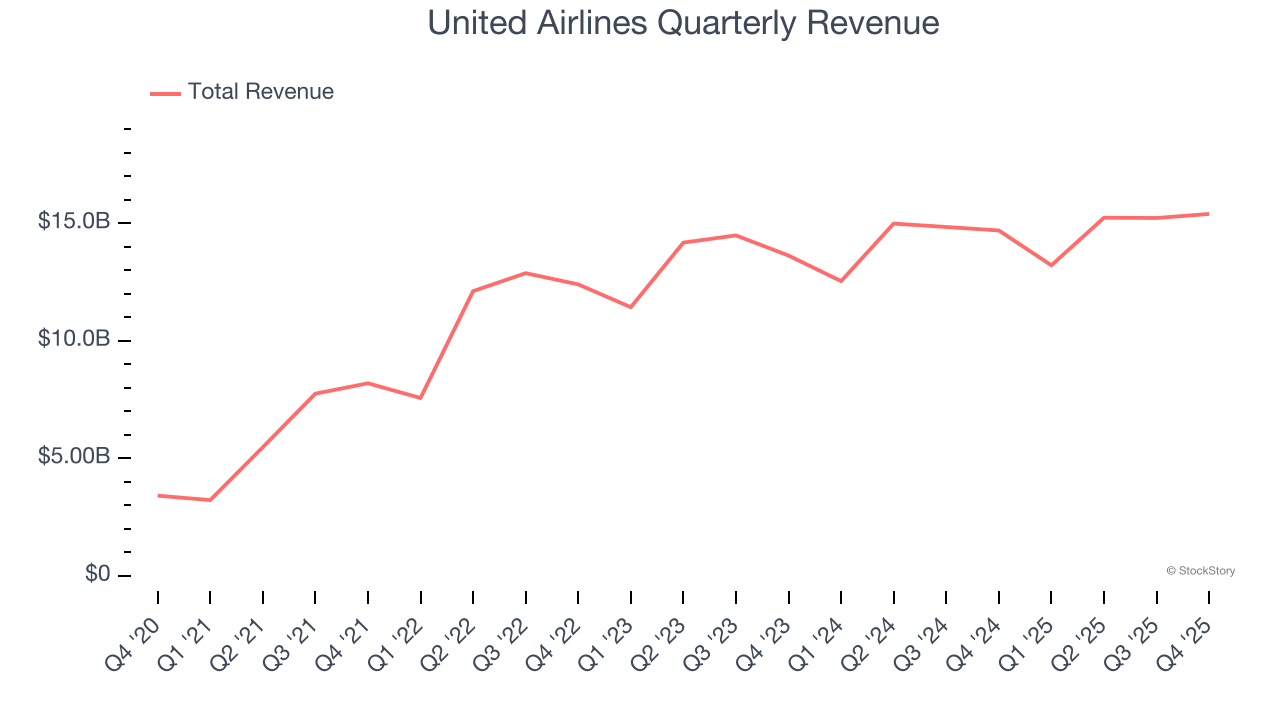
We at StockStory place the most emphasis on long-term growth, but within consumer discretionary, a stretched historical view may miss a company riding a successful new property or trend. United Airlines’s recent performance shows its demand has slowed as its annualized revenue growth of 4.9% over the last two years was below its five-year trend. 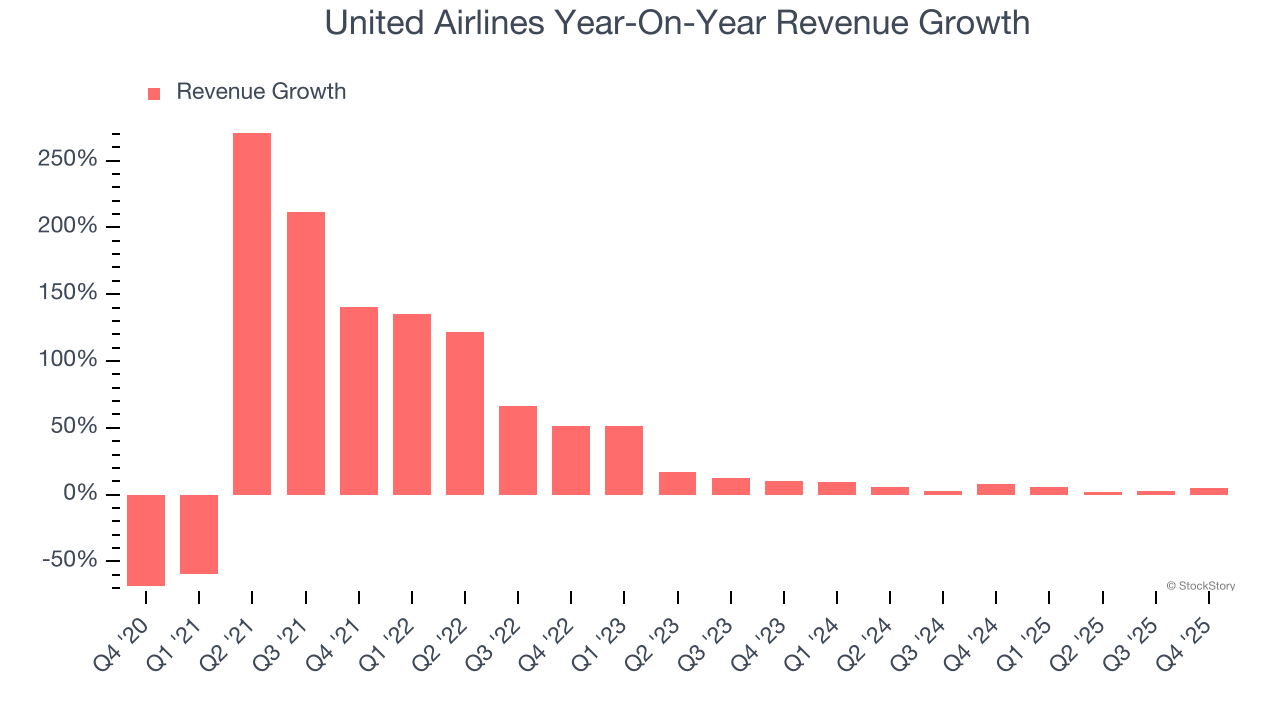
We can dig further into the company’s revenue dynamics by analyzing its number of revenue passenger miles, which reached 68.25 billion in the latest quarter. Over the last two years, United Airlines’s revenue passenger miles averaged 5.5% year-on-year growth. Because this number aligns with its revenue growth during the same period, we can see the company’s monetization was fairly consistent. 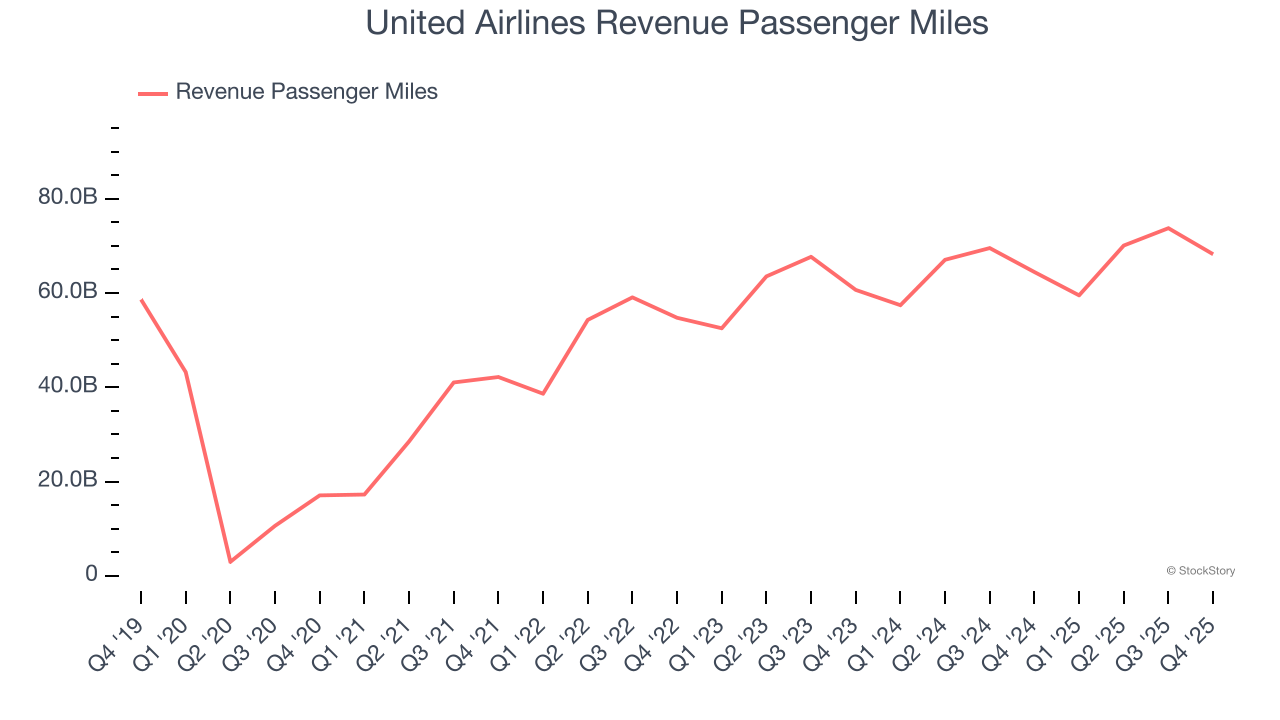
This quarter, United Airlines grew its revenue by 4.8% year on year, and its $15.4 billion of revenue was in line with Wall Street’s estimates.
Looking ahead, sell-side analysts expect revenue to grow 8.1% over the next 12 months. Although this projection implies its newer products and services will fuel better top-line performance, it is still below average for the sector.
The 1999 book Gorilla Game predicted Microsoft and Apple would dominate tech before it happened. Its thesis? Identify the platform winners early. Today, enterprise software companies embedding generative AI are becoming the new gorillas. a profitable, fast-growing enterprise software stock that is already riding the automation wave and looking to catch the generative AI next.
Operating Margin
Operating margin is a key measure of profitability. Think of it as net income - the bottom line - excluding the impact of taxes and interest on debt, which are less connected to business fundamentals.
United Airlines’s operating margin might fluctuated slightly over the last 12 months but has generally stayed the same, averaging 8.4% over the last two years. This profitability was inadequate for a consumer discretionary business and caused by its suboptimal cost structure.
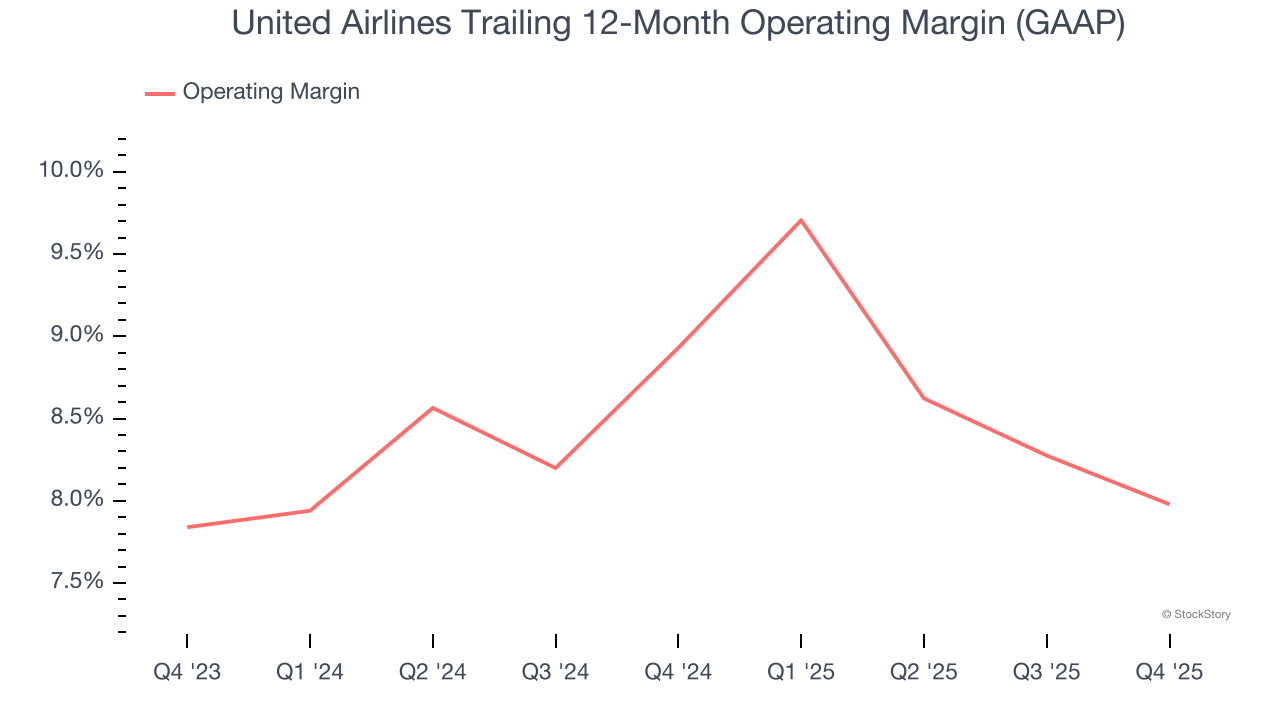
This quarter, United Airlines generated an operating margin profit margin of 9%, down 1.2 percentage points year on year. This reduction is quite minuscule and indicates the company’s overall cost structure has been relatively stable.
In the coming year, Wall Street expects United Airlines to become more profitable. Analysts are expecting the company’s trailing 12-month operating margin of 8% to rise to 9.4%.
Earnings Per Share
We track the long-term change in earnings per share (EPS) for the same reason as long-term revenue growth. Compared to revenue, however, EPS highlights whether a company’s growth is profitable.
United Airlines’s full-year EPS flipped from negative to positive over the last five years. This is encouraging and shows it’s at a critical moment in its life.
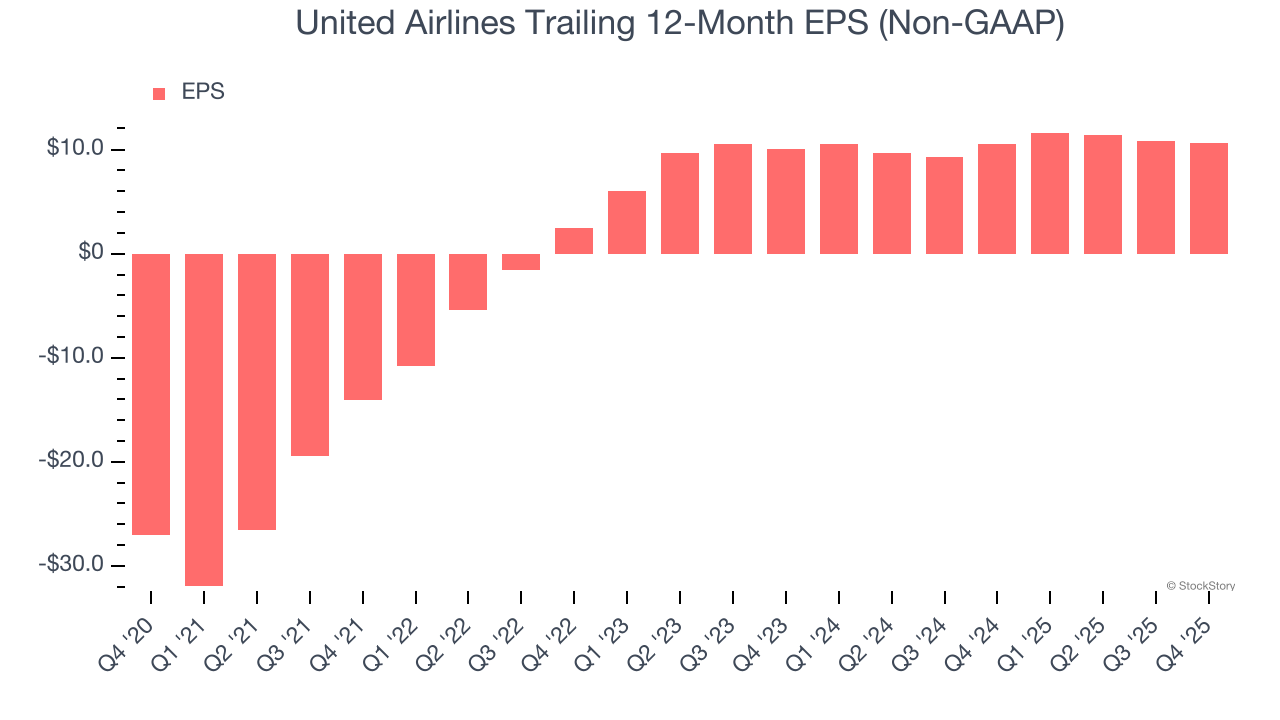
In Q4, United Airlines reported adjusted EPS of $3.10, down from $3.26 in the same quarter last year. Despite falling year on year, this print beat analysts’ estimates by 5.4%. Over the next 12 months, Wall Street expects United Airlines’s full-year EPS of $10.66 to grow 22%.
Key Takeaways from United Airlines’s Q4 Results
It was good to see United Airlines beat analysts’ EPS expectations this quarter. Zooming out, we think this was a decent quarter. The stock traded up 3.7% to $113.39 immediately after reporting.
So do we think United Airlines is an attractive buy at the current price? What happened in the latest quarter matters, but not as much as longer-term business quality and valuation, when deciding whether to invest in this stock. We cover that in our actionable full research report which you can read here (it’s free).