Today’s Date: January 9, 2026
Introduction
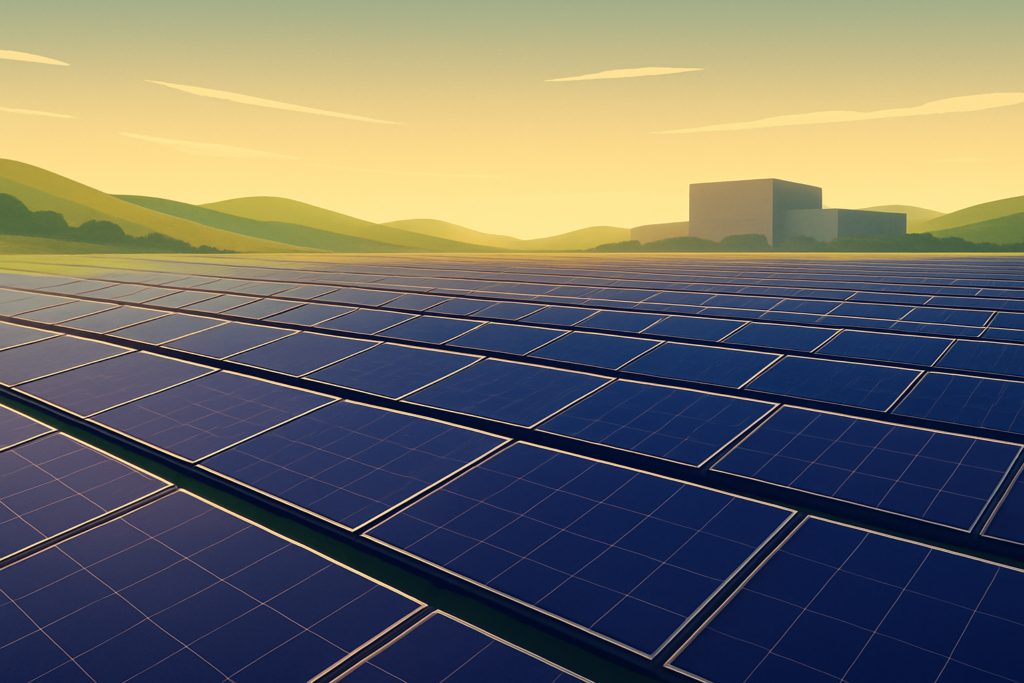
As the global energy transition accelerates into the second half of the decade, few companies have managed to maintain as strategic a "fortress" position as First Solar, Inc. (NASDAQ: FSLR). Once a niche player in a market dominated by silicon-based semiconductors, the Tempe, Arizona-headquartered firm has emerged as the definitive champion of American solar manufacturing. In early 2026, First Solar finds itself at the intersection of two of the decade's most powerful secular trends: the re-industrialization of the United States and the voracious electricity appetite of Artificial Intelligence (AI) data centers.
While the broader solar industry has faced headwinds from high interest rates and global oversupply, First Solar has insulated itself through a unique thin-film technology stack and a multi-year backlog that stretches toward the end of the decade. At PredictStreet, our AI-driven analysis indicates that the company’s recent manufacturing expansions in the American South have fundamentally altered its margin profile, making it less of a commodity manufacturer and more of a high-value infrastructure provider.
Historical Background
The First Solar story is one of American ingenuity and patient capital. It began in 1990 as Solar Cells, Inc. (SCI), founded by Harold McMaster, a legendary inventor known as the "Glass Genius" of Toledo, Ohio. McMaster’s breakthrough was the use of Cadmium Telluride (CdTe) for thin-film solar cells, an alternative to the traditional crystalline silicon (c-Si) path. His vision was to manufacture solar panels as efficiently and continuously as glass sheets on a float line.
However, the transition from lab to commercial scale was fraught with financial peril. In 1999, the company was recapitalized and rebranded as First Solar, LLC, following an acquisition by True North Partners—a venture capital firm funded by John Walton, son of Walmart founder Sam Walton. The Walton family’s involvement provided the long-term capital necessary to survive the "Valley of Death" in hardware innovation.
Since its 2006 IPO, the company has undergone several major transformations. The most significant occurred in 2016 under current CEO Mark Widmar, when the company made the bold decision to bypass its "Series 5" module and move directly to the "Series 6" large-format module. This pivot, combined with the exit from its engineering, procurement, and construction (EPC) business to focus purely on manufacturing, set the stage for the explosive growth seen in the 2020s.
Business Model
First Solar operates a vertically integrated manufacturing model that is unique among the world’s top solar companies. While rivals like JinkoSolar or Canadian Solar rely on a complex global supply chain for polysilicon, wafers, and cells, First Solar’s CdTe process converts raw materials into a finished module in a single, continuous automated line in under four hours.
Revenue Sources
The company generates revenue almost exclusively from the sale of solar modules to utility-scale project developers and independent power producers.
- Utility-Scale Modules: This is the core business, focusing on large-scale solar farms that feed the grid.
- Service and Warranties: While a smaller percentage of revenue, the company provides long-term performance guarantees for its modules.
Segments and Customer Base
First Solar’s customer base is increasingly dominated by large tech conglomerates (Google, Microsoft, Meta) looking to power their data centers with 100% renewable energy, as well as traditional utilities. Geographically, the U.S. remains its primary market, though it maintains a significant manufacturing and sales presence in India and Southeast Asia.
Stock Performance Overview
Over the last decade, FSLR has evolved from a volatile, sentiment-driven stock to a cornerstone industrial asset.
- 1-Year Performance: In 2025, the stock consolidated gains after a massive run in 2024, trading in a range between $210 and $285. As of early 2026, the stock sits near $272, reflecting a resilient market position despite broader sector volatility.
- 5-Year Performance: Looking back to 2021, the stock has nearly tripled. The primary catalyst was the 2022 Inflation Reduction Act (IRA), which provided the regulatory certainty needed to justify billions in capital expenditure.
- 10-Year Performance: From 2016 to 2026, FSLR has outperformed the S&P 500 significantly, transitioning from a $40-60 range-bound stock to a utility-scale powerhouse. Notable peaks occurred in mid-2024 as the "AI energy trade" took hold, with investors betting on solar as the fastest-to-deploy power source for new data centers.
Financial Performance
PredictStreet’s latest AI-generated estimates for the fiscal year 2025 suggest a company that is hitting its operational stride.
- Revenue: Estimated to finish FY 2025 between $4.95 billion and $5.20 billion, up from $4.2 billion in 2024.
- Earnings Per Share (EPS): 2025 estimates range from $14.00 to $15.00. While this was a slight downward revision from earlier "blue sky" projections due to glass supply constraints, it still represents a massive jump from 2023 levels.
- Margins: Gross margins remain the envy of the industry, consistently hovering near 40% (inclusive of Section 45X tax credits).
- Balance Sheet: First Solar maintains a "fortress balance sheet" with a net cash position of approximately $1.5 billion, providing a buffer against cyclical downturns and the capital needed for its next-gen tandem cell R&D.
Leadership and Management
The management team, led by CEO Mark Widmar and CFO Alex Bradley, is widely regarded by analysts as one of the most disciplined in the clean energy sector. Widmar’s strategy has been characterized by "saying no" to low-margin residential markets and "saying yes" to long-term, fixed-price contracts that provide visibility through the end of the decade.
The board’s governance has been particularly focused on navigating the complex geopolitical landscape. Their decision to stay away from Chinese silicon supply chains has been vindicated by the Uyghur Forced Labor Prevention Act (UFLPA) and subsequent trade disputes that have hamstrung many of their competitors.
Products, Services, and Innovations
The "Series 7" module is the current flagship of the First Solar fleet. Produced primarily in the new Alabama and Louisiana facilities, the Series 7 is designed specifically for the U.S. utility-scale market, offering a larger form factor and higher efficiency than previous generations.
The Perovskite Frontier
In 2023, First Solar acquired Evolar AB, a European leader in perovskite technology. As of January 2026, the company is operating a pilot line at its R&D innovation center in Ohio, developing a Perovskite-on-CdTe tandem cell. This "tandem" approach aims to stack two different light-absorbing layers to break the efficiency ceiling of traditional modules, with commercial deployment targeted for 2027-2029.
Competitive Landscape
The solar market is a tale of two technologies: Crystalline Silicon (c-Si) vs. Thin-Film (CdTe).
- The Rivals: Chinese giants like LONGi and JinkoSolar dominate the c-Si market, benefiting from massive economies of scale and low labor costs.
- The FSLR Advantage: First Solar’s CdTe technology is immune to the "polysilicon cycle." Furthermore, because First Solar modules are manufactured in the U.S., they help project developers qualify for the 10% Domestic Content Bonus under the IRA—a premium that Chinese imports cannot easily replicate.
Industry and Market Trends
Three macro drivers are currently favoring First Solar:
- AI Power Demand: The surge in AI data centers requires "giga-scale" power plants. Solar-plus-storage is currently the most scalable solution to meet these corporate 24/7 carbon-free energy goals.
- Reshoring: There is a bipartisan consensus on reducing dependence on Chinese supply chains for critical energy infrastructure.
- Decarbonization: Despite political cycles, corporate mandates for green energy are increasingly "locked in" by long-term power purchase agreements (PPAs).
Risks and Challenges
No investment is without risk, and First Solar faces several significant hurdles:
- Policy Volatility: While the IRA has long-term bipartisan support in many "red" states where manufacturing is located, any changes to tax credit monetization (Section 45X) would significantly impact the bottom line.
- Contractual Headwinds: In late 2025, the company saw roughly 6.9 GW of contract cancellations from BP-affiliated projects, highlighting that even a strong backlog can be subject to project-level delays or financing issues.
- Supply Chain: The company relies on specific materials like Tellurium, which is a byproduct of copper mining. Any disruption in tellurium supply or a massive spike in glass prices could pinch margins.
Opportunities and Catalysts
- South Carolina Expansion: The upcoming 3.7 GW "finishing line" in South Carolina will allow First Solar to onshore the final assembly of modules from its international factories, potentially qualifying more of its fleet for U.S. tax incentives.
- Tandem Cell Breakthroughs: Any positive data from the Perovskite-on-CdTe pilot line could serve as a major valuation re-rating catalyst.
- M&A Potential: With a strong cash position, First Solar is well-positioned to acquire smaller technology firms in the power electronics or energy storage space to offer a more holistic "solar plant in a box."
Investor Sentiment and Analyst Coverage
Institutional sentiment remains robust, with roughly 98% of shares held by institutions like Vanguard and BlackRock.
- Bull View: Analysts at Goldman Sachs and Morgan Stanley maintain "Buy" or "Overweight" ratings, citing the "sold out" position through 2026 as a unique safety net in a volatile market.
- Bear View: Some analysts, such as those at Jefferies, have expressed caution regarding "limited visibility" into new bookings for 2027 and potential downward pressure on American module prices if global silicon prices continue to crash.
- Retail Vibe: On social platforms, the sentiment is currently "Neutral to Bullish," with investors viewing FSLR as a safe-haven asset within the clean energy sector.
Regulatory, Policy, and Geopolitical Factors
Geopolitics is First Solar’s "invisible moat." The company is the primary beneficiary of:
- Anti-Dumping/Countervailing Duties (AD/CVD): Tariffs on solar cells from Southeast Asia help maintain the price premium for U.S.-made panels.
- UFLPA: Rigorous enforcement of forced labor laws effectively bars many low-cost Chinese competitors from the U.S. market.
- Foreign Entity of Concern (FEOC) Rules: These rules make it difficult for companies with significant Chinese state ownership to access U.S. tax credits, further narrowing the field in First Solar's favor.
Conclusion
First Solar enters 2026 as a uniquely positioned industrial powerhouse. By decoupling itself from the Chinese silicon supply chain and leaning into the "Made in America" narrative, it has transformed from a solar module manufacturer into a critical infrastructure provider for the 21st century.
For investors, the key will be watching the execution of the Louisiana and Alabama capacity ramps and the stability of the contract backlog. While policy risks and global pricing pressures remain, First Solar’s "fortress" model provides a margin of safety rarely seen in the renewable energy space. As AI continues to drive an unprecedented need for electrons, the "Glass Genius" legacy of Harold McMaster looks more relevant than ever.
This content is intended for informational purposes only and is not financial advice.