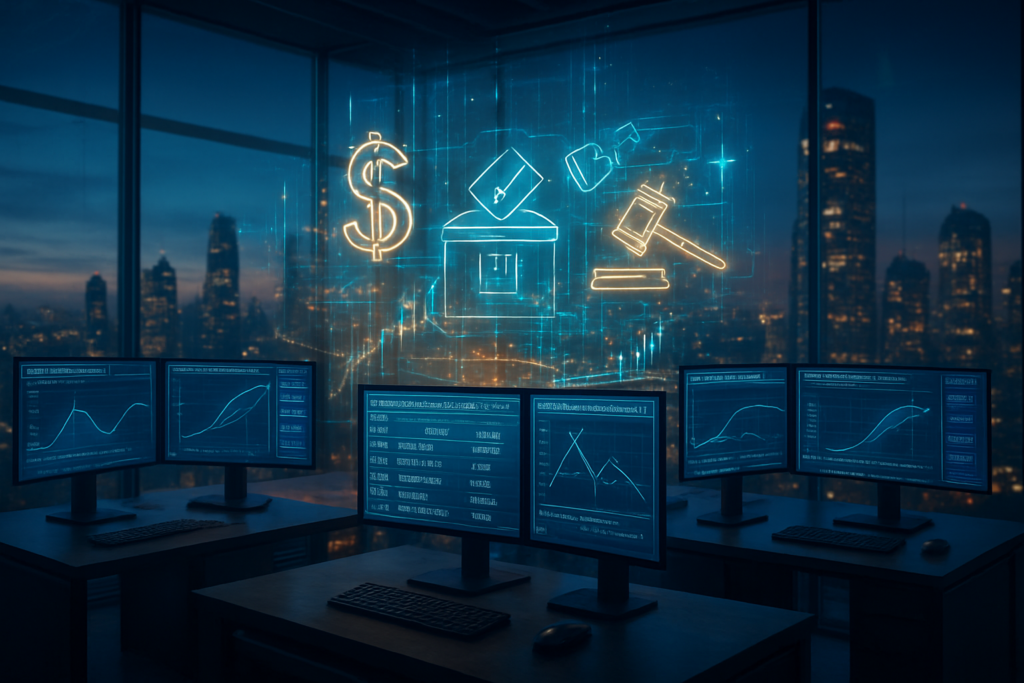
The era of prediction markets being dismissed as niche playgrounds for "degen" crypto enthusiasts and political junkies has officially ended. As of January 15, 2026, the world’s most elite high-frequency trading (HFT) firms have not just entered the arena—they have colonized it. Firms like DRW, Susquehanna International Group (SIG), and Jane Street are no longer watching from the sidelines; they are aggressively hiring mathematical talent to build out dedicated prediction market desks, treating event contracts with the same rigor as high-yield bonds or complex derivatives.
Currently, the primary "trade" isn't just about who will win the next election or what the Federal Reserve will do. Instead, it is a sophisticated arbitrage play. Institutional traders are exploiting price discrepancies between regulated platforms like Kalshi and the now ICE-backed Polymarket, leveraging massive balance sheets to capture fractions of a cent across billions in volume. This influx of "smart money" has transformed the market from a sentiment gauge into a hyper-efficient financial engine, with monthly volumes across the sector surpassing $8 billion for the first time in December 2025.
The Market: What’s Being Predicted
The prediction market landscape in early 2026 is defined by a bifurcated but increasingly connected ecosystem. On one side stands Kalshi, the CFTC-regulated heavyweight that paved the way for legal event trading in the U.S. On the other is Polymarket, which, following a landmark $2 billion investment from the Intercontinental Exchange (NYSE: ICE) in late 2025, has shed its "offshore" reputation to become a global liquidity hub.
These platforms are currently dominated by three major categories:
- Macroeconomic Policy: Contracts on the exact timing of Fed rate cuts, monthly CPI prints, and even the probability of a U.S. recession.
- The 2026 Midterm Elections: With the primary season approaching, hundreds of millions are already locked into "Control of the House" and "Senate Majority" markets.
- Climate and Infrastructure: Emerging markets for hurricane landfalls and major bridge completions, often used as insurance proxies.
Liquidity has reached an all-time high. On January 12, 2026, the industry recorded a single-day trading volume of $701.7 million. This depth is largely maintained by designated market makers like SIG, which was the first major firm to sign a formal liquidity agreement with Kalshi. Consequently, bid-ask spreads on high-profile contracts, which used to sit at a clunky 5% or 10%, have compressed to less than 0.5%, mirroring the efficiency of the S&P 500 options market.
Why Traders Are Betting
The catalyst for this Wall Street gold rush is the sheer "alpha" available in non-traditional data sets. Unlike the stock market, where information is disseminated in milliseconds via Bloomberg terminals, prediction markets often move based on "ground-truth" reality that algorithms are still learning to parse. To bridge this gap, firms like DRW and SIG have begun offering base salaries of approximately $200,000 for specialized "Event Traders," with total compensation packages for mid-level quants frequently reaching the $500,000 mark.
These traders are employed to execute three primary strategies:
- Cross-Platform Arbitrage: If a "Yes" contract for a Fed rate hike is trading at 62 cents on Kalshi but 65 cents on Polymarket, HFT bots execute thousands of trades per second to close that 3-cent gap, locking in a risk-free profit.
- Negative Correlation Baskets: Traders look for "sum-of-outcomes" errors. In a market where multiple candidates are running for a position, if the combined probability of all candidates exceeds 100% (or falls below 98%), institutional desks buy the entire basket to capture the mathematical delta.
- Asset-Class Hedging: Hedge funds, including firms like Saba Capital, are now using prediction markets as a "pure" hedge. Rather than buying gold to protect against inflation, they buy "CPI exceeds 3.1%" contracts on Kalshi, providing a direct payout that isn't muddied by equity market volatility.
Broader Context and Implications
The "professionalization" of these markets represents a paradigm shift in how society aggregates information. The 2024 court victories that allowed Kalshi to list election contracts served as the "Big Bang" for the industry. Since then, the entry of Interactive Brokers (NASDAQ: IBKR) via its ForecastEx platform and CME Group (NASDAQ: CME) through its partnership with FanDuel (owned by Flutter Entertainment (NYSE: FLUT)) has provided the regulatory plumbing necessary for pension funds and insurance companies to participate.
This shift has profound real-world implications. Prediction markets are increasingly viewed as more accurate than traditional polling or expert pundits. In fact, major news networks like CNBC and CNN have begun integrating live Kalshi and Polymarket odds into their daily broadcasts, effectively treating market prices as the "source of truth" for public sentiment. However, this transition hasn't been without friction. As HFT bots dominate the order books, retail participants are finding it harder to profit from "slow" news, leading to a market that is more accurate but arguably less "accessible" for the casual bettor.
What to Watch Next
The next six months will be a trial by fire for this new institutional infrastructure. The upcoming 2026 U.S. Midterm Elections will be the first major political event where Wall Street's dedicated desks are fully operational. Market observers are closely watching to see if the sheer volume of institutional capital can prevent the "price spikes" and manipulation attempts that occasionally plagued thinner markets in the early 2020s.
Additionally, keep an eye on the SEC. While the CFTC has largely embraced event contracts, several asset managers have recently filed for the first "Exchange Traded Prediction Funds" (ETPFs). These funds would allow retail investors to gain exposure to a diversified basket of high-probability outcomes through their standard brokerage accounts. If approved, it would mark the final step in the journey of prediction markets from the fringes of the internet to a standard component of a 401(k).
Bottom Line
The entry of firms like DRW and Susquehanna signals that prediction markets have reached a point of no return. With $200,000 base salaries and $8 billion in monthly volume, these are no longer "betting sites"—they are sophisticated financial exchanges. The "quantification of everything" has finally reached the realm of human events, turning the messy uncertainty of politics and macroeconomics into a tradable, liquid, and highly efficient asset class.
For the average observer, the primary takeaway is clear: the most accurate forecast for the future is no longer found in a poll or a think-tank report—it’s found in the order books of the world’s most sophisticated trading firms. As spreads flatten and liquidity deepens, prediction markets are evolving into the ultimate "truth machine," powered by the very same Wall Street engines that drive the global economy.
This article is for informational purposes only and does not constitute financial or betting advice. Prediction market participation may be subject to legal restrictions in your jurisdiction.
PredictStreet focuses on covering the latest developments in prediction markets.
Visit the PredictStreet website at https://www.predictstreet.ai/.