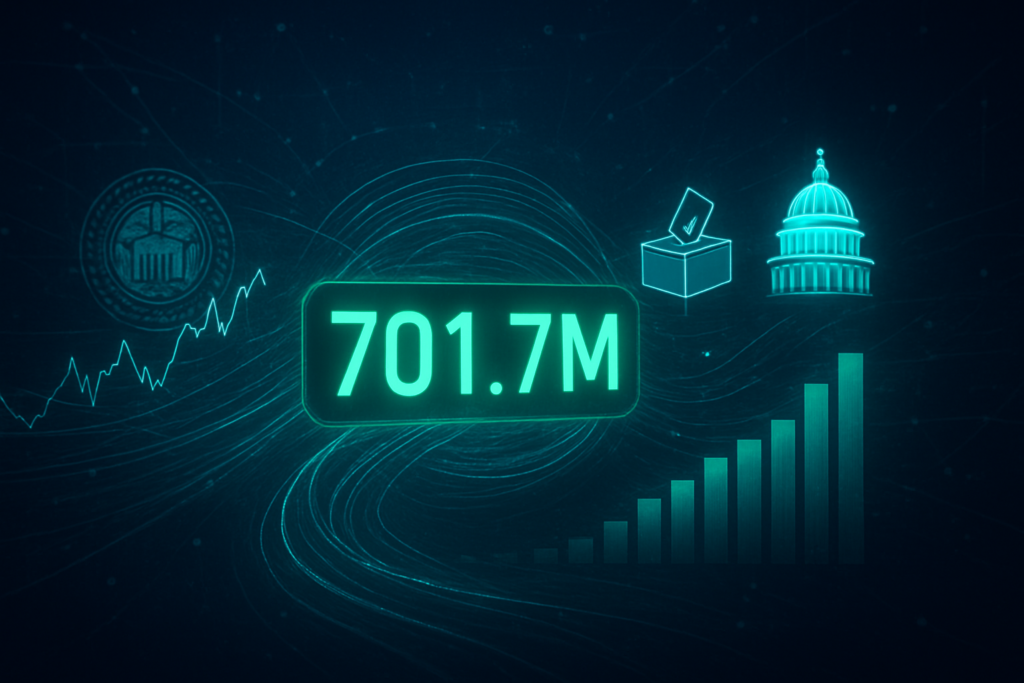
On January 12, 2026, the financial landscape witnessed a seismic shift as daily trading volume in prediction markets hit a staggering $701.7 million, marking the industry's most prolific 24-hour period in history. What was once dismissed as a niche corner of the internet for political hobbyists has officially transitioned into a primary "truth engine" for global finance. The surge was not merely a spike in speculative interest but a calculated migration of capital toward real-time, high-stakes information during a period of intense macroeconomic and geopolitical volatility.
The record-breaking day saw a dominant performance by Kalshi, which captured a massive 66.4% of the total market share. This explosion in activity was fueled by a "perfect storm" of data: a slowing labor market, an unprecedented constitutional clash between the executive branch and the Federal Reserve, and early-cycle positioning for the 2026 Midterm elections. As institutional giants and retail traders alike flocked to these platforms, the consensus among analysts is clear: prediction markets are no longer about "betting"—they are about "knowing."
The Market: What's Being Predicted
The bulk of the $701.7 million volume was concentrated on the CFTC-regulated exchange Kalshi, which processed approximately $465.9 million in trades. A significant portion of this liquidity flowed through retail gateways, particularly Robinhood (NASDAQ: HOOD), which has integrated Kalshi’s event contracts directly into its "Prediction Markets Hub." Other major players, including Coinbase (NASDAQ: COIN) and the crypto-native Polymarket—now backed by a $2 billion investment from the Intercontinental Exchange (NYSE: ICE)—accounted for the remainder of the day's record-setting activity.
The most active contracts on January 12 revolved around two pillars: central bank policy and political control. Traders poured over $120 million into a single contract on Kalshi: "Will the Fed cut interest rates in March?" Simultaneously, the market for "Who will control the House in 2027?" saw open interest swell to $150 million. These weren't just long-term wagers; they were highly liquid instruments being traded in real-time as news broke, with bid-ask spreads tightening to levels comparable to major equities.
Beyond traditional macro data, the day was marked by high-velocity "flash markets." Following the sudden news of a U.S. military operation in Venezuela, volume on contracts related to the capture of Nicolás Maduro spiked instantly. Similarly, a "volatility index" for the 2026 election cycle emerged in the form of Trump impeachment odds, which surged to 57% on the back of escalating domestic political tensions.
Why Traders Are Betting
The primary driver behind the January 12 surge was a dramatic escalation in the "Fed Independence" narrative. Following reports that the Department of Justice had issued subpoenas to Federal Reserve Chair Jerome Powell, the markets became the only place to find a real-time probability of a constitutional crisis. Traditional forecasting from institutions like JPMorgan Chase (NYSE: JPM) struggled to keep pace with the headlines, leading traders to use prediction markets to hedge against a potentially compromised central bank.
Market activity was also heavily influenced by the January 9 labor report, which showed a meager addition of 50,000 jobs. This data point, combined with a 4.4% unemployment rate, created a divide in opinion that only a market could resolve. While some analysts predicted a defensive "hold" by the Fed, the prediction markets moved aggressively toward a 25-basis point cut, providing a "source of truth" that anticipated subsequent movements in S&P 500 futures.
Institutional participation reached a tipping point as well. Firms like Goldman Sachs (NYSE: GS) and Interactive Brokers (NASDAQ: IBKR) have increasingly acknowledged these markets as vital sentiment indicators. The entry of CME Group (NASDAQ: CME) into the event contract space has provided the regulatory "moat" necessary for large-scale capital to enter. On January 12, this institutional liquidity met a wave of retail enthusiasm from the Robinhood and Coinbase ecosystems, creating a liquidity flywheel that shattered all previous records.
Broader Context and Implications
The record volume on January 12 highlights the maturation of prediction markets from "betting platforms" to "information aggregators." In an era of fragmented media and polarized polling, these platforms provide an objective, capital-weighted consensus. Brian Armstrong, CEO of Coinbase, noted that these markets are becoming superior to traditional news outlets because participants have "skin in the game," ensuring that the prevailing odds are the most accurate reflection of available data.
However, this rapid growth has not come without scrutiny. The massive volume on the Maduro capture contracts prompted U.S. Senators Adam Schiff and Alex Padilla to call for a CFTC investigation into potential insider trading. The concern is that prediction markets may be "too good" at uncovering information, potentially incentivizing the leak of sensitive government or corporate data for profit.
Historically, prediction markets have shown a remarkable ability to outperform pundits. From the 2024 elections to the 2025 inflation pivots, these platforms have consistently bottomed out ahead of the curve. The $701.7 million day suggests that the broader financial world has finally accepted this reality, integrating event contracts into the standard toolkit of risk management alongside options and futures.
What to Watch Next
As the dust settles on this record-breaking day, all eyes are on the January 13 CPI release. Prediction markets are currently pricing in a "sticky" headline inflation rate of 2.7%, and any deviation from this will likely trigger another massive volume day as traders recalibrate their Fed expectations. The market’s reaction to this data will be a crucial test of whether the January 12 volume was a one-time anomaly or the new baseline for the industry.
Furthermore, the legal battle involving the Federal Reserve and the DOJ is expected to generate a series of "binary events"—subpoena responses, grand jury leaks, and potential executive orders—that are tailor-made for prediction market trading. Traders should also monitor the upcoming primary filing deadlines for the 2026 Midterms, which will begin to lock in the field of candidates and drive the next wave of political liquidity.
Bottom Line
The events of January 12, 2026, represent a point of no return for the prediction market industry. With $701.7 million in daily volume and Kalshi commanding a dominant 66.4% share, the infrastructure of "knowing" has been firmly established. These platforms are no longer just a mirror of public opinion; they are a driver of it, influencing how major institutions hedge their bets and how the public interprets breaking news.
Ultimately, the surge in volume tells us that in an increasingly uncertain world, the value of a clear, market-driven probability is worth hundreds of millions of dollars. As prediction markets continue to integrate with mainstream financial platforms and gain institutional legitimacy, the line between "betting" and "investing" will continue to blur, leaving us with a powerful new tool for navigating the complexities of the 21st-century economy.
This article is for informational purposes only and does not constitute financial or betting advice. Prediction market participation may be subject to legal restrictions in your jurisdiction.
PredictStreet focuses on covering the latest developments in prediction markets.
Visit the PredictStreet website at https://www.predictstreet.ai/.