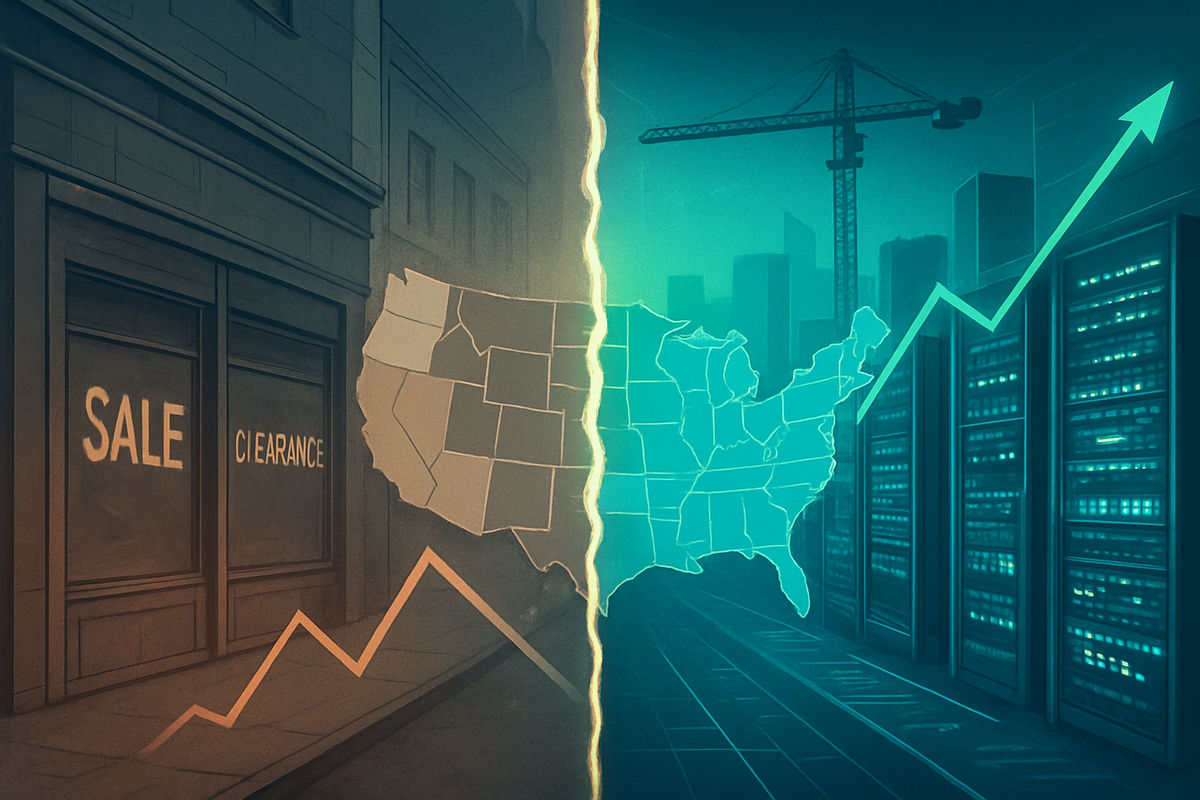
The Federal Reserve’s latest “Beige Book” summary, released on March 4, 2026, has sent a ripple of caution through the financial markets, painting a stark picture of an American economy split down the middle. While some sectors are riding the wave of a massive artificial intelligence infrastructure boom, the broader landscape is defined by widespread stagnation, cautious business sentiment, and the looming shadow of a new 15% global tariff policy. For the first time in over a year, five of the twelve Federal Reserve districts reported flat or declining economic activity, a troubling uptick from the previous period that suggests the “soft landing” narrative is facing its most significant test yet.
This latest report, which serves as a crucial data point for the Federal Open Market Committee (FOMC) ahead of its March 17-18 meeting, highlights a "bifurcated economy." On one side, industrial hubs in the South and Midwest are flourishing under the weight of data center construction and energy projects. On the other, coastal regions like San Francisco and New York are wrestling with cooling tech demand and a pervasive “bunker-minded” consumer. As businesses across all districts adopt a “no hire, no fire” approach to labor, the sentiment on Main Street is increasingly one of watchful anxiety, with many firms pausing capital expenditures until the full impact of the new trade surcharges is understood.
A Nation of Twelve Different Realities
The March 2026 Beige Book reveals that the geographic divide in the U.S. economy has widened significantly since the start of the year. Seven districts—including Philadelphia, Cleveland, and Atlanta—reported slight to moderate expansion, fueled primarily by the relentless demand for AI-ready infrastructure and renewable energy components. However, the report’s most concerning finding is the slide into stagnation for five key districts: New York, Minneapolis, San Francisco, Boston, and St. Louis. Contacts in these regions cited a combination of high living costs, a cooling in discretionary services, and the immediate chilling effect of the recently implemented 15% global tariff on imported materials.
Timeline-wise, this stagnation follows a period of "cautious optimism" seen in late 2024 and early 2025. The shift began in mid-2025 when persistent price sensitivity among low-income households started to erode retail margins. By early 2026, this had evolved into a "K-shaped" recovery where high-income spending remains robust, but the bottom 40% of earners have significantly pulled back. Initial market reactions to the March 4 release were mixed; while the S&P 500 initially gained 0.95% on hopes that stagnation would force the Fed to cut rates, those gains were quickly erased as investors realized that tariff-induced inflation might keep interest rates "higher-for-longer."
The labor market, once the primary engine of the post-pandemic recovery, is now in a state of suspended animation. The Beige Book describes a trend of "attrition without replacement," where firms are allowing headcounts to shrink naturally rather than resorting to mass layoffs. This shift is particularly visible in the manufacturing sector, where companies are pivoting toward "Physical AI" and industrial automation to offset rising labor and import costs. The report notes that nine out of twelve districts explicitly flagged the 15% tariff as a major cost driver, forcing manufacturers to choose between absorbing the blow or passing it on to an already exhausted consumer base.
Corporate Winners and Losers in the Bifurcated Market
The current economic environment has created a clear set of corporate victors and victims. Among the winners are the "infrastructure alphas"—companies that provide the literal nuts and bolts of the AI revolution. Vertiv Holdings (NYSE: VRT) has emerged as a top performer, with the Beige Book indirectly highlighting the 252% year-over-year growth in liquid cooling and power infrastructure orders. Similarly, Eaton Corporation (NYSE: ETN) has seen its shares outperform the broader market as the backlog for data center electrical equipment reached record highs in early 2026. These firms are largely "tariff-moated" because their long-cycle, mission-critical projects are less sensitive to short-term price fluctuations.
In the consumer sector, the divergence is even more pronounced. Walmart Inc. (NYSE: WMT) continues to solidify its position as the ultimate defensive play, with household penetration hitting a record 72% as middle-income families "trade down" to save money. Conversely, Dollar General (NYSE: DG) has faced a more turbulent start to 2026. While it benefits from trade-down traffic, its core low-income demographic is reportedly "skipping meals" to handle high-interest debt, leading to a cautious outlook from management. The retail sector at large is also bracing for impact; The Gap (NYSE: GPS) and other apparel giants have already signaled margin headwinds of up to 200 basis points due to the new global tariff regime.
The industrial automation space is another area of opportunistic growth. Rockwell Automation (NYSE: ROK) and Emerson Electric (NYSE: EMR) have seen a resurgence in domestic orders as manufacturers rush to automate production lines. By deploying AI-driven tools like "CoPilot" for factory design, these companies are helping U.S. firms decouple from expensive foreign labor and mitigate the cost of tariffed imports. Meanwhile, legacy industrials like Caterpillar Inc. (NYSE: CAT) are navigating a more complex path, struggling with the rising cost of metal inputs even as domestic infrastructure demand remains high.
The Broader Significance: A Shift in the "Soft Landing" Narrative
The findings in the latest Beige Book signal a fundamental shift in how the Federal Reserve views the current economic cycle. The "higher-for-longer" interest rate environment, which many hoped would end by 2025, now seems destined to continue through much of 2026. This is largely due to the inflationary pressure of the 15% global tariff, which complicates the Fed’s dual mandate of price stability and full employment. Historically, a "bifurcated economy" of this magnitude has often preceded a period of prolonged stagnation, similar to the "stagflation" era of the 1970s, though today’s productivity gains from AI provide a unique counterweight.
Regulatory and policy implications are also coming to the forefront. The Beige Book highlighted that the new tariff policy, implemented under Section 122 following a Supreme Court ruling on trade authority, has become the primary source of "economic uncertainty." For competitors and partners in the global supply chain, this means a shift toward "friend-shoring" and domestic production is no longer a strategic choice but a survival necessity. The ripple effects are already being felt in the tech sector; while NVIDIA Corporation (Nasdaq: NVDA) remains the dominant force in AI silicon, it must now navigate a 25% government surcharge on specific high-end exports, adding another layer of complexity to its global operations.
Furthermore, the "Physical AI" trend mentioned in the report suggests that the next phase of the industrial revolution is moving from the digital to the physical world. This shift is forcing a regulatory rethink of energy policy, as the massive power requirements of data centers clash with aging electrical grids. Districts like Atlanta and Dallas are reporting that energy infrastructure is now a top-tier economic priority, potentially leading to new federal incentives for grid modernization and nuclear energy deployment.
The Road Ahead: Potential Scenarios for the Rest of 2026
As the market looks toward the upcoming FOMC meeting, the primary question is whether the Fed will prioritize supporting the stagnant districts or fighting the inflationary threat posed by tariffs. In the short term, investors should expect continued volatility as markets digest high-frequency data on consumer spending and manufacturing costs. A potential strategic pivot for many companies will involve aggressive investments in automation to lower the "breakeven" point of their operations, essentially making themselves leaner to survive a period of flat growth.
Long-term, two primary scenarios emerge. In a "Success Scenario," the massive investments in AI infrastructure and domestic automation could trigger a productivity boom that offsets the inflationary effects of tariffs, leading to a late-2026 resurgence. However, a "Stagnation Scenario" is equally possible, where the K-shaped recovery deepens, low-income exhaustion leads to a broader retail collapse, and high interest rates finally break the resilient manufacturing sector. Market opportunities will likely remain concentrated in "mission-critical" sectors like energy, defense, and high-end automation, while traditional consumer discretionary and highly leveraged firms face a daunting uphill climb.
Final Assessment: Navigating a Patchwork Recovery
The March 4 Beige Book serves as a sobering reminder that the U.S. economy is not a monolith. The "Great Divergence" between growth hubs and stagnant regions is a defining characteristic of early 2026, driven by a volatile mix of technological breakthroughs and protectionist trade policies. For investors, the key takeaway is that the "tide that lifts all boats" has gone out, leaving behind a market where sector selection and geographic exposure are more important than ever.
Moving forward, the market will be hyper-focused on three things: the Fed’s language regarding "tariff-induced inflation," the pace of data center expansion, and the resilience of the low-income consumer. While the AI supercycle provides a powerful engine for growth, the friction of global trade barriers and the exhaustion of the American consumer represent significant headwinds. Investors should watch for the March 17-18 FOMC statement for any signs of a pivot, but for now, "cautious stagnation" remains the watchword of the day.
This content is intended for informational purposes only and is not financial advice