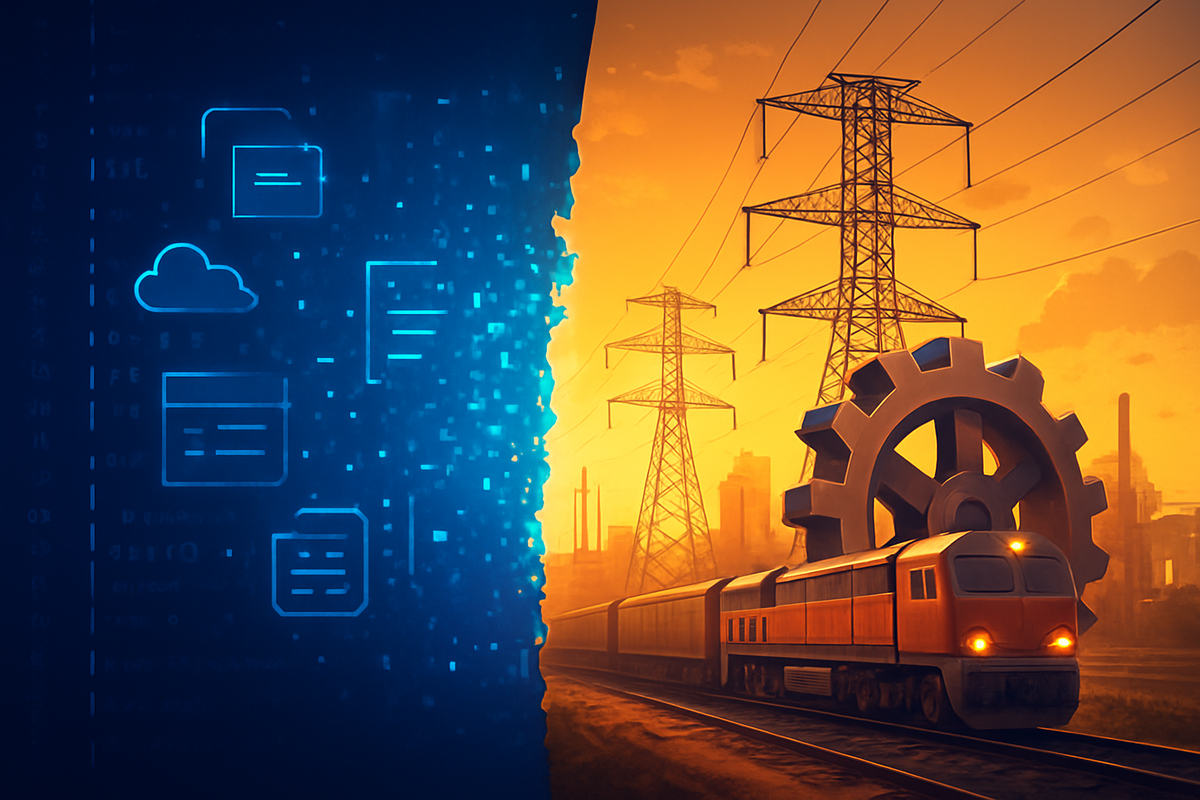
In a dramatic reversal of the multi-year technology bull run, the global equity markets have entered what analysts are calling the "Great Rotation of 2026." As of March 13, 2026, capital is aggressively exiting the once-bulletproof AI software sector, flowing instead into "physical asset" industries like energy, utilities, and industrial transportation. This "Atoms over Bits" trade reflects a growing market consensus that the digital revolution has hit a physical ceiling, as the infrastructure required to power and house artificial intelligence becomes more valuable than the software itself.
The immediate implications are stark: the iShares Expanded Tech-Software Sector ETF (BATS: IGV) has plummeted by nearly 18% year-to-date, while the Energy Select Sector SPDR (NYSE: XLE) has surged by 25%. This shift is being driven by a perfect storm of "power wall" constraints, sticky inflation, and geopolitical volatility that has pushed Brent Crude to $118 per barrel. Investors, once captivated by the promise of infinite digital scale, are now retreating to the safety of tangible assets and companies with the literal power to keep the lights on.
The Physical Wall: How Energy Shortages De-Railed the AI Dream
The narrative of early 2026 has been defined by the "Power Wall" crisis. For three years, the market focused on GPU availability and large language model (LLM) performance, but by late 2025, the bottleneck shifted from silicon to electricity. The massive energy requirements of agentic AI suites have outpaced grid capacity across North America and Europe. This reality hit home in February 2026 when several major tech firms reported massive backlogs in data center deployments due to a lack of power interconnection agreements.
The timeline leading to this rotation began in late 2025 with the signing of the "One Big Beautiful Bill Act" (OBBBA), a massive fiscal package that incentivized domestic manufacturing and infrastructure. As the OBBBA reached full implementation in January 2026, investors began to see the relative value in heavy industry over high-multiple software. This was compounded by a March escalation of military tensions in the Middle East involving the U.S. and Iran, which disrupted shipping in the Strait of Hormuz and sent fuel prices soaring. The result was a sudden re-rating of the entire market, favoring companies that own physical supply chains over those that sell "seats" on a digital platform.
Market reactions have been swift and unforgiving. The "SaaSpocalypse" of 2026 has seen valuation multiples for enterprise software companies—which often traded at 20x to 30x revenue—collapse toward historical norms. Meanwhile, the industrial and energy sectors are seeing their highest levels of capital inflow since the post-pandemic recovery. The initial euphoria surrounding AI has not disappeared, but it has matured into an "infrastructure first" mindset where the providers of electricity and freight are the primary beneficiaries of the technological surge.
Winners and Losers: The Great Re-Rating of 2026
The casualties of this rotation are the high-multiple tech giants that have led the market since 2023. Microsoft (NASDAQ: MSFT), long considered the safe haven of the AI era, has faced significant multiple compression as it grapples with an estimated $80 billion backlog in Azure services caused specifically by power shortages. Similarly, enterprise stalwarts like Salesforce (NYSE: CRM) and ServiceNow (NYSE: NOW) have seen double-digit declines as investors question their 24x+ price-to-sales multiples in an environment where "vibe coding" and agentic AI have begun to commoditize proprietary software code.
On the winning side of the ledger, energy and utility companies are the new "growth" stocks. ExxonMobil (NYSE: XOM) and Chevron (NYSE: CVX) are reporting record margins as oil prices hover near $120 per barrel. NextEra Energy (NYSE: NEE) has emerged as a standout performer, up 24% year-to-date, fueled by a massive 30-gigawatt backlog for AI data center power demand. In the transportation sector, railroads are seeing a resurgence as the essential movers of the physical goods required for the U.S. manufacturing boom. Union Pacific (NYSE: UNP) and CSX (NASDAQ: CSX) are thriving, with Union Pacific currently in the spotlight amid talks of a potential transcontinental merger that would consolidate the "real economy" supply chain.
However, the transportation sector is not a monolith. While railroads and industrial movers win, fuel-sensitive industries are being crushed. United Airlines (NASDAQ: UAL) and other major carriers have seen their stock prices battered by a 100% surge in jet fuel prices since last year. This "barbell" effect in the market means that while some physical assets are soaring, those dependent on cheap energy are suffering just as much as the software names they are meant to replace.
A Structural Shift in the Global Economy
This rotation fits into a broader historical trend where periods of rapid technological innovation are eventually met by the constraints of the physical world. Much like the railroad boom of the 19th century eventually led to a massive consolidation and a focus on the underlying commodities (coal and steel), the AI boom is entering its "industrial phase." The significance of this event cannot be overstated; it represents a move away from the "Bits" economy that dominated the 2010s and early 2020s, back to an "Atoms" economy where physical ownership and resource security are paramount.
The ripple effects are extending into the regulatory and policy spheres. The implementation of the OBBBA has essentially codified a "New Industrial Policy" for the United States, prioritizing domestic energy production and heavy manufacturing over digital services. This has created a regulatory environment where companies like Caterpillar (NYSE: CAT) are viewed as national security assets. Historically, this shift mirrors the late 1970s, where persistent inflation and energy shocks forced a similar move out of growth-oriented "Nifty Fifty" stocks and into hard assets and commodities.
Furthermore, the "Power Wall" has forced a rare alignment between tech companies and the nuclear energy sector. We are seeing unprecedented partnerships where tech firms are attempting to bypass public grids entirely by investing in small modular reactors (SMRs). This suggests that the future of the market may not be a simple "tech vs. energy" divide, but rather a merger of the two, where the most successful companies of the late 2020s will be those that control their own physical energy and logistics stacks.
The Road Ahead: Scenarios for the Rest of 2026
In the short term, the market is likely to remain volatile as it searches for a new equilibrium. If the Federal Reserve maintains its "simultaneous hold" on interest rates above 5%, the pressure on high-multiple software names will continue. Investors should prepare for a potential "strategic pivot" from software-heavy firms as they attempt to acquire or build their own physical infrastructure. We may see a wave of tech-to-utility acquisitions that would have been unthinkable just two years ago.
Longer term, the "Atoms over Bits" trade could evolve into a multi-year super-cycle. The demand for copper, lithium, and electricity is projected to grow exponentially through 2030, which may keep inflation "sticky" and favor the physical asset classes for the foreseeable future. The challenge for investors will be identifying which "real world" companies are actually benefiting from the AI infrastructure build-out and which are merely riding the coattails of rising commodity prices.
Potential scenarios include a "soft landing" for tech if power constraints are resolved faster than expected through regulatory easing for nuclear energy. Conversely, a prolonged geopolitical conflict in the Middle East could push oil prices toward $150, which would likely trigger a broader recession that could eventually drag down even the currently surging energy and industrial sectors. For now, the market is betting on the tangible over the virtual.
Assessing the Market Moving Forward
The rotation out of AI software and into energy and transportation marks the end of an era of "unconstrained growth" in the digital space. The key takeaway for investors is that the valuation of a company is no longer just a function of its code or its user base, but its physical footprint and its access to energy. The market is effectively telling us that while AI may be the brain of the future economy, energy and transportation are its heart and lungs.
Moving forward, the "Barbell Strategy"—holding core AI hardware and chips while heavily weighting heavy assets and low-obsolescence (HALO) stocks like Exxon and Union Pacific—appears to be the most resilient path. Investors should keep a close eye on the "Union Pacific-Norfolk Southern" merger developments and any further escalation in global energy markets.
As we navigate the rest of 2026, the primary metric to watch will not be "Monthly Active Users" or "Software ARR," but rather "Megawatts under Management" and "Cost per Ton-Mile." The virtual world has finally met the physical world, and for the moment, the physical world is winning.
This content is intended for informational purposes only and is not financial advice.