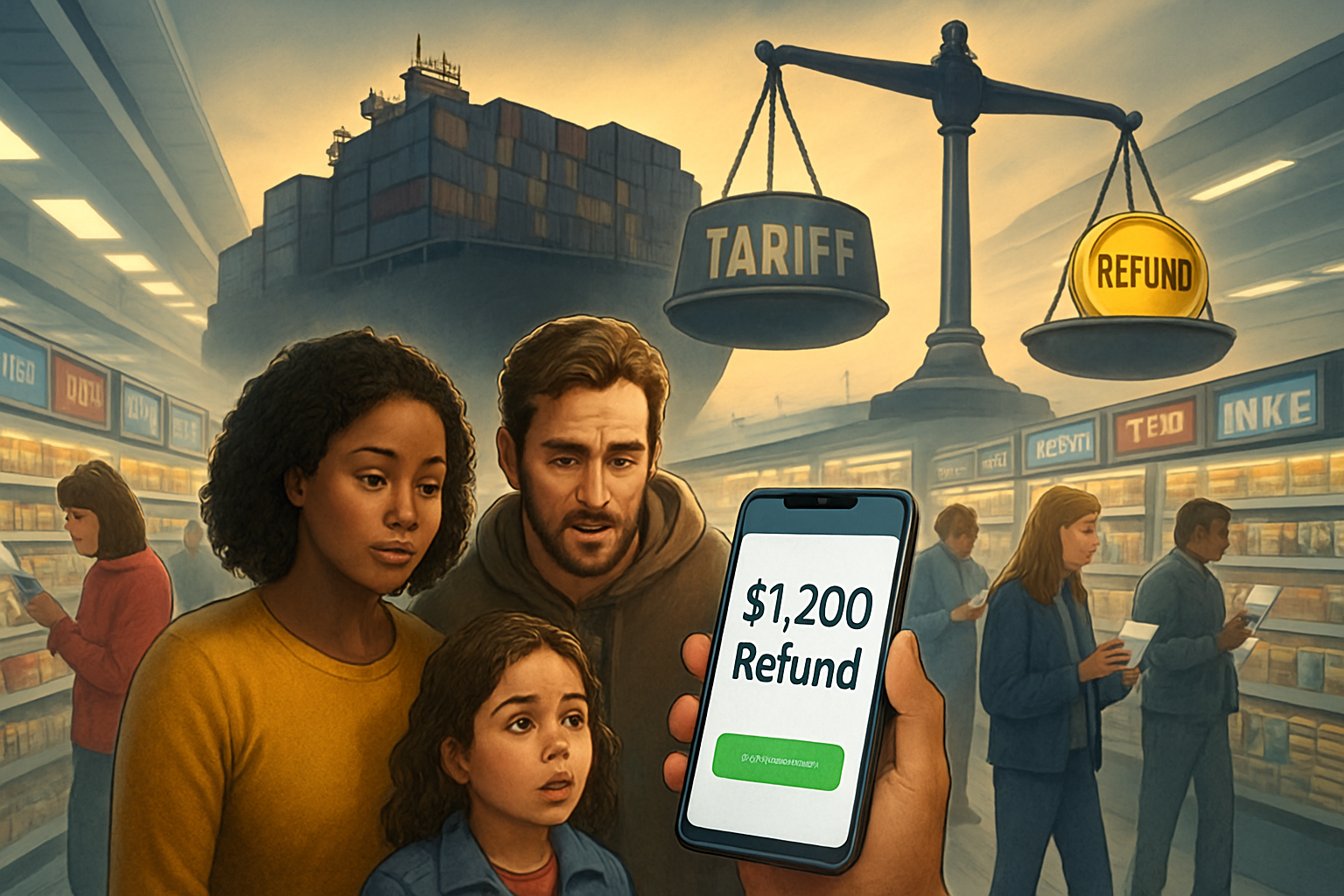
As the United States grapples with a volatile cocktail of trade-induced inflation and supply chain restructuring, Senator Martin Heinrich (D-N.M.) has introduced a high-stakes legislative gamble to put cash back into the pockets of consumers. On March 13, 2026, Heinrich officially moved the Tariff Refunds for Working Families Act to the Senate floor, proposing a series of direct tax rebates designed to offset the rising costs of imported goods. The bill arrives at a critical juncture where "tariff transmission lag"—the delay between trade policy shifts and retail price hikes—has finally hit the American consumer’s wallet with full force.
The legislation seeks to redistribute approximately $166 billion in revenue collected from recent foreign tariffs directly to low- and middle-income families. Under the proposal, joint filers earning $180,000 or less would receive a $1,200 "Working Families Refund," while individual filers earning under $90,000 would be eligible for $600. With an additional $600 earmarked for each dependent, a family of four could see a one-time injection of $2,400 within 40 days of the bill’s passage. The move is framed as a necessary correction to what Heinrich describes as an "unintended tax on the American dinner table," coming on the heels of a landmark Supreme Court ruling that has thrown the nation’s trade policy into legal limbo.
The Fight for the ‘Tariff Pot’: Timeline and Mechanics
The introduction of this bill follows a chaotic start to 2026 for the U.S. economy. In February, a 6-3 Supreme Court decision struck down several broad "reciprocal" tariffs previously implemented under the International Emergency Economic Powers Act (IEEPA), ruling that the executive branch had overstepped its constitutional authority. While the ruling technically invalidated the legal basis for these tariffs, the billions of dollars already collected remain in federal coffers. This has sparked a fierce legislative "gold rush" for those funds, with Senator Heinrich’s bill emerging as the primary populist counterweight to corporate-focused refund efforts.
Unlike the rival Tariff Refund Act of 2026, backed by Senators Ed Markey and Ron Wyden, which focuses on returning $135 billion directly to the importers of record (the businesses that paid the duties at the border), Heinrich’s plan argues that the true victims of the trade war are the consumers who absorbed the costs through higher prices. Economic data from Q1 2026 shows that inflation has "surprised to the upside," hitting 2.7% as retailers like Columbia Sportswear (Nasdaq: COLM) and Levi Strauss & Co. (NYSE: LEVI) implemented high single-digit price hikes to preserve margins. Heinrich’s bill aims to provide immediate relief before these inflationary pressures trigger a broader decline in consumer sentiment.
The mechanics of the bill are aggressive: it utilizes the Treasury's existing infrastructure from the 2020-2021 stimulus era to issue payments. To qualify, taxpayers must have filed returns for 2024 or 2025, a provision that also includes Social Security recipients. By anchoring the rebates to tariff revenue, Heinrich is attempting to bypass the traditional "deficit hawk" arguments that often stall stimulus spending, essentially framing the $166 billion as money that belongs to the public by right, rather than a new government expenditure.
Retail Winners and Supply Chain Losers: The Market Impact
The prospect of a massive cash infusion has sent ripples through the retail sector, creating a stark divide between domestic-heavy retailers and those with deep global supply chains. Large-scale discount retailers such as Walmart (NYSE: WMT) and Target (NYSE: TGT) are viewed as the primary beneficiaries of the proposed rebates. Both companies recently cautioned that their "paycheck-to-paycheck" customers were beginning to pull back on non-essential purchases due to rising grocery and apparel costs. A $2,400 check for a family of four would likely translate into an immediate boost in transaction volume for these big-box giants.
On the other side of the ledger, companies with heavy manufacturing exposure in China and Southeast Asia continue to face a "margin squeeze." Nike (NYSE: NKE) has already signaled that tariff-related logistics and duty costs could shave nearly $1 billion off its fiscal 2026 earnings. While a consumer rebate might support demand for high-end sneakers, it does little to alleviate the structural cost increases Nike faces at the border. Similarly, consumer staple powerhouse Procter & Gamble (NYSE: PG) has been forced to raise prices on household essentials like Dawn and Charmin, leading to fears that even with a rebate, consumers may begin "trading down" to private-label brands to save money.
Small-to-mid-cap retailers with fixed price points, such as Five Below (Nasdaq: FIVE) and Dollar General (NYSE: DG), are also in a precarious position. These companies have less flexibility to absorb 10–15% "global baseline" tariffs than their larger peers. For these stocks, the Heinrich bill is seen as a double-edged sword: it provides the consumer with the means to shop, but it does not solve the underlying cost-of-goods-sold (COGS) crisis that has plagued the sector since late 2025. Investors are increasingly favoring "cash-heavy" retailers that can use the stimulus-driven sales bump to further automate their supply chains and reduce reliance on expensive foreign labor.
Wider Significance: A New Era of Populist Trade Policy
The 'Tariff Refunds for Working Families Act' represents a significant shift in how trade policy and social safety nets intersect. Historically, tariff revenue was used to fund the general operations of the government or to protect specific domestic industries. By attempting to "loop" that revenue back to the individual consumer, Heinrich is pioneering a form of "Trade-Neutral Stimulus." This event fits into a broader trend of 2026: the politicization of the federal balance sheet as a tool to fight inflation, rather than just an instrument for infrastructure or defense.
The ripple effects extend to international trade partners and competitors. If the U.S. successfully implements a system where tariff costs are neutralized for the domestic voter, it may embolden future administrations to use tariffs more aggressively as a diplomatic tool, knowing the domestic political fallout (inflation) can be mitigated by rebates. However, this also sets a complex precedent. Critics argue that this creates a "circular economy of taxation" that could actually fuel further inflation by keeping demand artificially high while supply remains constrained by trade barriers.
Comparisons are already being drawn to the Alaska Permanent Fund or the "Green Checks" proposed in carbon tax debates. The Heinrich bill essentially treats the U.S. trade deficit as a resource to be "taxed and redistributed." From a regulatory standpoint, this could lead to more frequent legal challenges from corporations like Costco (Nasdaq: COST), which has already filed protective lawsuits to recover duties paid under the now-invalidated IEEPA tariffs. If the government gives the money to families, it may not have the funds left to settle the multi-billion-dollar claims currently working their way through the U.S. Court of International Trade.
The Road Ahead: Scenarios for 2026 and Beyond
In the short term, the fate of the Heinrich bill hinges on a deeply divided Congress. While the rebate is popular with voters, many lawmakers are wary of any action that could be perceived as "stimulus" while the Federal Reserve is still struggling to bring PCE inflation back to its 2% target. If the bill passes, expect a "mini-boom" in retail spending during the summer of 2026, which could provide a temporary floor for the S&P 500 retail index. However, if the bill fails, the market may brace for a "consumption cliff" as households exhaust their savings and face the full brunt of 5.6% projected price increases for non-durable goods.
Looking further ahead, we may see a strategic pivot in corporate America. Companies that have been "on the fence" about near-shoring production to Mexico or the U.S. may accelerate those plans to avoid the tariff-rebate cycle altogether. We could also see retailers experimenting with "tariff-exclusive" pricing, much like a sales tax, to make the cost of trade policy more transparent to the consumer—a move that would likely increase political pressure on both the White House and Congress.
Summary: What Investors Should Watch
The Tariff Refunds for Working Families Act is more than just a tax rebate; it is a fundamental test of how the U.S. manages the economic fallout of its "America First" trade posture. For investors, the key takeaways are clear: the bill could offer a significant, albeit temporary, lifeline to the retail sector, particularly for high-volume, low-margin players like Walmart and Target. However, the structural challenges of a post-SCOTUS trade environment remain unresolved.
Moving forward, the market will be closely watching the "Tariff Transmission" data coming out of Q2 2026. If price hikes continue to outpace wage growth, the pressure on Heinrich’s bill to pass will become overwhelming. Investors should keep a sharp eye on the U.S. Court of International Trade and any potential "global baseline" tariff announcements from the administration. The ultimate impact of this legislation will be measured by whether it truly offsets inflation or simply delays an inevitable reckoning for a consumer-driven economy built on global trade.
This content is intended for informational purposes only and is not financial advice.