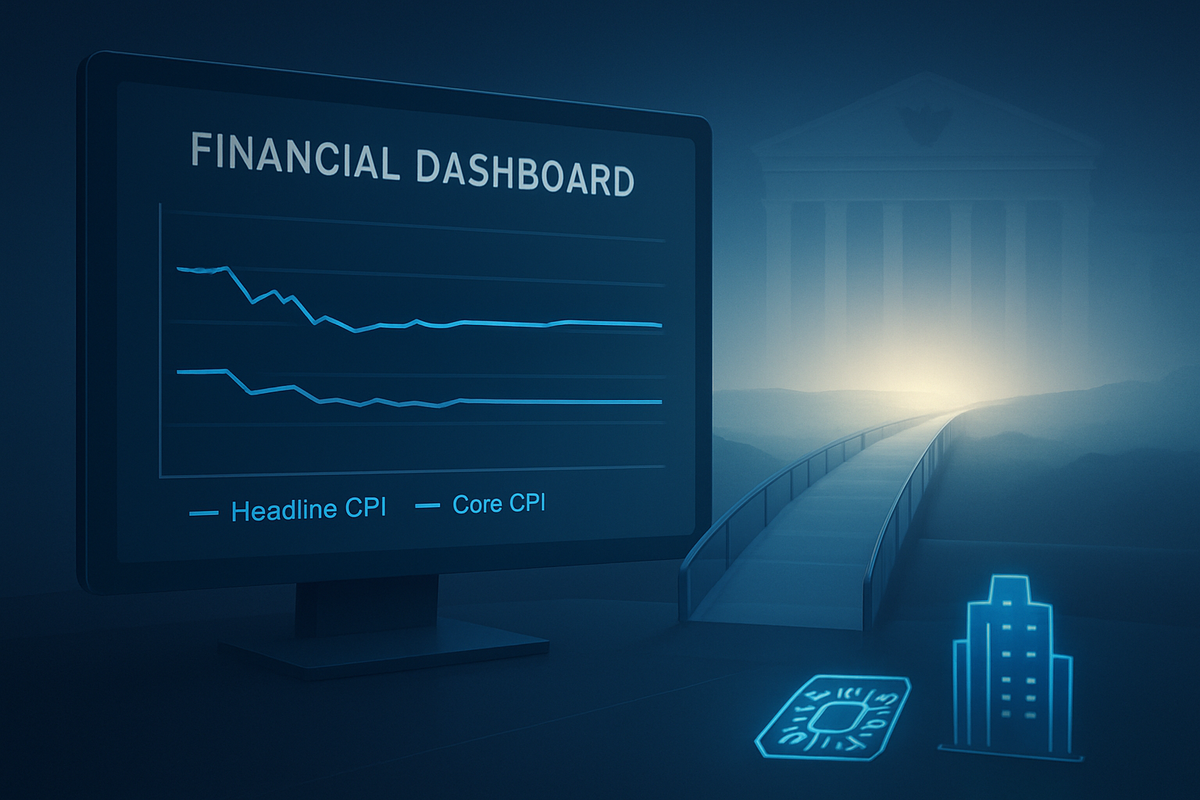
The latest inflation data for December has arrived with a sense of stability that offers both a sigh of relief and a note of caution for the Federal Reserve. Headline Consumer Price Index (CPI) remained at 2.7%, while the core figure—which excludes the often-volatile food and energy sectors—held firm at 2.6%. These numbers suggest that the aggressive disinflationary trends of early 2025 have transitioned into a more stubborn, yet controlled, plateau as the central bank navigates the final stretch of its journey toward a 2% target.
While the figures confirm that inflation is no longer the runaway train it was in previous years, the "steady" nature of the data likely prevents an immediate interest rate cut at the upcoming January meeting. For investors, this moderating trend signals that while the door to monetary easing remains open for later in 2026, the Federal Open Market Committee (FOMC) is likely to exercise "patient" oversight for at least one more cycle to ensure price stability has truly taken root.
Moderation Without Momentum: Inside the December CPI Report
The December CPI report, released by the Bureau of Labor Statistics (BLS) in mid-January 2026, paints a picture of a cooling economy that refuses to be rushed. The headline rate of 2.7% reflects a significant journey from the peaks of late 2024, yet it remains stubbornly above the Fed’s 2% comfort zone. Core CPI at 2.6% is particularly noteworthy, marking its lowest level since 2021, but the lack of downward movement from the previous month has reinforced the narrative that the "last mile" of inflation fighting is the most difficult.
The timeline leading to this moment has been defined by a series of strategic pauses and minor adjustments. Throughout 2025, the Federal Reserve executed three 25-basis-point cuts, bringing the federal funds rate down to its current range of 3.50%–3.75%. This cautious approach followed a 2024 defined by persistent "sticky" services inflation and global supply chain reconfigurations. Market players, including major institutional desks at Goldman Sachs (NYSE: GS) and Morgan Stanley (NYSE: MS), had been closely watching the December print to see if a January cut was viable.
The initial market reaction was one of muted acceptance. Treasury yields saw a slight flattening as traders recalibrated their expectations, with the CME FedWatch Tool quickly showing a near-unanimous 95% probability that the Fed will hold rates steady during its January 27–28 session. While equity markets initially dipped on the realization that a January "gift" in the form of a rate cut was unlikely, they recovered as the stability of the 2.6% core figure suggests that the risk of a re-acceleration of prices—the Fed’s greatest fear—is currently low.
Winners and Losers in a "Steady-State" Economy
In this environment of moderating but not falling inflation, the technology sector continues to be a primary beneficiary. High-growth firms like NVIDIA (NASDAQ: NVDA) and Microsoft (NASDAQ: MSFT) have shown they possess the pricing power necessary to maintain margins even when cost pressures remain slightly elevated. Furthermore, the prospect of lower rates later in 2026 provides a favorable valuation tailwind for these long-duration assets. Similarly, Amazon (NASDAQ: AMZN) and Alphabet (NASDAQ: GOOGL) benefit from a consumer base that, while cautious, is no longer seeing its purchasing power eroded by the double-digit price hikes of the early 2020s.
Real Estate Investment Trusts (REITs) are also emerging as potential winners as the interest rate ceiling becomes more defined. Companies such as American Tower (NYSE: AMT) and Prologis (NYSE: PLD) are highly sensitive to borrowing costs; a stabilization in rates allows these firms to better forecast their capital expenditures and refinancing needs. Additionally, niche players like Digital Realty (NYSE: DLR) are seeing increased demand for infrastructure to support the ongoing AI boom, making them attractive in a "soft landing" scenario where growth remains positive.
However, the outlook is more mixed for the banking sector. While J.P. Morgan (NYSE: JPM) and Bank of America (NYSE: BAC) have thrived on higher interest margins over the past two years, a plateau and eventual decline in rates could squeeze net interest income. These institutions are also facing a shifting regulatory landscape and potential caps on consumer lending rates, which, when combined with steady but not falling inflation, could lead to a tighter squeeze on profitability compared to the tech darlings. Meanwhile, discount retailers like Walmart (NYSE: WMT) must navigate a landscape where their cost-conscious customers still feel the cumulative weight of the last three years of price increases.
The Broader Significance: Navigating the Last Mile
This December data fits into a broader industrial trend of "normalization" following the pandemic-induced volatility. Historically, the Fed has struggled to balance the "higher for longer" mandate with the risk of over-tightening into a recession. The current 2.7% headline rate is a far cry from the nearly 9% seen in mid-2022, yet the plateau suggests that structural changes in the global economy—including domestic manufacturing shifts and energy transition costs—may have permanently raised the "neutral" rate of inflation.
Ripple effects are already being felt among international partners and competitors. As the U.S. remains patient, other central banks are forced to weigh their own easing cycles against the strength of the dollar. If the Fed delays cuts too long, it risks creating a divergence that could strain global trade. Comparison to the mid-1990s "soft landing" is often cited by historians; back then, the Fed successfully navigated a period of moderate growth and cooling inflation without triggering a downturn, a feat many believe Chair Jerome Powell is currently on the verge of repeating.
Policy implications extend beyond the Fed’s boardroom. The steady CPI figures give the current administration a "not good, not bad" narrative to carry into the early months of the 2026 legislative session. However, the persistence of shelter and service costs—the primary drivers of the 2.6% core figure—remains a political flashpoint. Regulatory pressure on "junk fees" and housing affordability are likely to increase as policymakers look for ways to lower the "cost of living" when monetary policy alone cannot reach the 2% finish line.
The Path Forward: Scenarios for Spring 2026
Short-term, the focus shifts entirely to the March and May FOMC meetings. While a January cut is off the table, the market is currently split on a March move. If the January and February CPI prints show even a slight dip toward 2.5%, the Fed may feel empowered to deliver a "insurance cut" to prevent the labor market from cooling too rapidly. Conversely, any upward surprise in energy or service costs could push the first cut of 2026 into the second half of the year, forcing corporations to maintain high-interest debt for longer than anticipated.
Strategic pivots are already underway. Many companies that had been waiting for "significantly lower" rates to initiate mergers and acquisitions or large-scale capital projects are beginning to realize that the 3.5% range may be the new floor. We are likely to see a flurry of corporate bond issuances in early 2026 as firms stop waiting for a return to zero-interest-rate policy (ZIRP) and instead lock in rates that are "good enough" in a stable-inflation environment.
The biggest challenge—and opportunity—lies in the labor market. If inflation remains steady while employment stays strong, the U.S. could enter a prolonged period of productivity-led growth. However, if the Fed's "patience" turns into "procrastination" and the economy begins to shed jobs, the pressure to cut rates aggressively would return, potentially reigniting inflation. Investors should prepare for a "sideways" market in the first quarter of 2026 as the data clarifies which of these scenarios will dominate the year.
Summary: A Balanced Outlook for 2026
The December CPI data serves as a bridge between the aggressive inflation-fighting of the past and the potential easing of the future. With headline inflation at 2.7% and core at 2.6%, the United States is in a period of economic equilibrium that is rare and fragile. The Fed has successfully brought prices down from their peaks, but the current stability suggests that they are not yet ready to declare "mission accomplished" and begin a rapid descent in rates.
Moving forward, the market will remain hyper-fixated on the "sticky" components of the core index, particularly housing and insurance costs. For investors, the takeaway is clear: the era of extreme volatility may be behind us, but the era of easy money is not returning. Success in 2026 will likely belong to those who focus on companies with strong balance sheets and the ability to grow regardless of whether the Fed cuts in March or June.
What to watch for in the coming months includes the Fed’s refreshed "Summary of Economic Projections" and any signs of a "second wave" of inflation caused by global trade tensions. While the January meeting is expected to be a non-event in terms of rate changes, the rhetoric from Chair Powell will be scrutinized for every hint of a pivot. For now, the motto is "steady as she goes," as the market adjusts to an economy that is finally finding its footing.
This content is intended for informational purposes only and is not financial advice