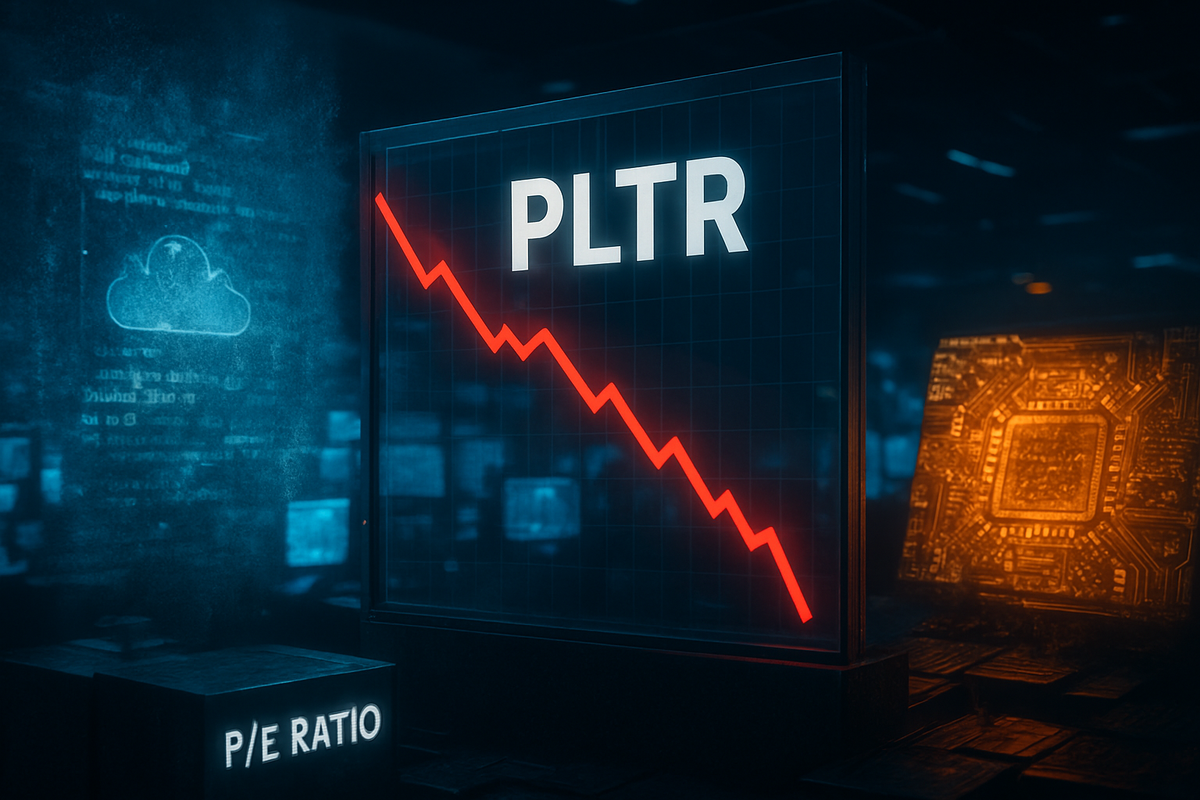
The high-flying momentum of the artificial intelligence sector met a cold reality in the opening weeks of 2026 as Palantir Technologies Inc. (NYSE: PLTR) saw its stock price tumble by more than 11%. This sudden retreat follows a historic "monster" year in 2025, where the data analytics giant surged by over 138%, reaching an all-time high of approximately $207. The slump, which began on the first trading day of the year, has sent shockwaves through the software-as-a-service (SaaS) sector, signaling that the market’s "perfection-priced" expectations may finally be catching up with reality.
The immediate implications are significant for both retail and institutional investors. For many, the 11% drop represents a "valuation reckoning" for a company that had become one of the most expensive stocks in the S&P 500. With a price-to-earnings (P/E) ratio that had ballooned past 400x and a price-to-sales (P/S) multiple exceeding 100x by late 2025, Palantir had effectively eliminated any margin for error. As technical support levels failed to hold in early January, the decline snowballed, triggering automated sell programs and a broader "de-risking" event across the high-growth software landscape.
The January Slide: A Timeline of Profit-Taking and Sector Shifting
The slump did not occur in a vacuum but was the result of a coordinated withdrawal of capital that began the moment the 2026 calendar turned. On January 2, 2026, Palantir shares dropped 5.9% in a single session—a move largely attributed to tax-advantaged profit-taking. Investors who had enjoyed triple-digit gains in 2025 waited until the first trading day of the new year to sell, successfully deferring their capital gains taxes until 2027. This initial selling pressure quickly morphed into a deeper structural correction as institutional desks began a strategic sector rotation.
By mid-January, the narrative shifted from simple profit-taking to a fundamental questioning of software valuations. While Palantir’s Artificial Intelligence Platform (AIP) continued to see "unmatched" demand, as noted by analysts at Citigroup Inc. (NYSE: C), the sheer weight of the stock's valuation made it a prime target for liquidation during a period of market-wide caution. Despite a late-breaking upgrade from Citigroup on January 12—which raised Palantir’s price target to $235—the stock struggled to find a floor, eventually settling into the $170–$177 range by January 16.
The stakeholders in this event are diverse, ranging from the company’s massive retail "army" to major institutional players who have spent the last two weeks shifting funds. Management, led by CEO Alex Karp, now faces a critical juncture. The upcoming Q4 2025 earnings report, scheduled for February 2, 2026, has become the most anticipated data point in the company's recent history. With guidance previously set between $1.32 billion and $1.33 billion in revenue, anything short of a significant beat-and-raise could further embolden the bears.
Winners and Losers: The Great AI Bifurcation
The "Software Winter" that cooled Palantir also took a toll on its peers in the application layer. Microsoft Corp. (NASDAQ: MSFT), the de facto leader of the AI revolution, saw its stock struggle with its own rich valuation and high capital expenditures, sliding roughly 5.6% year-to-date. Similarly, Snowflake Inc. (NYSE: SNOW) and C3.ai Inc. (NYSE: AI) faced double-digit declines. C3.ai was particularly hard-hit following news that Chairman Thomas Siebel sold over 300,000 shares in mid-January, a move that exacerbated fears that insiders might believe the AI software peak has passed.
However, the capital exiting software did not leave the technology sector entirely; instead, it flowed into the "picks and shovels" of the AI infrastructure. Micron Technology Inc. (NASDAQ: MU) emerged as a primary winner, surging on the back of insatiable demand for High Bandwidth Memory (HBM3E/HBM4). While software companies struggled to prove AI ROI, hardware giants like Taiwan Semiconductor Manufacturing Company (NYSE: TSM) and chip equipment makers like Applied Materials Inc. (NASDAQ: AMAT) were rewarded for their visible, immediate earnings growth. This "Great Rotation" suggests that investors are currently prioritizing the physical capacity to compute over the software that utilizes it.
Beyond tech, the beneficiaries of Palantir’s slump included "Real Economy" cyclicals. Institutional capital moved into Energy, Industrials, and Financials, with banks like The Goldman Sachs Group Inc. (NYSE: GS) seeing inflows as interest rate expectations remained "higher-for-longer." This broader market shift indicates a pivot toward stability and tangible cash flows, a stark contrast to the speculative fervor that drove Palantir to its $200+ peak in November 2025.
The AI Monetization Gap and Industry Trends
The slump in Palantir’s stock is a microcosm of a broader industry trend: the "AI Monetization Gap." Throughout 2025, the market rewarded any company with an AI story. In 2026, however, investors are becoming "ruthlessly discriminating." There is a growing concern that while AI software demand is high, the cost of compute power acts as a "tax" on developers, squeezing margins. Furthermore, a new narrative has emerged suggesting that Generative AI might cannibalize traditional seat-based licensing models—if an AI agent can do the work of five employees, the "per-seat" revenue model used by software firms for decades faces an existential threat.
This event also draws historical parallels to the post-2000 dotcom era. Much like the early 2000s, where hardware leaders like Cisco held their valuations longer than the software companies they supported, the 2026 market is favoring the "infrastructure layer." The current dip in Palantir reflects a transition from the "hype phase" of AI to the "execution phase," where companies must prove they can turn technological breakthroughs into sustainable bottom-line growth.
Regulatory and policy implications also loom. As Palantir continues to expand its footprint in the public sector, particularly with defense contracts, the scrutiny over its valuation and "mission-critical" status has increased. The market is now weighing the possibility that high-growth software may face "valuation ceilings" as governments and enterprises demand more transparency regarding the cost-benefit analysis of AI integration.
Looking Ahead: The Path to Recovery or Further Retreat
In the short term, all eyes are on the February 2 earnings call. For Palantir to reverse the current slump, it must demonstrate that its AIP is not just a tool for experimentation but a driver of operational efficiency that justifies its premium. A strategic pivot toward more aggressive commercial expansion or a surprise announcement regarding new sovereign contracts could provide the necessary catalyst for a rebound. However, the failure to meet the high bar of $1.33 billion in quarterly revenue could see the stock test its key support level at $150.
Longer-term, Palantir and its software peers may need to adapt their pricing models to better capture the value of AI. This could involve shifting away from "per-seat" metrics toward "per-outcome" or "consumption-based" models, similar to what Snowflake Inc. (NYSE: SNOW) has championed. The market opportunity for AI remains vast, but the challenge for 2026 will be navigating a environment where capital is no longer cheap and "good" results are no longer enough to satisfy a market that demands "perfect" results.
Summary and Investor Outlook
The 11% slump in Palantir’s stock at the start of 2026 serves as a stark reminder that even the most successful growth stories are subject to the laws of gravity when valuations become decoupled from near-term earnings. The event highlights a significant shift in market sentiment: a rotation from the software "application layer" to the semiconductor "infrastructure layer," and a move from speculative growth to cyclical value.
For investors, the key takeaway is that the "AI trade" is maturing. The days of broad-based sector rallies appear to be giving way to a more nuanced landscape where individual performance and margin preservation are paramount. Moving forward, the market will likely remain volatile as it digests the upcoming Q4 earnings season. Investors should closely watch for signs of "AI ROI" in corporate earnings reports and keep a sharp eye on semiconductor performance as a leading indicator of where the next wave of capital might flow. While the long-term outlook for Palantir remains robust in the eyes of many analysts, the road to $250 will likely be paved with more frequent corrections and a renewed focus on fundamental discipline.
This content is intended for informational purposes only and is not financial advice.