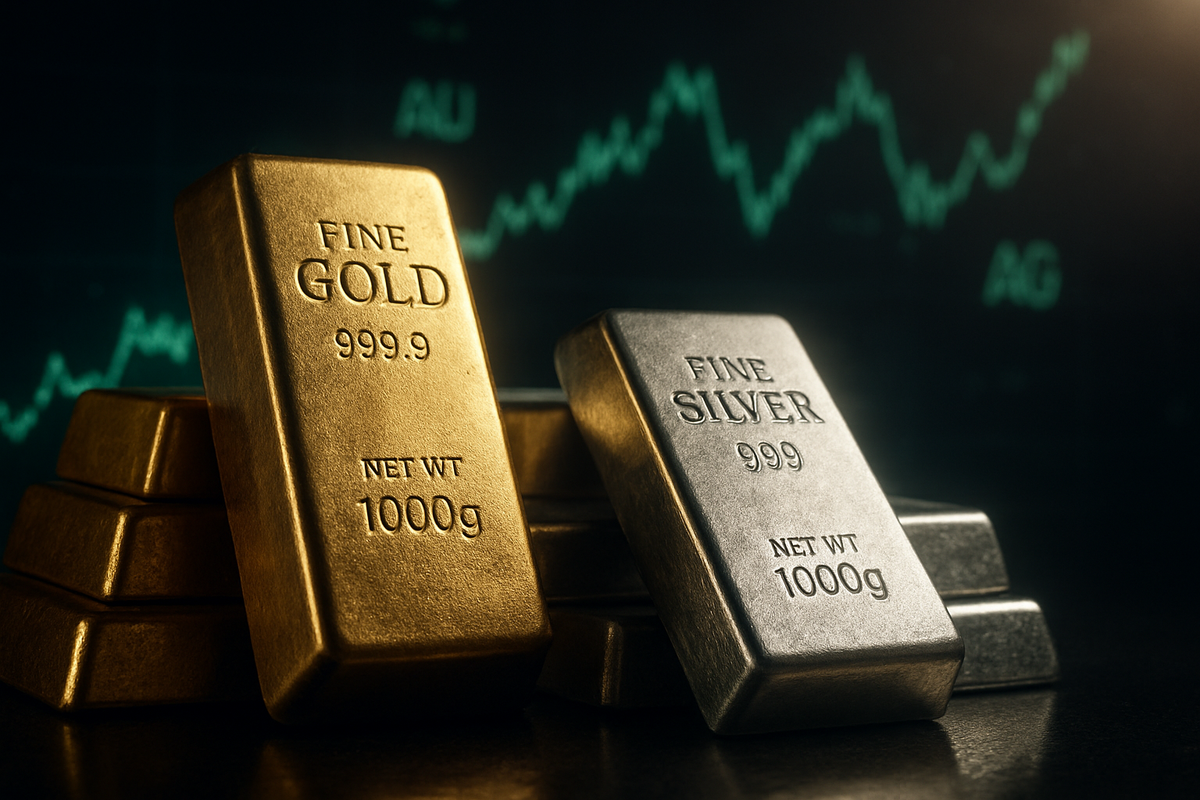
NEW YORK — The global financial landscape is undergoing a historic transformation as precious metals reach valuations once considered the realm of speculation. In a feverish week of trading ending December 23, 2025, gold prices have surged to an unprecedented peak of $4,497.55 per ounce, while silver has made a breathtaking run toward the $70 milestone, currently hovering at $69.44. This double-barreled rally marks a generational shift in capital allocation, driven by a perfect storm of a collapsing U.S. dollar, relentless core inflation, and a geopolitical environment that has seen the traditional safe-haven trade evolve into a mandatory institutional hedge.
According to recent reports from Reuters and Finimize, the current price action is not merely a short-term spike but a "price discovery" phase. As the U.S. dollar completes its worst annual performance since 2017—falling nearly 10% this year—investors have fled the greenback in favor of hard assets. This movement is further accelerated by persistent core inflation, which has remained stubbornly anchored at 2.7%, and a ballooning U.S. fiscal deficit that has led major financial institutions to reclassify gold from a cyclical hedge to a secular critical portfolio asset.
A Perfect Storm: The Path to $4,500 and $70
The ascent of gold and silver in 2025 has been a calculated climb rather than a sudden burst. The timeline of this rally began in earnest during the third quarter of the year, as markets began pricing in aggressive Federal Reserve rate cuts for 2026. Traders are currently betting on the federal funds rate falling as low as 3.00%, a move that has historically bolstered the appeal of non-yielding assets. The psychological barrier of $4,000 for gold was breached in October, and the momentum has only intensified as central banks—particularly those in the BRICS nations—accelerated their "de-dollarization" strategies, with collective purchases estimated to exceed 850 tons this year alone.
Geopolitical volatility has served as the primary catalyst for the most recent leg of the rally. The announcement of a U.S. naval blockade regarding sanctioned oil tankers moving in and out of Venezuela, combined with the lack of resolution in the Middle East and Eastern Europe, has created a "flight to safety" of historic proportions. Unlike previous cycles, the current demand is characterized by "firm conviction," with Reuters noting that investors are choosing to hold their positions through the festive year-end break rather than taking profits.
In the silver market, the story is even more dramatic. Finimize has labeled silver the "high-octane trade" of 2025, with the metal outperforming gold with year-to-date gains exceeding 120%. This is largely due to a structural supply-demand deficit that has persisted for five consecutive years. Silver's dual role as a monetary asset and a critical industrial material for the AI and green energy sectors has led to a "physical availability crisis," with lease rates on the London Bullion Market Association (LBMA) spiking to an extraordinary 39% in October.
Winners and Losers: The Corporate Divide
The surge in metal prices has created a stark divide in the corporate world. Among the primary beneficiaries are major gold producers like Newmont Corporation (NYSE: NEM) and Barrick Gold (NYSE: GOLD). Newmont, the world’s leading producer, reported record free cash flow reaching $4.5 billion in the first three quarters of 2025, while its stock has seen year-to-date returns of approximately 170%. Similarly, Agnico Eagle Mines (NYSE: AEM) and Kinross Gold (NYSE: KGC) have moved into net cash positions, allowing for aggressive dividend increases and share buybacks that were unthinkable just two years ago.
In the silver space, pure-play miners have seen spectacular returns. Pan American Silver (NYSE: PAAS) and First Majestic Silver (NYSE: AG) have both accelerated exploration projects as their margins expanded rapidly at $60+ silver. Wheaton Precious Metals (NYSE: WPM), a leading streaming company, has emerged as a top-tier winner; its business model allows it to purchase silver at fixed low costs (roughly $5.75/oz) and sell at the current $70 market rate, resulting in unprecedented profit margins. Interestingly, First Solar (NASDAQ: FSLR) has also outperformed its peers in the renewable sector. Unlike competitors who rely on silver-heavy crystalline silicon technology, First Solar’s thin-film modules use significantly less silver, giving them a distinct cost advantage as silver paste now accounts for 15% of the total cost of traditional solar panels.
Conversely, companies with high exposure to silver as an industrial input are facing significant headwinds. Tesla (NASDAQ: TSLA) has seen its manufacturing margins pressured as the cost of silver for EV electronics and next-generation battery R&D has climbed. While silver represents a small fraction of a vehicle's total cost, the $70 price tag adds roughly $100 in direct material costs per vehicle. Furthermore, high-performance computing and 5G infrastructure providers are struggling with inelastic demand for ultra-pure silver, which is essential for the high-frequency electrical connections required in AI servers.
Wider Significance and Historical Precedents
The current rally is fundamentally different from the 1980 or 2011 peaks. In those instances, prices were driven by speculative bubbles or short-lived inflationary scares. In 2025, the move is rooted in a structural shift in the global monetary system. The U.S. Geological Survey (USGS) recently added silver to its Critical Minerals List, a move that underscores the metal's importance to national security and the energy transition. This regulatory shift enables federal support for domestic mining but also signals that the era of "cheap silver" is likely over.
Furthermore, the market has entered a state of deep "backwardation," where immediate physical delivery of silver commands a premium of over $2.00 per ounce over future delivery. This indicates that industrial buyers are so desperate for physical metal to avoid factory shutdowns that they are willing to pay any price. This "short squeeze" is being exacerbated by geopolitical maneuvers, such as the Chinese Ministry of Commerce's recent announcement of strict export licensing for silver, set to begin in January 2026. Since China controls a vast portion of global refined silver supply, this move is being viewed as a strategic use of commodity dominance.
The Road Ahead: What Comes Next?
As we move into 2026, the short-term outlook remains bullish but volatile. The primary risk to the rally would be a sudden hawkish pivot by the Federal Reserve if inflation were to re-accelerate beyond 3%, though current data suggests a cooling trend. Investors should watch for the official implementation of Chinese export restrictions on January 1st, which could provide the final push needed to send silver well beyond the $70 mark.
In the long term, the market may see a massive wave of consolidation. Junior miners like Aris Mining (TSX: ARMN) and Coeur Mining (NYSE: CDE) are becoming attractive acquisition targets for majors looking to replenish their reserves at these new price floors. Additionally, the industrial sector will likely accelerate "thrifting" efforts—finding ways to use less silver or replace it with copper—though the technical limitations of such substitutions mean that demand will remain robust for the foreseeable future.
Final Wrap-Up: A New Era for Hard Assets
The record-breaking performance of gold and silver in late 2025 is a clear signal that the market is repricing risk in a post-globalization world. The key takeaways for investors are the transition of precious metals into critical industrial assets and the continued erosion of the U.S. dollar's dominance. Gold at $4,500 and silver at $70 are no longer "stretch goals" but the new benchmarks for a market grappling with fiscal instability and resource scarcity.
Moving forward, the focus will shift from price milestones to supply chain resilience. Investors should keep a close eye on central bank gold reserves and COMEX inventory levels, which have hit historic lows. As we enter 2026, the "debasement trade" appears to be the dominant theme, and for those holding physical bullion or high-quality mining equities, the outlook has never been brighter.
This content is intended for informational purposes only and is not financial advice.