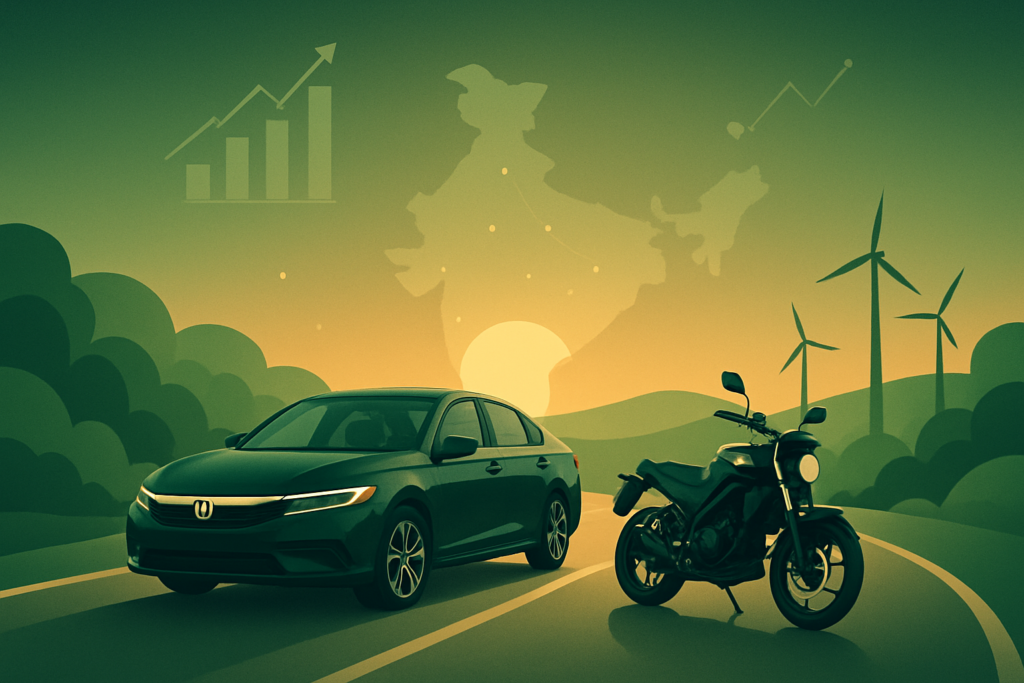
On March 12, 2026, Honda Motor Co., Ltd. (NYSE: HMC; TYO: 7267) sent shockwaves through the automotive industry by announcing the immediate cancellation of three major North American electric vehicle (EV) models originally slated for 2027 and 2028 production. This decision was accompanied by a significant revision of the company’s consolidated financial forecasts, marking one of the most aggressive strategic pivots in the company’s 78-year history.
Once considered a latecomer to the battery-electric race that was desperately trying to catch up, Honda has now officially signaled a "Pragmatic Realignment." By slashing its North American EV pipeline and reallocating billions in capital toward its high-margin hybrid lineup and the burgeoning Indian market, Honda is betting that the "EV-only" future is arriving much later than regulators and competitors anticipated. This article provides a deep-dive analysis of Honda’s new trajectory, the financial implications of its March 12 decision, and what this means for investors in the "New Mobility" era.
Historical Background
Honda’s identity has always been rooted in engineering independence. Founded in 1948 by Soichiro Honda and Takeo Fujisawa, the company began as a manufacturer of auxiliary engines for bicycles. By the 1960s, it had become the world’s largest motorcycle manufacturer, a title it holds to this day.
The company’s entry into the automotive world was defined by the CVCC (Compound Vortex Controlled Combustion) engine in the 1970s, which allowed the Honda Civic to meet stringent U.S. Clean Air Act standards without a catalytic converter. This "engineering first" culture led to the creation of iconic nameplates like the Accord and the launch of Acura—the first Japanese luxury brand—in 1986. Historically, Honda has avoided the massive cross-shareholding structures (keiretsu) common in Japan, preferring to maintain its autonomy, a trait that has both fueled its innovation and, at times, isolated it from the massive scale advantages of rivals like Toyota.
Business Model
Honda operates a diversified mobility business model built on four primary pillars:
- Automobiles (approx. 63% of revenue): Known for the Civic, CR-V, and Accord, this segment is currently undergoing a massive shift from internal combustion engines (ICE) to the e:HEV hybrid system.
- Motorcycles (approx. 19% of revenue): This is Honda’s "cash engine." With dominant market shares in Southeast Asia, India, and Brazil, the motorcycle segment typically accounts for over 50% of the group’s operating profit, providing the liquidity needed to fund automotive R&D.
- Power Products (Life Creation): This includes portable generators, outboard marine engines, and lawn equipment. Honda is currently electrifying this segment to align with global sustainability trends.
- Aero and Other: Centered on the HondaJet and GE Honda Aero Engines. While a small portion of revenue, it serves as a high-tech incubator for aerodynamics and materials science.
Stock Performance Overview
As of mid-March 2026, HMC stock has shown resilience despite the volatility of the broader auto sector.
- 1-Year Performance: HMC has outperformed the S&P 500 Auto Index, gaining 12% as investors cheered the company’s focus on high-margin hybrids during the global "EV winter" of 2025.
- 5-Year Performance: The stock has seen a 45% appreciation, largely driven by the record-breaking profitability of its motorcycle division and a disciplined buyback program.
- 10-Year Performance: On a decade-long horizon, Honda has lagged behind tech-centric rivals like Tesla but has remained a staple for value investors, offering a consistent dividend yield ranging between 3% and 4.5%.
The March 12 announcement led to a 4.2% jump in the stock price in Tokyo, as the market reacted positively to the "rationalization" of the EV strategy, which many feared would burn excessive cash.
Financial Performance
In the revised forecast issued on March 12, 2026, Honda adjusted its FY2026 outlook:
- Operating Profit: Revised upward by 8% to ¥1.25 trillion. While the cancellation of EV models led to a one-time impairment charge of ¥110 billion, the reduction in planned CAPEX for 2026-2027 more than offset the loss.
- Revenue: Expected to remain flat at ¥21.5 trillion, as lower EV volumes are replaced by higher-margin hybrid sales.
- Margins: Automotive operating margins, which had dipped to 4.1% during the peak of EV R&D spending in 2024, are now projected to recover to 5.8% by year-end 2026.
- Cash Flow: Free cash flow remains robust, supported by the motorcycle division, which continues to see 15%+ margins in emerging markets.
Leadership and Management
CEO Toshihiro Mibe, who took the helm in 2021, has transitioned from being an "EV Crusader" to a "Strategic Realist." Mibe, an engineer by training who previously led Honda R&D, initially pushed for a 100% EV/FCV (Fuel Cell Vehicle) lineup by 2040.
However, his recent shift emphasizes "The Bridge Strategy." Mibe’s leadership is now characterized by capital discipline. The March 12 decision is seen as his signature move—acknowledging that while the destination remains electric, the path must be profitable. CFO Shinji Aoyama has also been instrumental in redirecting investment toward India, identifying it as the "next North America" for Honda’s scale.
Products, Services, and Innovations
The centerpiece of Honda’s current innovation is the e:HEV hybrid system. Unlike traditional hybrids, the e:HEV uses the electric motor to drive the vehicle most of the time, with the engine acting as a generator.
- The "0 Series": While three models were cancelled, Honda is still proceeding with its flagship "0 Series" EV for 2026, which features a low-profile design and "thin" battery technology.
- Solid-State Batteries: Honda continues to operate a pilot production line for all-solid-state batteries, aiming for mid-to-late 2020s implementation.
- Hydrogen (FCEV): Honda remains one of the few global players (alongside Toyota and Hyundai) committed to hydrogen, recently launching the CR-V e:FCEV in select markets.
Competitive Landscape
Honda finds itself in a "pincer movement" between legacy giants and new entrants:
- Toyota (TM): The primary rival. Toyota’s early and aggressive bet on hybrids has paid off, and Honda is now effectively following the Toyota playbook to protect its margins.
- Tesla (TSLA): Tesla remains the cost leader in EVs. Honda’s decision to cancel models is an admission that it cannot currently match Tesla’s "Unboxed" manufacturing costs in the North American EV segment.
- Chinese OEMs (BYD, Xiaomi): In the ASEAN and Indian markets, Chinese manufacturers are Honda’s biggest threat. To counter this, Honda is leveraging its 6,000+ motorcycle touchpoints in India to build an EV charging and service ecosystem.
Industry and Market Trends
The "Great EV Slowdown" of 2025-2026 has redefined the industry. Consumer anxiety over charging infrastructure and high interest rates have cooled demand for $50,000+ EVs.
- The Hybrid Resurgence: Hybrids are no longer seen as "transitional" but as a long-term consumer preference.
- The Rise of India: India has surpassed Japan as the world's third-largest auto market. Honda’s pivot recognizes that the next 100 million middle-class consumers will come from Delhi and Mumbai, not Detroit or Munich.
Risks and Challenges
- Regulatory Backlash: In the U.S. and EU, strict emissions targets remain. If Honda’s hybrid pivot isn't "green" enough, it faces billions in potential fines.
- Software Lag: Honda continues to struggle with "Software-Defined Vehicle" (SDV) capabilities compared to Tesla and Chinese rivals.
- The "China Exit": Honda’s sales in China have cratered (down 25% year-on-year in 2025). The company must manage a painful downsizing of its Chinese joint ventures.
Opportunities and Catalysts
- India’s "Activa" Moment for Cars: Honda’s brand equity in India (via the Activa scooter) is unparalleled. If it can translate this to its upcoming "Elevate" SUV series and small EVs, it could dominate the market.
- Sony-Honda Mobility (Afeela): The joint venture with Sony provides a high-margin, tech-forward "halo" brand that could redefine Honda’s digital interior experience.
- Aero Profitability: The HondaJet Echelon, set for 2028 certification, could turn the Aero segment into a meaningful profit contributor.
Investor Sentiment and Analyst Coverage
Wall Street sentiment has shifted from "Neutral" to "Overweight" following the March 12 announcement.
- Goldman Sachs: Noted that Honda’s "return to capital discipline is a major de-risking event."
- Morgan Stanley: Highlighted the India strategy as a "hidden gem" in Honda’s valuation.
- Retail Sentiment: On platforms like Reddit and X, Honda is praised for its "reliability" and for "not forcing EVs," which resonates with a large segment of the North American car-buying public.
Regulatory, Policy, and Geopolitical Factors
- U.S. Inflation Reduction Act (IRA): Honda’s pivot to hybrids complicates its eligibility for some U.S. tax credits, which favor full EVs.
- India’s PLI Scheme: Honda is a major beneficiary of India’s Production-Linked Incentive (PLI) scheme for advanced chemistry cells and automotive manufacturing.
- Trade Tensions: As a Japanese company with a massive U.S. footprint, Honda is sensitive to any changes in the USMCA (United States-Mexico-Canada Agreement) rules regarding parts sourcing.
Conclusion
Honda’s decision on March 12, 2026, represents a "Great Recalibration." By sacrificing the optics of being an "EV leader" in the short term, the company is fortifying its balance sheet for the long haul.
For investors, Honda offers a unique profile: the stability and cash flow of a dominant global motorcycle business, combined with a high-margin hybrid automotive strategy and a high-growth "call option" on the Indian market. While the risks of lagging in software and pure-EV technology remain, Honda’s management has proven they are willing to make the hard choices necessary to preserve shareholder value. In the volatile race to 2030, Honda has chosen the path of the marathon runner over the sprinter—a move that may ultimately prove to be the most "electrifying" decision of all.
This content is intended for informational purposes only and is not financial advice.
Finterra Editorial Team
© 2026 Finterra Financial Media Group. All rights reserved.