Arguments for West Virginia v. B.P.J. & Little v Hecox were presented in front of the US Supreme Court today. The States revealed once again their strategy to reinterpret our Constitution and civil rights laws so that core principles of fairness and safety only apply to majority groups.
Sent on behalf of FLUX and Lambda Legal:
This press release features multimedia. View the full release here: https://www.businesswire.com/news/home/20260113366446/en/
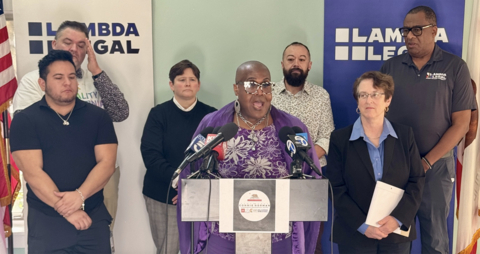
Dr. Toni Newman, Chair of Transcanwork, speaks as (left to right) Shane Stahl, Viscount Lucas Rojas, Stacy Dahl - LGBT Center, Dannie Cesena, Jenny Pizer and Shedrick Davis - Lambda Legal look on.
Today, LGBTQI+ leaders from across the State gathered to share their thoughts on the arguments made in the Supreme Court today in the West Virginia v. B.P.J. & Little v. Hecox Cases. Lambda Legal and FLUX International hosted the press conference at the Connie Norman Empowerment Center.
“Let me remind you that this is a case about ONE transgender girl in West Virginia. Of course, there are other transgender young people in West Virginia who would benefit enormously from participating in school teams with their friends. But only one has stepped forward. And our wins in this case in the lower courts just said that she alone gets to participate because the State has no valid reasons for excluding her. Still, West Virginia, like 26 other states and the Trump Administration, is determined to prevent her from playing sports with her friends,” said Jenny Pizer, Senior Counsel with Lambda Legal, which is co-counsel for BPJ (the trans girl who is the plaintiff in the second case argued today).
Dannie Ceseňa, Director of the CA LGBTQ Health and Human Services Network, emphasized, “Sports are more than just a game. We focus on overall mental health for all Californians we serve, and I know that many of them rely on sports for mental health and a sense of belonging. Denying any American the right to participate is just not acceptable.”
Dr. Toni Newman, the Chair of Transcanwork, leaned into that sentiment, stating, “The Constitution says all Americans, and I am an American, we ask for fairness without prejudice.”
Viscount Lucas Rojas, who is the Chief of Operations for FLUX and the Connie Norman Center, recalled his days as a youth athlete, saying, “Being able to be part of a team has helped me find belonging in my community and helped build my character. No one should be denied that right.”
“This Court has surprised us at times, and no one can predict with confidence how the Court will rule in these cases,” Pizer continued. “But the questions we heard today showed that the Justices know that changing long-settled sex discrimination doctrine could undermine arguments some of them seem to favor on behalf of cisgender girls and women, and probably for cisgender men and boys, too. That was a positive sign. Still, the stakes are high. Every one of us has a direct stake in being protected against discrimination based on other people’s notions about sex and gender. When the government acts to exclude a group of people from a public program or activity, it is supposed to have valid reasons – not generalized, unsubstantiated assumptions. West Virginia did not, and does not, have valid reasons for excluding BPJ from her team. If the Supreme Court allows her exclusion, even assuming the decision will be limited to school sports bans, it will be yet another worrisome signal for all of us about the state of our legal system.”
View source version on businesswire.com: https://www.businesswire.com/news/home/20260113366446/en/
If the Supreme Court allows the exclusion of Trans athlete Becky Pepper-Jackson in West Virginia, even assuming the decision will be limited to school sports bans, it will be yet another worrisome signal for all of us about the state of our legal system.
Contacts
Scottie Jeanette Madden
818.489.4341 mobile
scottiejeanette.madden@fluxidentity.org
Erik Wilson, Lambda Legal
213 .618.1443 mobile
ewilson@lambdalegal.org