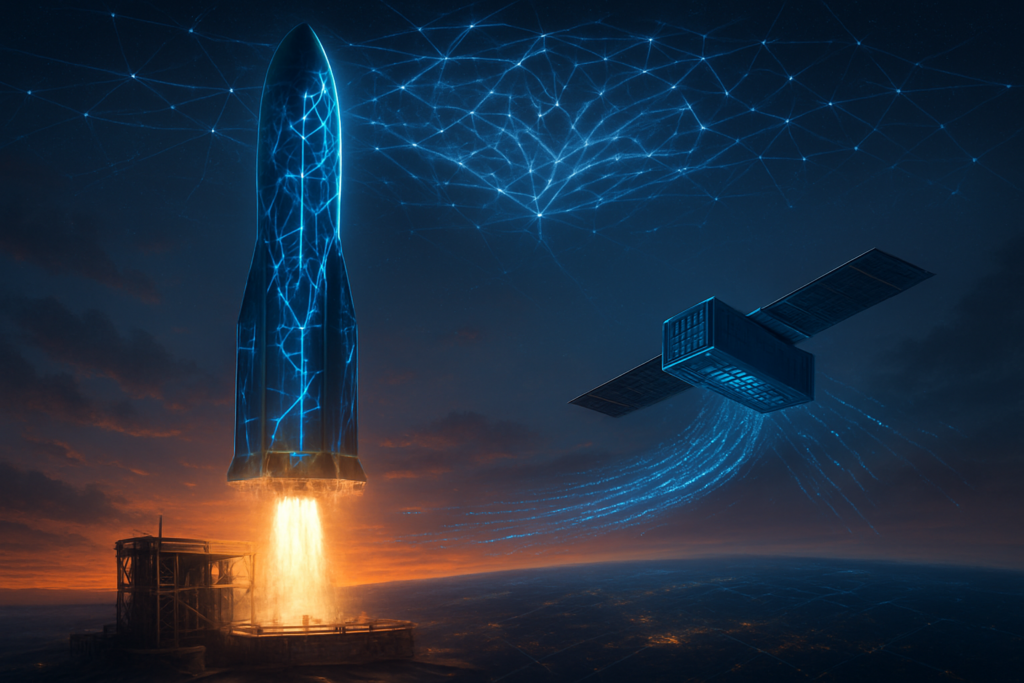
The global technology landscape is reeling from reports that Elon Musk is preparing to finalize a historic merger between his aerospace giant, SpaceX, and his artificial intelligence venture, xAI. According to leaked filings and sources close to the matter, the combined entity—tentatively referred to by insiders as the "Muskonomy" or "X-Space"—is targeting a staggering $1.5 trillion valuation ahead of a rumored Initial Public Offering (IPO) set for mid-June 2026. This consolidation would mark the birth of the world’s first vertically integrated "Orbital AI" conglomerate, uniting the massive data engine of the X platform (formerly Twitter) with the physical infrastructure of the Starlink satellite constellation and the cognitive capabilities of the Grok chatbot.
The immediate significance of this development cannot be overstated. By merging the most successful launch provider in history with a leading-edge AI lab, Musk is effectively attempting to move the "brain" of the internet from terrestrial data centers to the vacuum of space. If successful, the mid-June IPO—rumored to be scheduled for June 28, 2026—would not only be the largest in history, potentially raising over $50 billion, but would also redefine the concept of a "Hyperscaler" for the AI era.
The Technical Core: Starlink V3 as the "Orbital Brain"
At the heart of the merger is a radical shift in computing architecture. Technical specifications revealed in recent FCC filings suggest that SpaceX’s upcoming Starlink V3 constellation is being designed not just for communication, but as a distributed "Orbital Data Center." Each V3 satellite is reportedly equipped with dedicated "compute bays" capable of housing radiation-hardened AI chips. By leveraging the vacuum of space for passive radiative cooling and direct solar energy for power, the merged entity aims to bypass the massive cooling costs and power-grid constraints that are currently delaying terrestrial AI expansions for competitors.
Unlike previous satellite iterations, the V3 units utilize advanced laser mesh networking with a 4 Tbps backhaul, allowing the entire constellation to act as a single, distributed supercomputer. This enables "parallel inference," where a user’s query to the Grok chatbot can be processed across multiple orbital nodes simultaneously. This "satellite-edge" model significantly reduces latency for global users, as queries can be processed in orbit and beamed directly to Starlink terminals or AI-integrated mobile devices, bypassing several "hops" required in traditional ground-based fiber networks.
Industry experts and the AI research community are closely monitoring this "sovereign cloud" concept. While traditional AI labs like OpenAI and Google DeepMind rely on terrestrial data centers owned by Microsoft (NASDAQ: MSFT) or Alphabet (NASDAQ: GOOGL), the SpaceX-xAI merger creates a cloud that exists outside national land-use regulations and terrestrial power limitations. Former Tesla AI chief Andrej Karpathy has noted that this allows for an "AI-first hardware" stack, where the company owns everything from the silicon to the rocket that launches it, to the network that delivers it.
Disruption of the Hyperscaler Hierarchy
The strategic implications for the "Big Tech" status quo are profound. For years, the AI market has been dominated by a triad of cloud providers: Microsoft Azure, Google Cloud, and Amazon (NASDAQ: AMZN) Web Services. A merged SpaceX-xAI entity threatens to disrupt this hierarchy by offering a "Neocloud" that is geographically independent and vertically integrated. Analysts suggest that this merger would likely end existing collaborations, such as the Azure Space partnership, as Musk moves to bring all compute requirements in-house.
Major AI labs and tech giants now face a "space race" of a different kind. Reports indicate that OpenAI’s Sam Altman has already explored partnerships with emerging rocket firms like Stoke Space to secure a path to orbital compute. Meanwhile, companies with existing satellite interests, such as EchoStar (NASDAQ: SATS), have seen significant stock volatility as investors weigh the potential for a SpaceX monopoly on high-bandwidth, AI-enabled satellite services. The competitive advantage of having a real-time data engine like X feeding directly into an orbital compute mesh gives Grok a "temporal edge" that terrestrial models may struggle to match.
The merger also positions the new entity as a dominant force in defense and national security. In early 2026, the Pentagon's interest in the Starshield network has expanded to include "integrated AI maneuvers." By embedding Grok’s intelligence into the Starshield constellation, SpaceX provides the U.S. military with autonomous threat detection and real-time intelligence that operates independently of vulnerable ground-based infrastructure. This military-industrial synergy is a key driver behind the aggressive $1.5 trillion valuation target.
Sovereignty, Physical AI, and the Broader Landscape
Beyond the financial and technical metrics, the SpaceX-xAI merger represents a pivotal moment in the evolution of "Physical AI." While most AI developments have remained trapped in the digital realm of chat interfaces and image generation, the integration with SpaceX brings AI into the physical world of robotics and aerospace. This fits into the broader trend of "embodied intelligence," where AI is used to manage complex, real-world systems like Starship launches, Tesla (NASDAQ: TSLA) Optimus robots, and global satellite constellations.
However, the merger is not without its critics. Ethics researchers and space policy experts have raised concerns about the "sovereignty" of an orbital AI. If a trillion-dollar AI entity exists primarily in international waters (or rather, international space), it poses unique challenges for regulation, safety oversight, and data privacy. Comparisons have been made to the "Too Big to Fail" banks of 2008, with some arguing that a company controlling both the world’s primary satellite network and its most powerful AI could become a "Too Big to Regulate" entity.
Furthermore, the environmental impact of launching tens of thousands of "compute satellites" is a point of contention. While space-based AI avoids terrestrial power and water use, it contributes to orbital congestion and potential "Kessler Syndrome" risks. The AI landscape is shifting from a battle over algorithms to a battle over the "physical substrate" of intelligence, and Musk’s merger is the most aggressive move yet to secure that substrate.
The Horizon: Mars and Autonomous Earth
Looking forward, the near-term goal of the merger is to solidify the "X-Space" ecosystem ahead of the mid-June 2026 IPO. Expect to see the first "Grok-Native" Starlink terminals, which include localized NPU (Neural Processing Unit) hardware for seamless integration with the orbital cloud. In the longer term, this merger is the foundational step for Musk’s "Mars as a backup" strategy. An autonomous, AI-driven infrastructure is essential for colonizing a planet where the communication delay to Earth can be as high as 20 minutes; the AI must be able to manage life support, resource extraction, and navigation without human intervention.
Challenges remain, particularly regarding the radiation-hardening of high-performance GPUs. Current-generation AI chips are highly sensitive to cosmic rays, and while SpaceX has made strides in shielding, maintaining a high-uptime orbital supercomputer is a massive engineering hurdle. Predictions from financial experts suggest that if the merger successfully demonstrates "orbital inference" at scale by Q2 2026, the $1.5 trillion valuation might actually be conservative, potentially paving the way for the world’s first $5 trillion company by the end of the decade.
A New Chapter in AI History
The rumored merger between SpaceX and xAI is more than just a financial consolidation; it is a declaration of intent to own the future of intelligence and infrastructure. By linking the digital pulse of X with the physical reach of Starlink, Elon Musk is attempting to create a "closed-loop" ecosystem that handles data from ingestion to processing to delivery. As the mid-June 2026 IPO approaches, the market's appetite for this "all-in" bet on the future of humanity will be the ultimate test of Musk’s vision.
In the coming weeks, investors should watch for the formal transition of "K2" merger entities in Nevada and any updates regarding the Starlink V3 launch schedule. If these milestones align, the "Orbital Brain" will no longer be a matter of science fiction, but the backbone of the new global economy. The transition from terrestrial to celestial AI may well be remembered as the most significant shift in technology since the dawn of the internet itself.
This content is intended for informational purposes only and represents analysis of current AI developments.
TokenRing AI delivers enterprise-grade solutions for multi-agent AI workflow orchestration, AI-powered development tools, and seamless remote collaboration platforms.
For more information, visit https://www.tokenring.ai/.