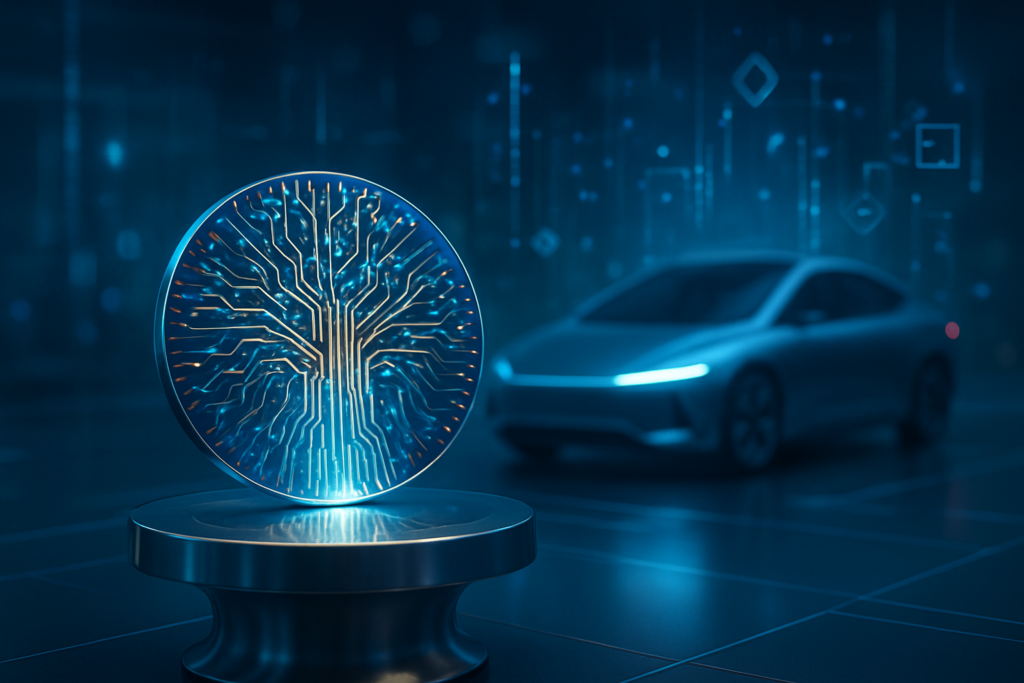
In a move that has sent shockwaves through the global semiconductor and automotive sectors, Samsung Electronics (KRX: 005930) and Tesla, Inc. (NASDAQ: TSLA) have finalized a monumental $16.5 billion agreement to manufacture the next generation of Full Self-Driving (FSD) chips. This multi-year deal, officially running through 2033, positions Samsung as the primary architect for Tesla’s "AI6" hardware—the silicon brain designed to transition the world’s most valuable automaker from driver assistance to true Level 4 unsupervised autonomy.
The partnership represents more than just a supply contract; it is a strategic realignment of the global tech supply chain. By leveraging Samsung’s cutting-edge 3nm and 2nm Gate-All-Around (GAA) transistor architecture, Tesla is securing the massive computational power required for its "world model" AI. For Samsung, the deal serves as a definitive validation of its foundry capabilities, proving that its domestic manufacturing in Taylor, Texas, can compete with the world’s most advanced fabrication facilities.
The GAA Breakthrough: Scaling the 60% Yield Wall
At the heart of this $16.5 billion deal is a significant technical triumph: Samsung’s stabilization of its 3nm GAA process. Unlike the traditional FinFET (Fin Field-Effect Transistor) technology used by competitors like TSMC (NYSE: TSM) for previous generations, GAA allows for more precise control over current flow, reducing power leakage and increasing efficiency. Reports from late 2025 indicate that Samsung has finally crossed the critical 60% yield threshold for its 3nm and 2nm-class nodes. This milestone is the industry-standard benchmark for profitable mass production, a figure that had eluded the company during the early, turbulent phases of its GAA rollout.
The "AI6" chip, the centerpiece of this collaboration, is expected to deliver a staggering 1,500 to 2,000 TOPS (Tera Operations Per Second). This represents a tenfold increase in compute performance over the current Hardware 4.0 systems. To achieve this, Samsung is employing its SF2A automotive-grade process, which integrates a Backside Power Delivery Network (BSPDN). This innovation moves the power routing to the rear of the wafer, significantly reducing voltage drops and allowing the chip to maintain peak performance without draining the vehicle's battery—a crucial factor for maintaining electric vehicle (EV) range during intensive autonomous driving tasks.
Industry experts have noted that Tesla engineers were reportedly given unprecedented access to "walk the line" at Samsung’s Taylor facility. This deep collaboration allowed Tesla to provide direct input on manufacturing optimizations, effectively co-engineering the production environment to suit the specific requirements of the AI6. This level of vertical integration is rare in the industry and highlights the shift toward custom silicon as the primary differentiator in the automotive race.
Shifting the Foundry Balance: Samsung’s Strategic Coup
This deal marks a pivotal shift in the ongoing "foundry wars." For years, TSMC has held a dominant grip on the high-end semiconductor market, serving as the sole manufacturer for many of the world’s most advanced chips. However, Tesla’s decision to move its most critical future hardware back to Samsung signals a desire to diversify its supply chain and mitigate the geopolitical risks associated with concentrated production in Taiwan. By utilizing the Taylor, Texas foundry, Tesla is creating a "domestic" silicon pipeline, located just miles from its Austin Gigafactory, which aligns perfectly with the incentives of the U.S. CHIPS Act.
For Samsung, securing Tesla as an anchor client for its 2nm GAA process is a major blow to TSMC’s perceived invincibility. It proves that Samsung’s bet on GAA architecture—a technology TSMC is only now transitioning toward for its 2nm nodes—has paid off. This successful partnership is already attracting interest from other Western "hyperscalers" like Qualcomm and AMD, who are looking for viable alternatives to TSMC’s capacity constraints. The $16.5 billion figure is seen by many as a floor; with Tesla’s plans for robotaxis and the Optimus humanoid robot, the total value of the partnership could eventually exceed $50 billion.
The competitive implications extend beyond the foundries to the chip designers themselves. By developing its own custom AI6 silicon with Samsung, Tesla is effectively bypassing traditional automotive chip suppliers. This move places immense pressure on companies like NVIDIA (NASDAQ: NVDA) and Mobileye to prove that their off-the-shelf autonomous solutions can compete with the hyper-optimized, vertically integrated stack that Tesla is building.
The Era of the Software-Defined Vehicle and Level 4 Autonomy
The Samsung-Tesla deal is a clear indicator that the automotive industry has entered the era of the "Software-Defined Vehicle" (SDV). In this new paradigm, the value of a car is determined less by its mechanical components and more by its digital capabilities. The AI6 chip provides the necessary "headroom" for Tesla to move away from dozens of small Electronic Control Units (ECUs) toward a centralized zonal architecture. This centralization allows a single powerful chip to control everything from powertrain management to infotainment and, most importantly, the complex neural networks required for Level 4 autonomy.
Level 4 autonomy—defined as the vehicle's ability to operate without human intervention in specific conditions—requires the car to run a "world model" in real-time. This involves simulating and predicting the movements of every object in a 360-degree field of vision simultaneously. The massive compute power provided by Samsung’s 3nm and 2nm GAA chips is the only way to process this data with the low latency required for safety. This milestone mirrors previous AI breakthroughs, such as the transition from CPU to GPU training for Large Language Models, where a hardware leap enabled a fundamental shift in software capability.
However, this transition is not without concerns. The increasing reliance on a single, highly complex chip raises questions about system redundancy and cybersecurity. If the "brain" of the car is compromised or suffers a hardware failure, the implications for a Level 4 vehicle are far more severe than in traditional cars. Furthermore, the environmental impact of manufacturing such advanced silicon remains a topic of debate, though the efficiency gains of the GAA architecture are intended to offset some of the energy demands of the AI itself.
Future Horizons: From Robotaxis to Humanoid Robots
Looking ahead, the implications of the AI6 chip extend far beyond the passenger car. Tesla has already indicated that the architecture of the AI6 will serve as the foundation for the "Optimus" Gen 3 humanoid robot. The spatial awareness, path planning, and object recognition required for a robot to navigate a human home or factory are nearly identical to the challenges faced by a self-driving car. This cross-platform utility ensures that the $16.5 billion investment will yield dividends across multiple industries.
In the near term, we can expect the first AI6-equipped vehicles to begin rolling off the assembly line in late 2026 or early 2027. These vehicles will likely serve as the vanguard for Tesla’s long-promised robotaxi fleet. The challenge remains in the regulatory environment, as hardware capability often outpaces legal frameworks. Experts predict that as the safety data from these next-gen chips begins to accumulate, the pressure on regulators to approve unsupervised autonomous driving will become irresistible.
A New Chapter in AI History
The $16.5 billion deal between Samsung and Tesla is a watershed moment in the history of artificial intelligence and transportation. It represents the successful marriage of advanced semiconductor manufacturing and frontier AI software. By successfully scaling the 3nm GAA process and reaching a 60% yield, Samsung has not only saved its foundry business but has also provided the hardware foundation for the next great leap in mobility.
As we move into 2026, the industry will be watching closely to see how quickly the Taylor facility can scale to meet Tesla’s insatiable demand. This partnership has set a new standard for how tech giants and automakers must collaborate to survive in an AI-driven world. The "Silicon Sovereignty" of the future will belong to those who can control the entire stack—from the gate of the transistor to the code of the autonomous drive.
This content is intended for informational purposes only and represents analysis of current AI developments.
TokenRing AI delivers enterprise-grade solutions for multi-agent AI workflow orchestration, AI-powered development tools, and seamless remote collaboration platforms.
For more information, visit https://www.tokenring.ai/.