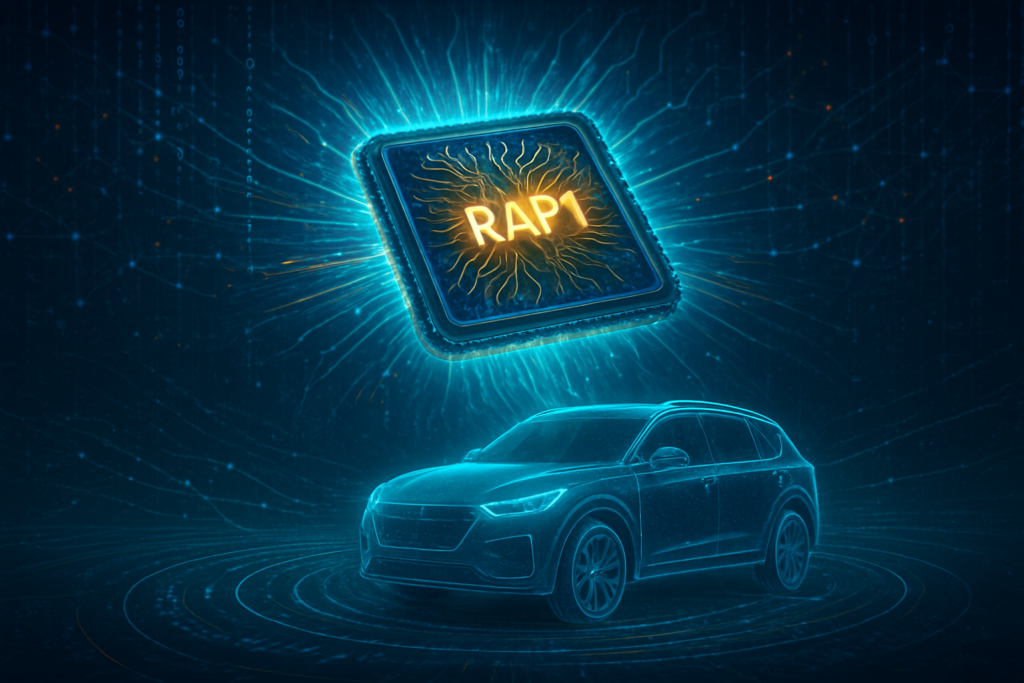
In a move that signals a decisive shift toward "silicon sovereignty," Rivian (NASDAQ: RIVN) has officially entered the custom semiconductor race with the unveiling of its RAP1 (Rivian Autonomy Processor 1) chip. Announced during the company’s inaugural Autonomy & AI Day on December 11, 2025, the RAP1 is designed to be the foundational engine for Level 4 (L4) autonomous driving and the centerpiece of Rivian’s next-generation Software-Defined Vehicle (SDV) architecture.
The introduction of the RAP1 marks the end of Rivian’s reliance on off-the-shelf processing solutions from traditional chipmakers. By designing its own silicon, Rivian joins an elite group of "full-stack" automotive companies—including Tesla (NASDAQ: TSLA) and several Chinese EV pioneers—that are vertically integrating hardware and software to unlock unprecedented levels of AI performance. This development is not merely a hardware upgrade; it is a strategic maneuver to control the entire intelligence stack of the vehicle, from the neural network architecture to the physical transistors that execute the code.
The Technical Core: 1,800 TOPS and the Large Driving Model
The RAP1 chip is a technical powerhouse, fabricated on a cutting-edge 5-nanometer (nm) process by TSMC (NYSE: TSM). At its heart, the chip utilizes the Armv9 architecture from Arm Holdings (NASDAQ: ARM), featuring 14 Arm Cortex-A720AE cores specifically optimized for automotive safety and high-performance computing. The most striking specification is its AI throughput: a single RAP1 chip delivers between 1,600 and 1,800 sparse INT8 TOPS (Trillion Operations Per Second). When integrated into Rivian’s new Autonomy Compute Module 3 (ACM3)—which utilizes dual RAP1 chips—the system achieves a combined performance that dwarfs the 254 TOPS of the previous-generation NVIDIA (NASDAQ: NVDA) DRIVE Orin platform.
Beyond raw power, the RAP1 is architected to run Rivian’s "Large Driving Model" (LDM), an end-to-end AI system trained on massive datasets of real-world driving behavior. Unlike traditional modular stacks that separate perception, planning, and control, the LDM uses a unified neural network to process over 5 billion pixels per second from a suite of LiDAR, imaging radar, and high-resolution cameras. To handle the massive data flow between chips, Rivian developed "RivLink," a proprietary low-latency interconnect that allows multiple RAP1 units to function as a single, cohesive processor. This hardware-software synergy allows for "Eyes-Off" highway driving, where the vehicle handles all aspects of the journey under specific conditions, moving beyond the driver-assist systems common in 2024 and 2025.
Reshaping the Competitive Landscape of Automotive AI
The launch of the RAP1 has immediate and profound implications for the broader tech and automotive sectors. For years, NVIDIA has been the dominant supplier of high-end automotive AI chips, but Rivian’s pivot illustrates a growing trend of major customers becoming competitors. By moving in-house, Rivian claims it can reduce its system costs by approximately 30% compared to purchasing third-party silicon. This cost efficiency is a critical component of Rivian’s new "Autonomy+" subscription model, which is priced at $49.99 per month—significantly undercutting the premium pricing of Tesla’s Full Self-Driving (FSD) software.
This development also intensifies the rivalry between Western EV makers and Chinese giants like Nio (NYSE: NIO) and Xpeng (NYSE: XPEV), both of whom have recently launched their own custom AI chips (the Shenji NX9031 and Turing AI chip, respectively). As of early 2026, the industry is bifurcating into two groups: those who design their own silicon and those who remain dependent on general-purpose chips from vendors like Qualcomm (NASDAQ: QCOM). Rivian’s move positions it firmly in the former camp, granting it the agility to push over-the-air (OTA) updates that are perfectly tuned to the underlying hardware, a strategic advantage that legacy automakers are still struggling to replicate.
Silicon Sovereignty and the Era of the Software-Defined Vehicle
The broader significance of the RAP1 lies in the realization of the Software-Defined Vehicle (SDV). In this paradigm, the vehicle is no longer a collection of mechanical parts with some added electronics; it is a high-performance computer on wheels where the hardware is a generic substrate for continuous AI innovation. Rivian’s zonal architecture collapses hundreds of independent Electronic Control Units (ECUs) into a unified system governed by the ACM3. This allows for deep vertical integration, enabling features like "Rivian Unified Intelligence" (RUI), which extends AI beyond driving to include sophisticated voice assistants and predictive maintenance that can diagnose mechanical issues before they occur.
However, this transition is not without its concerns. The move toward proprietary silicon and closed-loop AI ecosystems raises questions about long-term repairability and the "right to repair." As vehicles become more like smartphones, the reliance on a single manufacturer for both hardware and software updates could lead to planned obsolescence. Furthermore, the push for Level 4 autonomy brings renewed scrutiny to safety and regulatory frameworks. While Rivian’s "belt and suspenders" approach—using LiDAR and radar alongside cameras—is intended to provide a safety margin over vision-only systems, the industry still faces the monumental challenge of proving that AI can handle "edge cases" with greater reliability than a human driver.
The Road Ahead: R2 and the Future of Autonomous Mobility
Looking toward the near future, the first vehicles to feature the RAP1 chip and the ACM3 module will be the Rivian R2, scheduled for production in late 2026. This mid-sized SUV is expected to be the volume leader for Rivian, and the inclusion of L4-capable hardware at a more accessible price point could accelerate the mass adoption of autonomous technology. Experts predict that by 2027, Rivian may follow the lead of its Chinese competitors by licensing its RAP1 technology to other smaller automakers, potentially transforming the company into a Tier 1 technology supplier for the wider industry.
The long-term challenge for Rivian will be the continuous scaling of its AI models. As the Large Driving Model grows in complexity, the demand for even more compute power will inevitably lead to the development of a "RAP2" successor. Additionally, the integration of generative AI into the vehicle’s cabin—providing personalized, context-aware assistance—will require the RAP1 to balance driving tasks with high-level cognitive processing. The success of this endeavor will depend on Rivian’s ability to maintain its lead in silicon design while navigating the complex global supply chain for 5nm and 3nm semiconductors.
A Watershed Moment for the Automotive Industry
The unveiling of the RAP1 chip is a watershed moment that confirms the automotive industry has entered the age of AI. Rivian’s transition from a buyer of technology to a creator of silicon marks a coming-of-age for the company and a warning shot to the rest of the industry. By early 2026, the "Silicon Club"—comprising Tesla, Rivian, and the leading Chinese EV makers—has established a clear technological moat that legacy manufacturers will find increasingly difficult to cross.
As we move forward into 2026, the focus will shift from the specifications on a datasheet to the performance on the road. The coming months will be defined by how well the RAP1 handles the complexities of real-world environments and whether consumers are willing to embrace the "Eyes-Off" future that Rivian is promising. One thing is certain: the battle for the future of transportation is no longer being fought in the engine bay, but in the microscopic architecture of the silicon chip.
This content is intended for informational purposes only and represents analysis of current AI developments.
TokenRing AI delivers enterprise-grade solutions for multi-agent AI workflow orchestration, AI-powered development tools, and seamless remote collaboration platforms.
For more information, visit https://www.tokenring.ai/.