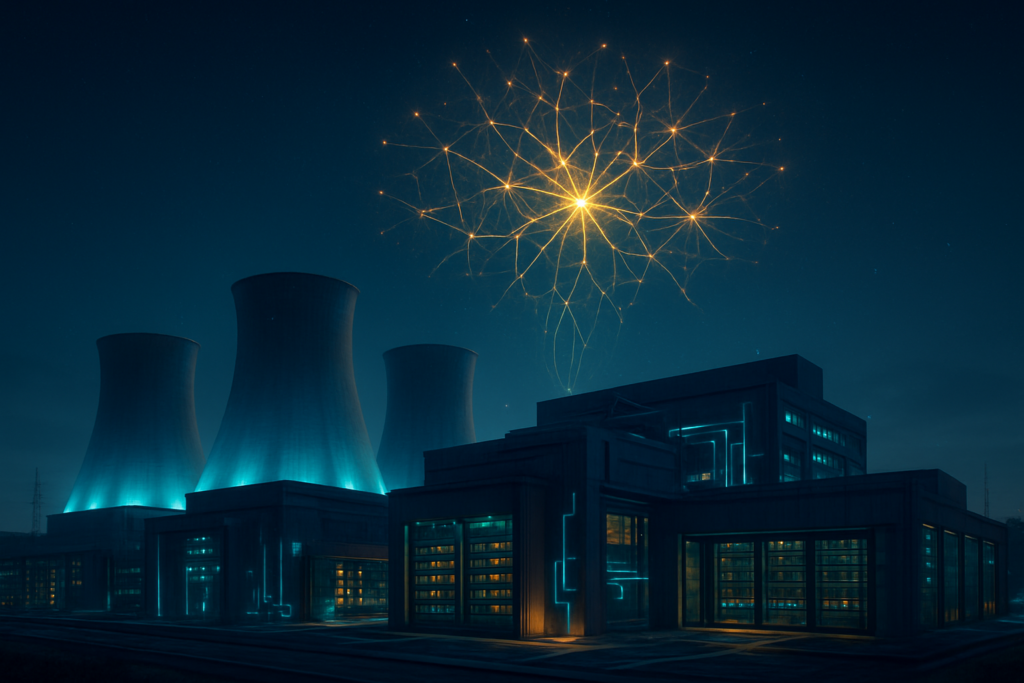
In a move that fundamentally redraws the map of the global AI infrastructure race, Meta Platforms (NASDAQ: META) has officially unveiled its "Prometheus" supercluster project, supported by a historic 6.6-gigawatt (GW) nuclear energy procurement strategy. Announced in early January 2026, the initiative marks the single largest corporate commitment to nuclear power in history, positioning Meta as a primary financier and consumer of the next generation of carbon-free energy. As the demand for artificial intelligence compute grows exponentially, Meta’s pivot toward advanced nuclear energy signifies a departure from traditional grid reliance, ensuring the company has the "firm" baseload power necessary to fuel its pursuit of artificial superintelligence (ASI).
The "Prometheus" project, anchored in a massive 1-gigawatt data center complex in New Albany, Ohio, represents the first of Meta’s "frontier-scale" training environments. By securing long-term power purchase agreements (PPAs) with pioneers like TerraPower and Oklo Inc. (NYSE: OKLO), alongside utility giants Vistra Corp. (NYSE: VST) and Constellation Energy (NASDAQ: CEG), Meta is effectively decoupling its AI growth from the constraints of an aging national electrical grid. This move is not merely a utility deal; it is a strategic fortification designed to power the next decade of Meta’s Llama models and beyond.
Technical Foundations: The Prometheus Architecture
The Prometheus supercluster is a technical marvel, operating at a scale previously thought unattainable for a single training environment. The cluster is designed to deliver 1 gigawatt of dedicated compute capacity, utilizing Meta’s most advanced hardware configuration to date. Central to this architecture is a heterogeneous mix of silicon: Meta has integrated NVIDIA (NASDAQ: NVDA) Blackwell GB200 systems and Advanced Micro Devices (NASDAQ: AMD) Instinct MI300 accelerators alongside its own custom-designed MTIA (Meta Training and Inference Accelerator) silicon. This "multi-vendor" strategy allows Meta to optimize specific layers of its neural networks on the most efficient hardware available, reducing both latency and energy overhead.
To manage the unprecedented heat generated by the Blackwell GPUs, which operate within Meta's "Catalina" rack architecture at roughly 140 kW per rack, the company has transitioned to air-assisted liquid cooling systems. This cooling innovation is essential for the Prometheus site in Ohio, which spans five massive, purpose-built data center buildings. Interestingly, to meet aggressive deployment timelines, Meta utilized high-durability, weatherproof modular structures to house initial compute units while permanent buildings were completed—a move that allowed training on early phases of the next-generation Llama 5 model to begin months ahead of schedule.
Industry experts have noted that Prometheus differs from previous superclusters like the AI Research SuperCluster (RSC) primarily in its energy density and "behind-the-meter" integration. Unlike previous iterations that relied on standard grid connections, Prometheus is designed to eventually draw power directly from nearby nuclear facilities. The AI research community has characterized the launch as a "paradigm shift," noting that the sheer 1-GW scale of a single cluster provides the memory bandwidth and interconnect speed required for the complex reasoning tasks associated with the transition from Large Language Models (LLMs) to Agentic AI and AGI.
The Nuclear Arms Race: Strategic Implications for Big Tech
The scale of Meta’s 6.6-GW nuclear strategy has sent shockwaves through the tech and energy sectors. By comparison, Microsoft (NASDAQ: MSFT) and its deal for the Crane Clean Energy Center at Three Mile Island, and Google’s (NASDAQ: GOOGL) partnership with Kairos Power, represent only a fraction of Meta’s total committed capacity. Meta’s strategy is three-pronged: it funds the "uprating" of existing nuclear plants owned by Vistra and Constellation, provides venture-scale backing for TerraPower’s Natrium advanced reactors, and supports the deployment of Oklo’s Aurora "Powerhouses."
This massive procurement gives Meta a distinct competitive advantage. As major AI labs face a "power wall"—where the availability of electricity becomes the primary bottleneck for training larger models—Meta has secured a decades-long runway of 24/7 carbon-free power. For utility companies like Vistra and Constellation, the deal transforms them into essential "AI infrastructure" plays. Following the announcement, shares of Oklo and Vistra surged by 18% and 15% respectively, as investors realized that the future of AI is inextricably linked to the resurgence of nuclear energy.
For startups and smaller AI labs, Meta’s move raises the barrier to entry for training frontier models. The ability to fund the construction of nuclear reactors to power data centers is a luxury only the trillion-dollar "Hyperscalers" can afford. This development likely accelerates a consolidation of the AI industry, where only a handful of companies possess the integrated stack—silicon, software, and energy—required to compete at the absolute frontier of machine intelligence.
Wider Significance: Decarbonization and the Grid Crisis
The Prometheus project sits at the intersection of two of the 21st century's greatest challenges: the race for advanced AI and the transition to a carbon-free economy. Meta’s commitment to nuclear energy is a pragmatic response to the reliability issues of solar and wind for data centers that require constant, high-load power. By investing in Small Modular Reactors (SMRs), Meta is not just buying electricity; it is catalyzing a new American industrial sector. TerraPower’s Natrium reactors, for instance, include a molten salt energy storage system that allows the plant to boost its output during peak training loads—a feature perfectly suited for the "bursty" nature of AI compute.
However, the move is not without controversy. Environmental advocates have raised concerns regarding the long lead times of SMR technology, with many of Meta’s contracted reactors not expected to come online until the early 2030s. There are also ongoing debates regarding the immediate carbon impact of keeping aging nuclear plants operational rather than decommissioning them in favor of newer renewables. Despite these concerns, Meta’s Chief Global Affairs Officer, Joel Kaplan, has argued that these deals are vital for "securing America’s position as a global leader in AI," framing the Prometheus project as a matter of national economic and technological security.
This milestone mirrors previous breakthroughs in industrial history, such as the early 20th-century steel mills building their own power plants. By internalizing its energy supply chain, Meta is signaling that AI is no longer just a software competition—it is a race of physical infrastructure, resource procurement, and engineering at a planetary scale.
Future Developments: Toward the 5-GW "Hyperion"
The Prometheus supercluster is only the beginning of Meta’s infrastructure roadmap. Looking toward 2028, the company has already teased plans for "Hyperion," a staggering 5-GW AI cluster that would require the equivalent energy output of five large-scale nuclear reactors. The success of the current deals with TerraPower and Oklo will serve as the blueprint for this next phase. In the near term, we can expect Meta to announce further "site-specific" nuclear integrations, possibly placing SMRs directly adjacent to data center campuses to bypass the public transmission grid entirely.
The development of "recycled fuel" technology by companies like Oklo remains a key area to watch. If Meta can successfully leverage reactors that run on spent nuclear fuel, it could solve two problems at once: providing clean energy for AI while addressing the long-standing issue of nuclear waste. Challenges remain, particularly regarding the Nuclear Regulatory Commission’s (NRC) licensing timelines for these new reactor designs. Experts predict that the speed of the "AI-Nuclear Nexus" will be determined as much by federal policy and regulatory reform as by technical engineering.
A New Epoch for Artificial Intelligence
Meta’s Prometheus project and its massive nuclear pivot represent a defining moment in the history of technology. By committing 6.6 GW of power to its AI ambitions, Meta has transitioned from a social media company into a cornerstone of the global energy and compute infrastructure. The key takeaway is clear: the path to Artificial Superintelligence is paved with uranium. Meta’s willingness to act as a venture-scale backer for the nuclear industry ensures that its "Prometheus" will have the fire it needs to reshape the digital world.
In the coming weeks and months, the industry will be watching for the first training benchmarks from the Prometheus cluster and for any regulatory hurdles that might face the TerraPower and Oklo deployments. As the AI-nuclear arms race intensifies, the boundaries between the digital and physical worlds continue to blur, ushering in an era where the limit of human intelligence is defined by the wattage of the atom.
This content is intended for informational purposes only and represents analysis of current AI developments.
TokenRing AI delivers enterprise-grade solutions for multi-agent AI workflow orchestration, AI-powered development tools, and seamless remote collaboration platforms.
For more information, visit https://www.tokenring.ai/.