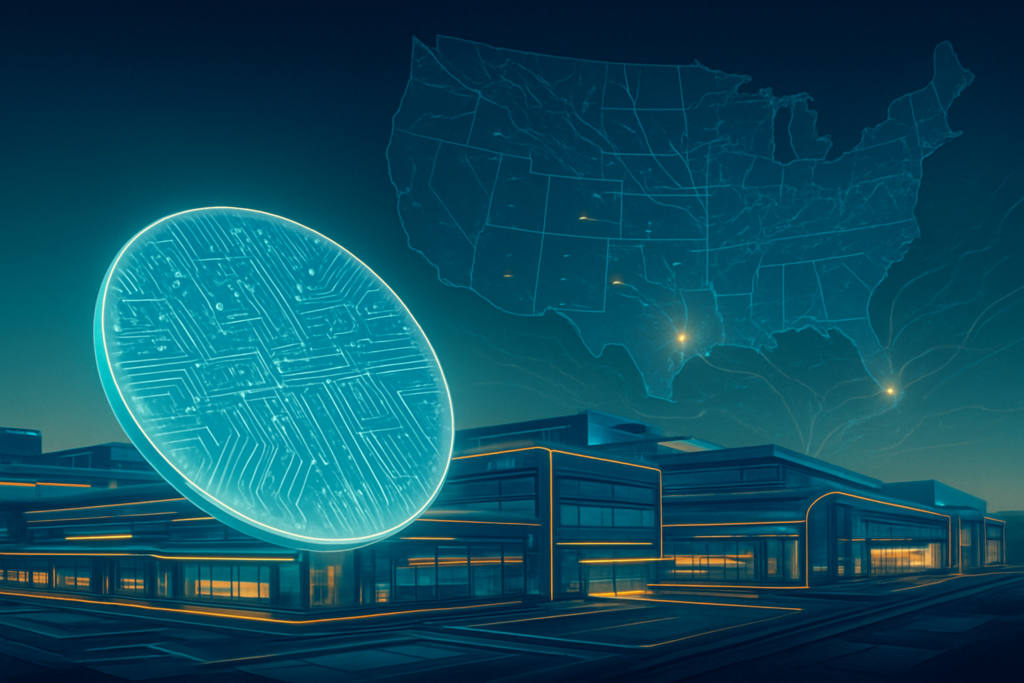
CHANDLER, AZ – As 2026 begins, the American semiconductor landscape has reached a historic turning point. The US CHIPS and Science Act has officially transitioned from a legislative ambition into its "delivery phase," marked by the commencement of high-volume manufacturing (HVM) at Intel’s (NASDAQ: INTC) Ocotillo campus. Fab 52 is now actively churning out 18A silicon, the world’s most advanced process node, signaling the return of leading-edge manufacturing to American soil.
This milestone is joined by a resurgence in the "Silicon Prairie," where Samsung (KRX: 005930) has successfully resumed operations and equipment installation at its Taylor, Texas facility following a strategic pause in mid-2025. Together, these developments represent a definitive victory for bipartisan manufacturing policies spanning the Biden and Trump administrations. By re-establishing the United States as a premier destination for logic chip fabrication, these facilities are significantly reducing the global "single point of failure" risk currently concentrated in East Asia.
Technical Dominance: The 18A Era and RibbonFET Innovation
Intel’s 18A (1.8nm-class) process represents more than just a nomenclature shift; it is the culmination of the company’s "Five Nodes in Four Years" roadmap. The technical breakthrough rests on two primary pillars: RibbonFET and PowerVia. RibbonFET is Intel’s first implementation of a Gate-All-Around (GAA) transistor architecture, which replaces the aging FinFET design to provide higher drive current and lower leakage. Complementing this is PowerVia, a pioneering backside power delivery system that moves power routing to the bottom of the wafer, decoupling it from signal lines. This separation drastically reduces voltage droop and allows for more efficient transistor packing.
Industry analysts and researchers have reacted with cautious optimism as yields for 18A are reported to have stabilized between 65% and 75%—a critical threshold for commercial profitability. Initial benchmark data suggests that 18A provides a 10% improvement in performance-per-watt over its predecessor, Intel 20A, and positions Intel to compete directly with TSMC’s (NYSE: TSM) upcoming 2nm production. The first consumer product utilizing this technology, the "Panther Lake" Core Ultra Series 3, began shipping to OEMs earlier this month, with a full retail launch scheduled for late January 2026.
Strategic Realignment: Foundry Competition and Corporate Winners
The move into HVM at Fab 52 is a massive boon for Intel Foundry, which has struggled to gain traction against the dominance of TSMC. In a landmark victory for the domestic ecosystem, Apple (NASDAQ: AAPL) has reportedly qualified Intel’s 18A for a subset of its future M-series silicon, intended for 2027 release. This marks the first time in over a decade that Apple has diversified its leading-edge manufacturing beyond Taiwan. Simultaneously, Microsoft (NASDAQ: MSFT) and Meta (NASDAQ: META) are expected to leverage the Arizona facility for their custom AI accelerators, seeking to bypass the multi-year queues at TSMC.
Samsung’s Taylor facility is also pivoting toward a high-stakes future. After pausing in 2025 to recalibrate its strategy, the Taylor fab has bypassed its original 4nm plans to focus exclusively on 2nm (SF2) production. While Samsung is currently in the equipment installation phase—moving in advanced High-NA EUV lithography machines—the Texas plant is positioned to be a primary alternative for companies like NVIDIA (NASDAQ: NVDA) and Qualcomm (NASDAQ: QCOM). The strategic advantage of having two viable leading-edge foundries on US soil cannot be overstated, as it provides domestic tech giants with unprecedented leverage in price negotiations and supply chain security.
Geopolitics and the "Silicon Heartland" Legacy
The activation of these fabs is the most tangible evidence yet of the CHIPS Act's success in "de-risking" the global technology supply chain. For years, the concentration of 90% of the world’s advanced logic chips in Taiwan was viewed by economists and defense officials as a critical vulnerability. The emergence of the "Silicon Desert" in Arizona and the "Silicon Prairie" in Texas creates a dual-hub system that insulates the US economy from potential regional conflicts or maritime disruptions in the Pacific.
This development also marks a shift in the broader AI landscape. As generative AI models grow in complexity, the demand for specialized, high-efficiency silicon has outpaced global capacity. By bringing 18A and 2nm production to domestic shores, the US is ensuring that the hardware necessary to run the next generation of AI—from LLMs to autonomous systems—is manufactured within its own borders. While concerns regarding the environmental impact of these massive "mega-fabs" and the local water requirements in arid regions like Arizona persist, the economic and security benefits have remained the primary drivers of federal support.
Future Horizons: The Roadmap to 14A and Beyond
Looking ahead, the semiconductor industry is already focused on the sub-2nm era. Intel has already begun pilot work on its 14A node, which is expected to enter the equipment-ready phase by 2027. Experts predict that the next two years will see an aggressive "talent war" as Intel, Samsung, and TSMC (at its own Arizona site) compete for the specialized workforce required to operate these complex facilities. The challenge of scaling a skilled workforce remains the most significant bottleneck for the continued expansion of the US semiconductor footprint.
Furthermore, we can expect a surge in "chiplet" technology, where components manufactured at different fabs are combined into a single package. This would allow a company to use Intel 18A for high-performance compute cores while using Samsung’s Taylor facility for specialized AI accelerators, all integrated into a domestic assembly process. The long-term goal of the Department of Commerce is to create a "closed-loop" ecosystem where design, fabrication, and advanced packaging all occur within North America.
A New Chapter for Global Technology
The successful ramp-up of Intel’s Fab 52 and the resumption of Samsung’s Taylor project represent more than just corporate achievements; they are the benchmarks of a new era in industrial policy. The US has officially broken the cycle of manufacturing offshoring that defined the previous three decades, proving that leading-edge silicon can be produced competitively in the West.
In the coming months, the focus will shift from construction and "first silicon" to yield optimization and customer onboarding. Watch for further announcements regarding TSMC’s Arizona progress and the potential for a "CHIPS 2" legislative package aimed at securing the supply of mature-node chips used in the automotive and medical sectors. For now, the successful delivery of 18A marks the beginning of the "Silicon Renaissance," a period that will likely define the technological and geopolitical landscape of the late 2020s.
This content is intended for informational purposes only and represents analysis of current AI and semiconductor developments as of January 15, 2026.
TokenRing AI delivers enterprise-grade solutions for multi-agent AI workflow orchestration, AI-powered development tools, and seamless remote collaboration platforms. For more information, visit https://www.tokenring.ai/.