Quarterly earnings results are a good time to check in on a company’s progress, especially compared to its peers in the same sector. Today we are looking at Nasdaq (NASDAQ: NDAQ) and the best and worst performers in the financial exchanges & data industry.
Financial exchanges and data providers operate trading platforms and sell market information. They enjoy relatively stable revenue from trading fees and subscriptions, increasing demand for data analytics, and expansion opportunities in emerging markets. Challenges include regulatory oversight of market structure, competition from alternative trading venues, and substantial technology investments needed to maintain low-latency trading infrastructure and data security.
The 10 financial exchanges & data stocks we track reported a satisfactory Q4. As a group, revenues beat analysts’ consensus estimates by 0.8%.
In light of this news, share prices of the companies have held steady as they are up 3% on average since the latest earnings results.
Nasdaq (NASDAQ: NDAQ)
Originally founded in 1971 as the world's first electronic stock market, Nasdaq (NASDAQ: NDAQ) operates global exchanges and provides technology, data, and corporate services that help companies, investors, and financial institutions navigate capital markets.
Nasdaq reported revenues of $1.39 billion, up 13.4% year on year. This print exceeded analysts’ expectations by 1.4%. Overall, it was a strong quarter for the company with a beat of analysts’ EPS estimates and a narrow beat of analysts’ revenue estimates.
Adena Friedman, Chair and CEO said, “It was an excellent year of execution for Nasdaq, as we achieved strong organic growth, accelerated innovation, and successfully delivered across our three strategic priorities: Integrate, Innovate, and Accelerate. For the first time, Nasdaq exceeded $5 billion in annual net revenue and $4 billion in annual Solutions revenue, reflecting the power, resilience and adaptability of our platform."
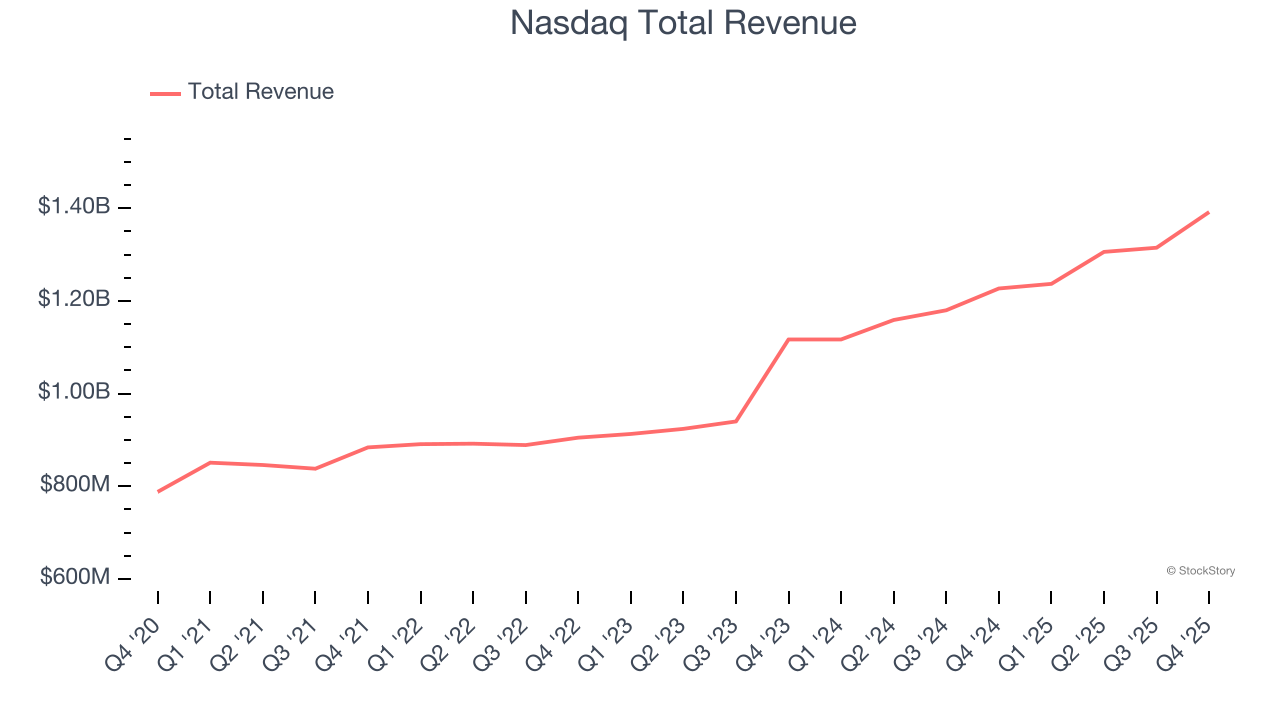
Nasdaq pulled off the fastest revenue growth of the whole group. Investor expectations, however, were likely higher than Wall Street’s published projections, leaving some wishing for even better results (analysts’ consensus estimates are those published by big banks and advisory firms, not the investors who make buy and sell decisions). The stock is down 10.9% since reporting and currently trades at $87.96.
Is now the time to buy Nasdaq? Access our full analysis of the earnings results here, it’s free.
Best Q4: Morningstar (NASDAQ: MORN)
Founded in 1984 by Joe Mansueto with just $80,000 in personal savings, Morningstar (NASDAQ: MORN) provides independent investment data, research, and analysis tools that help investors, advisors, and institutions make informed financial decisions.
Morningstar reported revenues of $641.1 million, up 8.5% year on year, outperforming analysts’ expectations by 2.2%. The business had an exceptional quarter with a beat of analysts’ EPS estimates and an impressive beat of analysts’ EBITDA estimates.
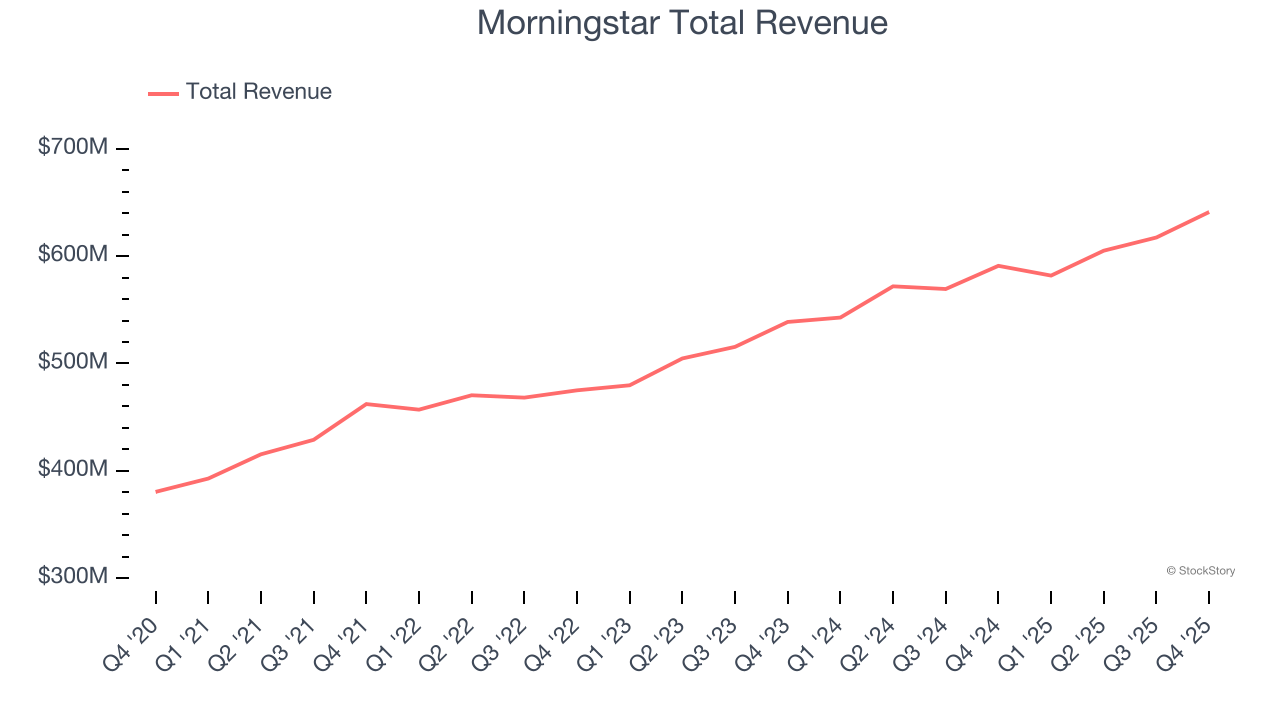
Morningstar delivered the biggest analyst estimates beat among its peers. The market seems happy with the results as the stock is up 18.4% since reporting. It currently trades at $182.40.
Is now the time to buy Morningstar? Access our full analysis of the earnings results here, it’s free.
Weakest Q4: S&P Global (NYSE: SPGI)
Tracing its roots back to 1860 when it published the first railroad industry manual, S&P Global (NYSE: SPGI) provides credit ratings, market intelligence, commodity data, automotive analytics, and financial indices that help investors and businesses make decisions.
S&P Global reported revenues of $3.92 billion, up 9% year on year, in line with analysts’ expectations. It was a slower quarter as it posted full-year EPS guidance meeting analysts’ expectations and a miss of analysts’ EPS estimates.
As expected, the stock is down 2.2% since the results and currently trades at $434.32.
Read our full analysis of S&P Global’s results here.
CME Group (NASDAQ: CME)
Born from the Chicago Mercantile Exchange founded in 1898 as a butter and egg trading venue, CME Group (NASDAQ: CME) operates the world's largest derivatives marketplace where traders can buy and sell futures and options contracts across interest rates, equities, currencies, commodities, and more.
CME Group reported revenues of $1.65 billion, up 8.1% year on year. This print met analysts’ expectations. Taking a step back, it was a mixed quarter as it failed to impress in some other areas of the business.
The stock is up 8.3% since reporting and currently trades at $317.51.
Read our full, actionable report on CME Group here, it’s free.
Moody's (NYSE: MCO)
Founded in 1900 during America's railroad boom when investors needed reliable information on bond risks, Moody's (NYSE: MCO) provides credit ratings, risk assessment tools, and analytical solutions that help organizations evaluate financial risks and make informed investment decisions.
Moody's reported revenues of $1.89 billion, up 13% year on year. This result topped analysts’ expectations by 1.6%. It was a strong quarter as it also produced full-year EPS guidance meeting analysts’ expectations and a beat of analysts’ EPS estimates.
The stock is up 12.9% since reporting and currently trades at $477.83.
Read our full, actionable report on Moody's here, it’s free.
the economy and the impact of potential tariffs and corporate tax cuts remain, leaving much uncertainty around 2025.
Want to invest in winners with rock-solid fundamentals? Check out our Hidden Gem Stocks and add them to your watchlist. These companies are poised for growth regardless of the political or macroeconomic climate.
StockStory’s analyst team — all seasoned professional investors — uses quantitative analysis and automation to deliver market-beating insights faster and with higher quality.