Digital ad verification company DoubleVerify (NYSE: DV) fell short of the market’s revenue expectations in Q4 CY2025, but sales rose 7.9% year on year to $205.6 million. On the other hand, the company expects next quarter’s revenue to be around $180 million, close to analysts’ estimates. Its GAAP profit of $0.18 per share was 10.3% above analysts’ consensus estimates.
Is now the time to buy DoubleVerify? Find out by accessing our full research report, it’s free.
DoubleVerify (DV) Q4 CY2025 Highlights:
- Revenue: $205.6 million vs analyst estimates of $208.8 million (7.9% year-on-year growth, 1.5% miss)
- EPS (GAAP): $0.18 vs analyst estimates of $0.16 (10.3% beat)
- Adjusted EBITDA: $77.8 million vs analyst estimates of $78.94 million (37.8% margin, 1.4% miss)
- Revenue Guidance for Q1 CY2026 is $180 million at the midpoint, roughly in line with what analysts were expecting
- EBITDA guidance for Q1 CY2026 is $50 million at the midpoint, in line with analyst expectations
- Operating Margin: 18.4%, down from 20.3% in the same quarter last year
- Free Cash Flow Margin: 30.2%, up from 20.7% in the previous quarter
- Market Capitalization: $1.54 billion
Company Overview
Using advanced analytics to evaluate over 17 billion digital ad transactions daily, DoubleVerify (NYSE: DV) provides AI-powered technology that verifies digital ads are viewable, fraud-free, brand-suitable, and displayed in the intended geographic location.
Revenue Growth
A company’s long-term performance is an indicator of its overall quality. Any business can have short-term success, but a top-tier one grows for years. Over the last five years, DoubleVerify grew its sales at a solid 25.1% compounded annual growth rate. Its growth beat the average software company and shows its offerings resonate with customers.
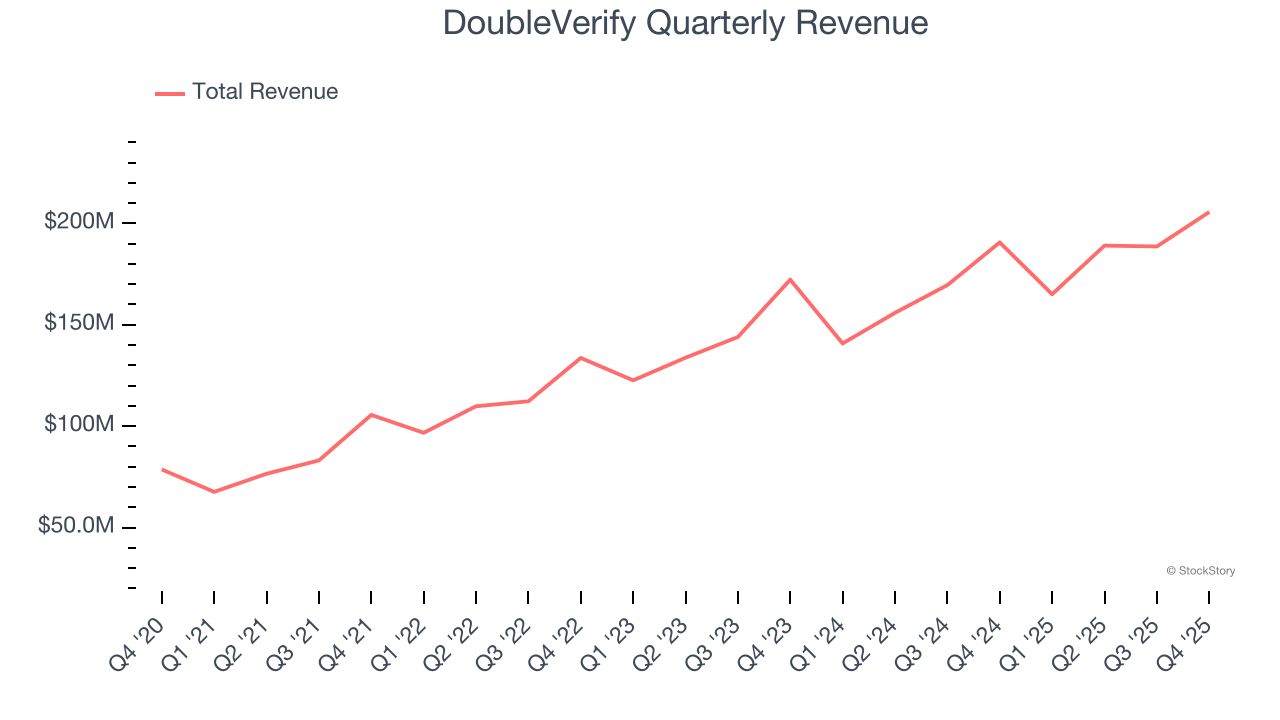
Long-term growth is the most important, but within software, a half-decade historical view may miss new innovations or demand cycles. DoubleVerify’s recent performance shows its demand has slowed as its annualized revenue growth of 14.3% over the last two years was below its five-year trend. We’re wary when companies in the sector see decelerations in revenue growth, as it could signal changing consumer tastes aided by low switching costs. 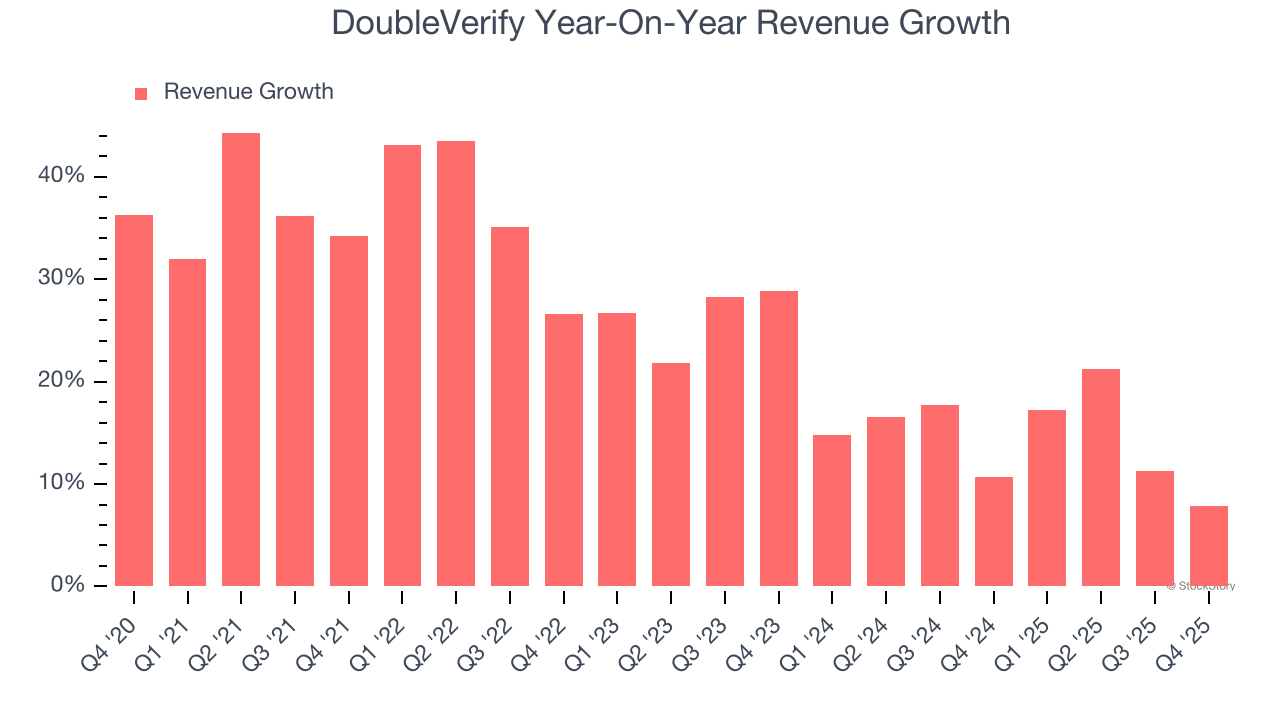
This quarter, DoubleVerify’s revenue grew by 7.9% year on year to $205.6 million, missing Wall Street’s estimates. Company management is currently guiding for a 9.1% year-on-year increase in sales next quarter.
Looking further ahead, sell-side analysts expect revenue to grow 10.5% over the next 12 months, a deceleration versus the last two years. This projection is underwhelming and suggests its products and services will face some demand challenges.
Software is eating the world and there is virtually no industry left that has been untouched by it. That drives increasing demand for tools helping software developers do their jobs, whether it be monitoring critical cloud infrastructure, integrating audio and video functionality, or ensuring smooth content streaming. Click here to access a free report on our 3 favorite stocks to play this generational megatrend.
Customer Acquisition Efficiency
The customer acquisition cost (CAC) payback period measures the months a company needs to recoup the money spent on acquiring a new customer. This metric helps assess how quickly a business can break even on its sales and marketing investments.
DoubleVerify’s recent customer acquisition efforts haven’t yielded returns as its CAC payback period was negative this quarter, meaning its incremental sales and marketing investments outpaced its revenue. The company’s inefficiency indicates it operates in a highly competitive environment where there is little differentiation between DoubleVerify’s products and its peers.
Key Takeaways from DoubleVerify’s Q4 Results
We struggled to find many positives in these results. Its revenue missed and its EBITDA fell slightly short of Wall Street’s estimates. Overall, this was a softer quarter. The stock traded down 2.2% to $9.32 immediately following the results.
DoubleVerify’s latest earnings report disappointed. One quarter doesn’t define a company’s quality, so let’s explore whether the stock is a buy at the current price. When making that decision, it’s important to consider its valuation, business qualities, as well as what has happened in the latest quarter. We cover that in our actionable full research report which you can read here (it’s free).