
Financial services giant State Street (NYSE: STT) reported Q4 CY2025 results beating Wall Street’s revenue expectations, with sales up 7.5% year on year to $3.67 billion. Its non-GAAP profit of $2.97 per share was 4.7% above analysts’ consensus estimates.
Is now the time to buy State Street? Find out by accessing our full research report, it’s free.
State Street (STT) Q4 CY2025 Highlights:
- Assets Under Management: $5.67 trillion vs analyst estimates of $5.57 trillion (20.1% year-on-year growth, 1.7% beat)
- Revenue: $3.67 billion vs analyst estimates of $3.61 billion (7.5% year-on-year growth, 1.5% beat)
- Pre-tax Profit: $918 million (25% margin)
- Adjusted EPS: $2.97 vs analyst estimates of $2.84 (4.7% beat)
- Market Capitalization: $38.07 billion
Company Overview
Dating back to 1792 when Boston's Long Wharf was the center of global shipping and trade, State Street (NYSE: STT) provides custody, investment management, and other financial services to institutional investors like pension funds, asset managers, and central banks worldwide.
Revenue Growth
A company’s long-term sales performance can indicate its overall quality. Even a bad business can shine for one or two quarters, but a top-tier one grows for years. Unfortunately, State Street’s 3.6% annualized revenue growth over the last five years was sluggish. This fell short of our benchmark for the financials sector and is a rough starting point for our analysis.
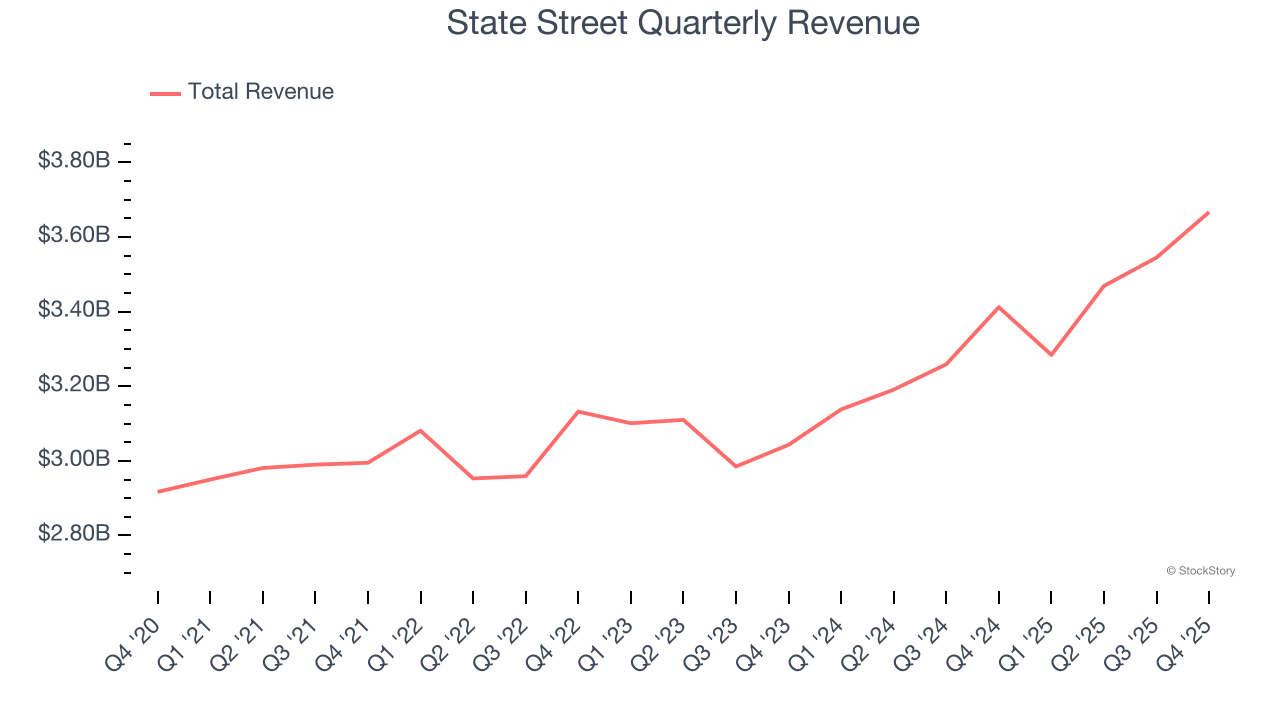
We at StockStory place the most emphasis on long-term growth, but within financials, a half-decade historical view may miss recent interest rate changes, market returns, and industry trends. State Street’s annualized revenue growth of 6.8% over the last two years is above its five-year trend, but we were still disappointed by the results. 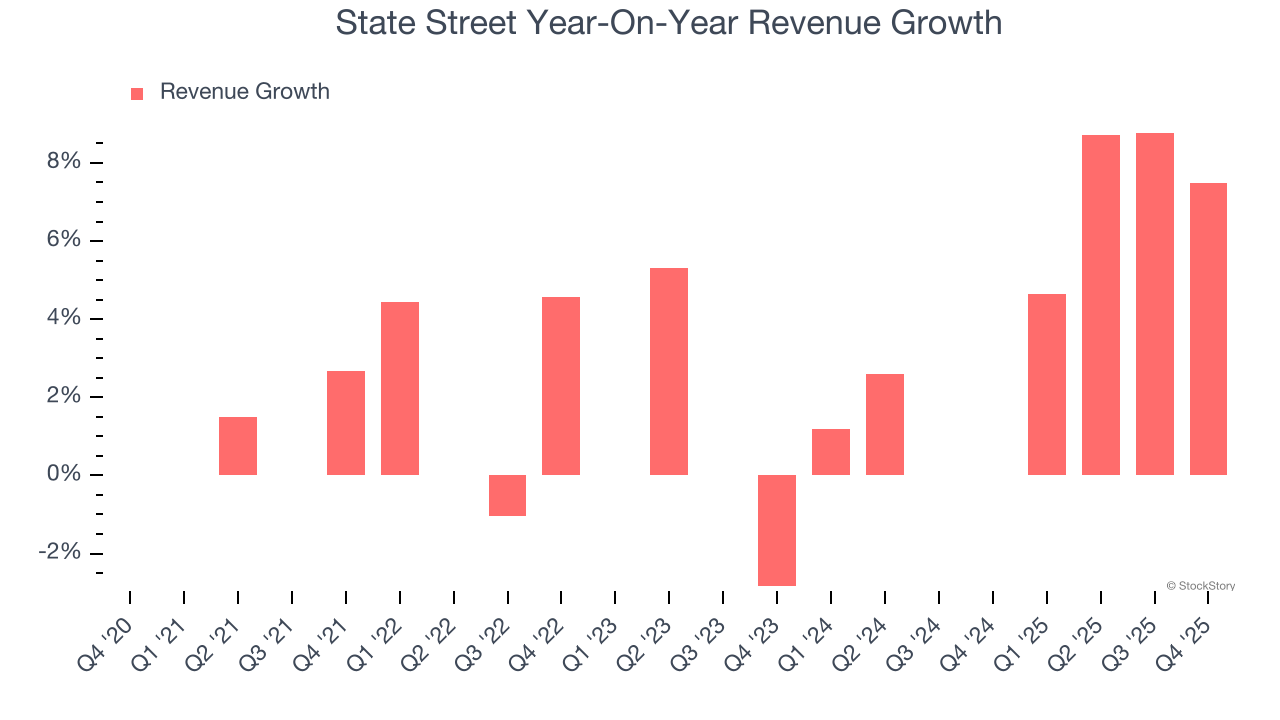 Note: Quarters not shown were determined to be outliers, impacted by outsized investment gains/losses that are not indicative of the recurring fundamentals of the business.
This quarter, State Street reported year-on-year revenue growth of 7.5%, and its $3.67 billion of revenue exceeded Wall Street’s estimates by 1.5%.
Software is eating the world and there is virtually no industry left that has been untouched by it. That drives increasing demand for tools helping software developers do their jobs, whether it be monitoring critical cloud infrastructure, integrating audio and video functionality, or ensuring smooth content streaming. Click here to access a free report on our 3 favorite stocks to play this generational megatrend.
Assets Under Management (AUM)
Assets Under Management (AUM) encompasses all client funds under a firm's investment management umbrella. The recurring fee structure on these assets provides consistent revenue generation, offering financial stability even during periods of poor investment returns, though sustained underperformance can impact future asset flows.
State Street’s AUM has grown at an annual rate of 11.1% over the last five years, a step above the broader financials industry and faster than its total revenue. When analyzing State Street’s AUM over the last two years, we can see that growth accelerated to 17.2% annually. Fundraising or short-term investment performance were net contributors for the company over this shorter period since assets grew faster than total revenue. Keep in mind that asset growth can be erratic and seasonal, so we don't rely on it too heavily for our business quality analysis.
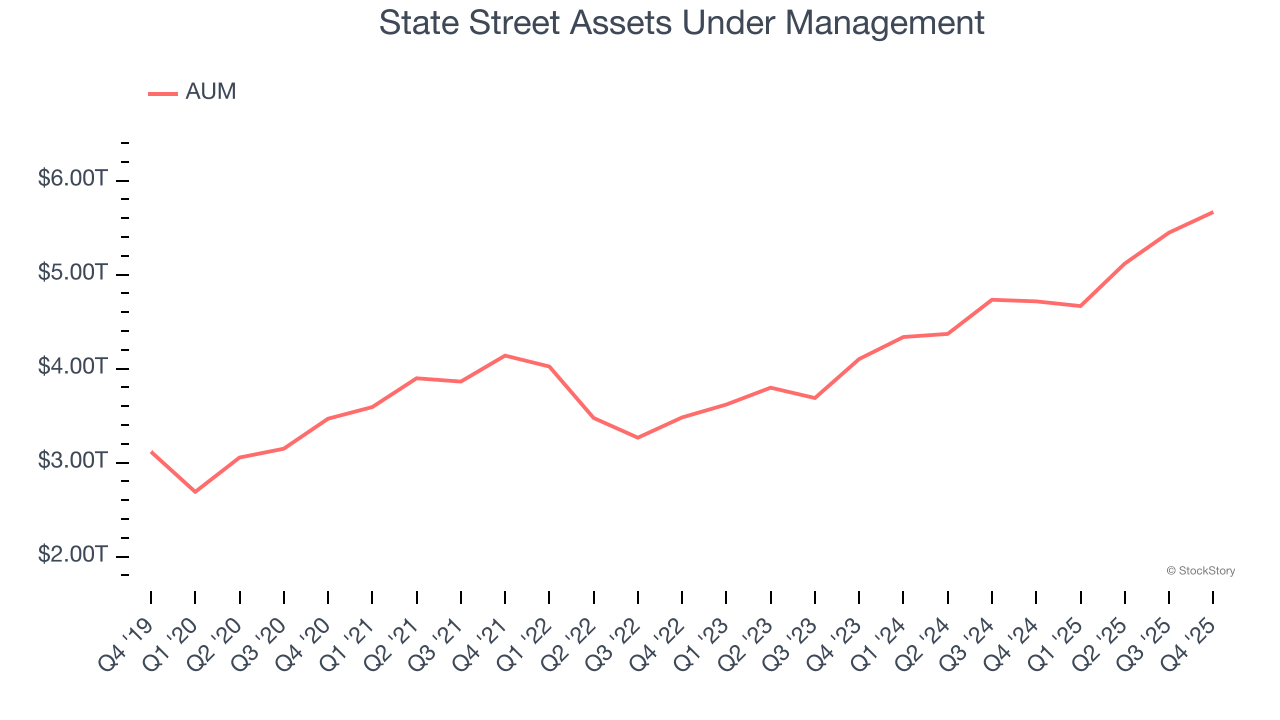
State Street’s AUM punched in at $5.67 trillion this quarter, beating analysts’ expectations by 1.7%. This print was 20.1% higher than the same quarter last year.
Key Takeaways from State Street’s Q4 Results
It was encouraging to see State Street beat analysts’ AUM expectations this quarter. We were also glad its EPS outperformed Wall Street’s estimates. Overall, this print had some key positives. Investors were likely hoping for more, and shares traded down 2% to $133.53 immediately after reporting.
Is State Street an attractive investment opportunity right now? We think that the latest quarter is only one piece of the longer-term business quality puzzle. Quality, when combined with valuation, can help determine if the stock is a buy. We cover that in our actionable full research report which you can read here (it’s free).