SolarEnergies.ca has released an updated 2026 guide for Nova Scotia homeowners considering solar power, with clearer numbers, fewer assumptions, and a stronger focus on avoiding costly mistakes. The update arrives at a time when many households are still seeing old rebate information online, even though the market has changed and buyers now face a very different financial setup than they did just a year ago.
The revised guide explains a simple reality. Solar in Nova Scotia still makes sense for many homes, but the path to savings now depends more on system design, current electricity costs, financing structure, and battery strategy than on large upfront rebates. That matters because many homeowners continue to search for programs that are no longer open, then build expectations around savings that do not match the current market.
SolarEnergies.ca said the updated guide was created to correct that confusion and give homeowners a more practical view of what solar looks like in 2026. Nova Scotia remains one of the more interesting residential solar markets in Canada because power prices are high, net metering is still active, and many homes can generate roughly 1,000 to 1,100 kilowatt-hours per installed kilowatt each year, depending on roof angle, shading, and site conditions. In plain terms, that means the province still has a solid case for rooftop solar even after major incentive changes.
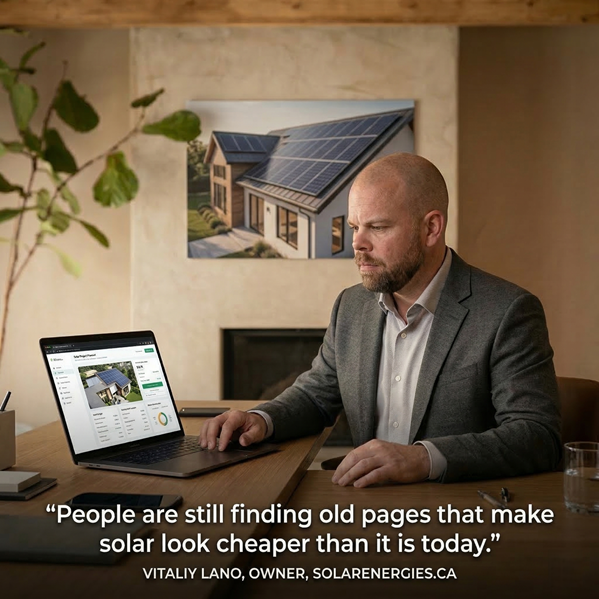
Vitaliy Lano, owner of SolarEnergies.ca, stated that too many homeowners are still reading articles built around rebate programs that are gone. “People are still finding old pages that make solar look cheaper than it is today,” Lano said. “That creates the wrong expectation right from the start. The goal of this update was to show the real math, the real financing questions, and the real situations where solar still works very well in Nova Scotia.”
The guide explains that the biggest freebies are over. Efficiency Nova Scotia’s SolarHomes rebate closed to new homeowner applications in 2025, and the federal Greener Homes programs are no longer available to new applicants. That shift means households now need to evaluate projects based on actual installed cost, estimated yearly production, financing terms, and long-term ownership plans instead of relying on grant-heavy marketing.
At the same time, the economics of self-generation remain hard to ignore. Nova Scotia Power’s residential electricity rate now sits at 18.187 cents per kilowatt-hour, along with a monthly base charge of $19.17. For homeowners already dealing with rising utility costs, solar offers a way to lock in part of the household’s electricity cost for decades. SolarEnergies.ca notes that a standard 9.17 kW system may cost about $23,000 to $29,000 in cash before financing, based on current market ranges, but the long-term math still deserves serious attention because annual bill savings can be meaningful.
Lano commented that the discussion around solar in 2026 has to be more honest than it was during the rebate era. “A lot of sales talk still leans on monthly payment language,” he said. “That is where people need to slow down. A low monthly number does not automatically mean a strong deal. The cash price, the financed price, the term length, any built-in lender fees, and the expected production all matter.”
That point sits at the center of the new SolarEnergies.ca calculator and planning framework. Rather than throwing out broad estimates, the calculator is designed to help homeowners start with the last 12 months of electricity bills, match system size to actual usage, estimate output using Nova Scotia-specific production ranges, and compare likely savings against current power rates. It also helps users review financing possibilities, including cash purchases, municipal financing in some cases, and private lending offers that may advertise zero-down or promotional 0% structures.
SolarEnergies.ca said one of the most misunderstood topics in the current market is zero-down financing. The site’s updated guide explains that zero-down does not mean free and that promotional financing often carries hidden costs on the merchant side, which can raise the financed project price even when the monthly payment looks attractive. That difference can leave homeowners comparing payment plans instead of comparing the full deal.
“Zero-down can still be useful,” Lano expressed. “For the right homeowner, it can make solar possible without draining savings. But the monthly payment cannot be the only thing on the page that gets attention. Buyers should always ask for the cash price and the full financed price side by side. That alone can stop a bad decision.”
The update also draws a sharper line between solar panels and battery storage. SolarEnergies.ca notes that standard grid-tied systems shut off during outages for safety, which means panels alone do not keep a fridge, internet router, or other essential loads running when the grid is down. That job belongs to battery storage. In 2026, battery incentives remain one of the few live areas of support in Nova Scotia, with the Home Battery Storage Rebate offering up to $2,500 and an additional $500 available for eligible households that enroll in Eco Shift.
Lano added that battery storage deserves a separate conversation instead of being folded into every quote by default. “A battery can make a lot of sense if outage backup matters or if the household wants more control over when energy is used,” he said. “But not every roof needs storage, and not every family needs the extra cost. Sometimes, solar only is the cleaner financial move. Sometimes the battery is exactly what makes the project worth doing. The math should decide that.”
The guide also speaks directly to fit. Homes with lower shading, workable roof space, and higher annual electricity use tend to have a stronger financial case. South-facing roofs usually perform best, though east- and west-facing surfaces can still work well with the right equipment. SolarEnergies.ca warns that shade from trees, chimneys, neighboring buildings, and complex roof shapes can change the economics fast, which is why the updated guide encourages homeowners to look past broad marketing claims and ask for site-specific numbers.
Another part of the new release focuses on contract questions. SolarEnergies.ca recommends that buyers ask every installer for the installed cash price, the full financed price, equipment and workmanship warranty details, early payoff conditions, utility approval responsibilities, and a realistic production estimate based on the actual roof. The site also points out that the cheapest quote is not always the best quote, especially if workmanship protection is weak or the installer lacks clear local experience.
According to SolarEnergies.ca, the wider message is not that solar suddenly stopped working in Nova Scotia after rebates closed. The message is that the market has matured. The easy money is gone, but the practical case remains for many households because electricity is expensive, net metering still works, and solar hardware continues to offer long service life with low maintenance.
Lano suggested that homeowners treat 2026 as a year for better questions, not panic. “This is still a good province for solar,” he said. “The key change is that buyers need cleaner information. A solid roof, a fair price, realistic production numbers, and clear financing terms can still turn into a very strong home upgrade. The people who take the time to check the math are usually the ones who feel best about the decision later.”
https://www.youtube.com/watch?v=BEgMdMU0iIw
For more information about solar energy in Nova Scotia and a free solar calculator, visit the company's website.
###
For more information about Solar Energies In Canada SEIC, contact the company here:
Solar Energies In Canada SEIC
Vitaliy Lano
2368680609
admin@solarenergies.ca