The "Greenland Framework," a diplomatic and strategic pivot announced by President Donald Trump at the World Economic Forum in Davos on January 21, 2026, has sent shockwaves through geopolitical prediction markets. After weeks of escalating tensions that some dubbed the "Arctic Missile Crisis," the market is now pricing in a sophisticated compromise: the transition from an outright purchase of the world's largest island to a "sovereign lease" model.
As of late January 2026, the probability of the United States establishing a permanent, sovereign-controlled presence in Greenland by the end of President Trump’s term has surged. Traders are no longer betting on a simple real estate transaction, but on a complex geopolitical architecture that integrates Greenland into the U.S. "Golden Dome" missile defense system. This shift has triggered record volume on platforms like Polymarket and Kalshi, as participants weigh the likelihood of a "Cyprus-style" arrangement over the next three years.
The Market: What's Being Predicted
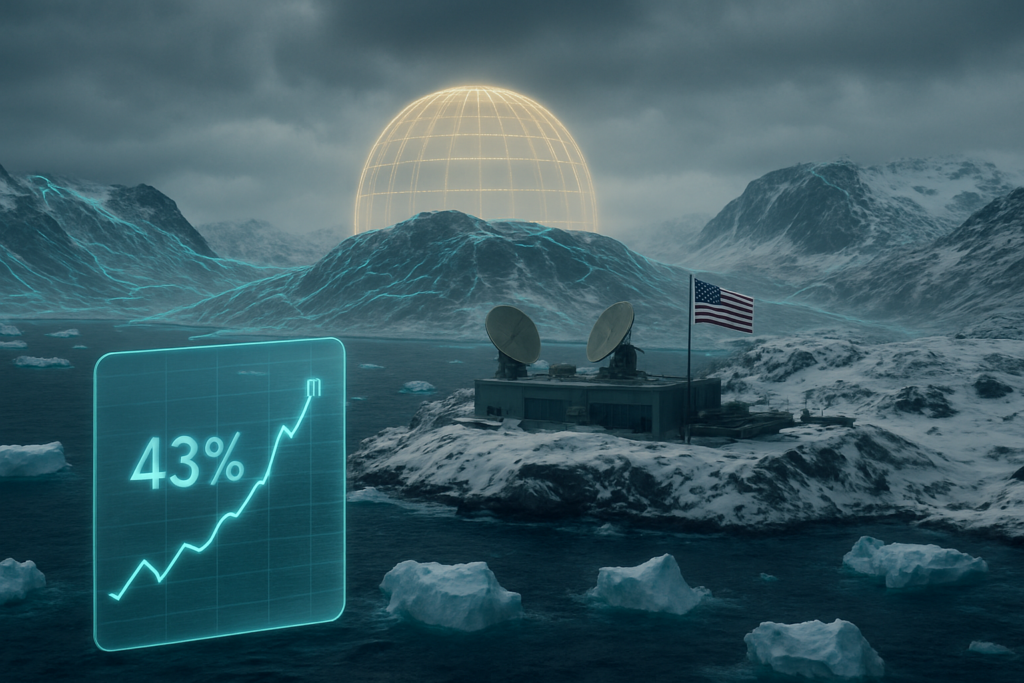
The betting landscape for Greenland has matured significantly since the initial rumors surfaced in 2019. On Polymarket, the contract for "U.S. acquires Greenland by end of 2026" is currently trading at 23%, a significant bounce from the 5% lows seen in mid-2025. However, the real action is in the longer-dated markets. On Kalshi, the probability that the U.S. will achieve "sovereign control or title" over any part of Greenland by January 20, 2029, is currently sitting at 43%, with total trading volume across Greenland-related contracts nearing $20 million.
The resolution criteria for these markets have become increasingly granular. Most platforms now specify that "acquisition" includes the creation of Sovereign Base Areas (SBAs), similar to the British territories in Cyprus. This allows for a "Yes" resolution even if the entire island does not become the 51st state, provided the U.S. gains "right, title, and ownership" over strategic zones like the Pituffik Space Base. This nuance has allowed liquidity to pool in "partial acquisition" contracts, which are currently trading at a premium compared to "total annexation" scenarios.
Why Traders Are Betting
The primary driver of the recent market volatility was the "Greenland Crisis" of early January 2026. After Deputy Chief of Staff Stephen Miller declined to rule out military force to secure the island’s rare earth minerals, odds for a forced takeover spiked to nearly 40%. However, the unveiling of the "Greenland Framework" in Davos provided a diplomatic off-ramp. Traders are now betting that the Trump administration will use 25% tariffs on European goods—specifically targeting Denmark and its neighbors—as a "hammer" to force a lease agreement rather than a sale.
Strategic interests are also fueling the "Yes" side of the trade. The integration of Greenland into the "Golden Dome" (NYSE: RTX)—the space-based missile defense constellation—is seen by defense analysts as a non-negotiable for the Pentagon. Reports of a $2 billion contract for SpaceX to provide a 600-satellite "Starshield" constellation have led traders to believe the U.S. will not stop until its "ground station bridge" in Greenland is fully secured. Additionally, the U.S. Commerce Department's $1.6 billion investment in companies like USA Rare Earth (Nasdaq:USAR) signals a long-term commitment to bypassing Chinese supply chains via Greenlandic minerals.
Broader Context and Implications
This market represents a new era for prediction platforms, which are increasingly being used as "real-time sentiment gauges" for high-stakes diplomacy. Unlike traditional polling, which struggled to capture the rapid shift in Danish-U.S. relations, prediction markets reacted instantly to the appointment of Louisiana Governor Jeff Landry as Special Envoy to Greenland. Traders recognized Landry’s "culinary diplomacy"—involving high-profile fishing trips with Greenlandic officials—as a signal that the administration was moving toward a "hearts and minds" economic approach rather than a purely hostile one.
The real-world implications are immense. If the "Greenland Framework" succeeds, it could redefine national sovereignty in the 21st century, creating a precedent for "sovereign economic zones" in strategic territories. For investors, the "Greenland Trade" has extended beyond the prediction platforms and into the equities of mining firms. Amaroq Minerals (TSXV:AMRQ), which holds significant gold and strategic metal assets in South Greenland, has seen its stock price correlate closely with the "Yes" odds on Kalshi, serving as a secondary vehicle for those looking to play the Greenland narrative.
What to Watch Next
The next major catalyst for this market will be the scheduled "Operation Arctic Endurance" in mid-2026. This NATO-led exercise will test the security of the proposed Greenland corridor and serve as a "stress test" for the Framework. If Denmark or the Greenlandic Parliament (Inatsisartut) refuses to participate or blocks U.S. access during the exercise, expect the "Yes" odds for 2026 to plummet while the "forced acquisition" contracts on decentralized platforms may see a speculative spike.
Traders should also monitor the U.S. Treasury’s implementation of the 10% "Greenland Tariff" on European nations currently opposing the Framework. Any signs of a "thaw" in Copenhagen—perhaps prompted by economic pressure or a promise of shared mineral royalties—would likely send the odds of a 2029 acquisition toward the 60% mark. Conversely, a victory for the opposition in the upcoming Danish snap elections could freeze negotiations entirely.
Bottom Line
The Greenland Framework has transformed a fringe geopolitical meme into a multi-million dollar prediction market. By moving from a "purchase" to a "sovereign lease" model, the Trump administration has created a viable, albeit controversial, path forward that markets are beginning to take seriously. The current 43% probability on Kalshi suggests that while the deal is far from certain, it is no longer being treated as a fantasy.
Prediction markets have proven to be an invaluable tool in this saga, cutting through the noise of diplomatic "no's" to reveal a underlying belief that economic and security pressures will eventually lead to a U.S. foothold on the island. As we move deeper into 2026, the intersection of missile defense, rare earth mining, and aggressive trade policy will continue to make the Greenland market one of the most volatile and closely watched sectors in the forecasting world.
This article is for informational purposes only and does not constitute financial or betting advice. Prediction market participation may be subject to legal restrictions in your jurisdiction.
PredictStreet focuses on covering the latest developments in prediction markets.
Visit the PredictStreet website at https://www.predictstreet.ai/.