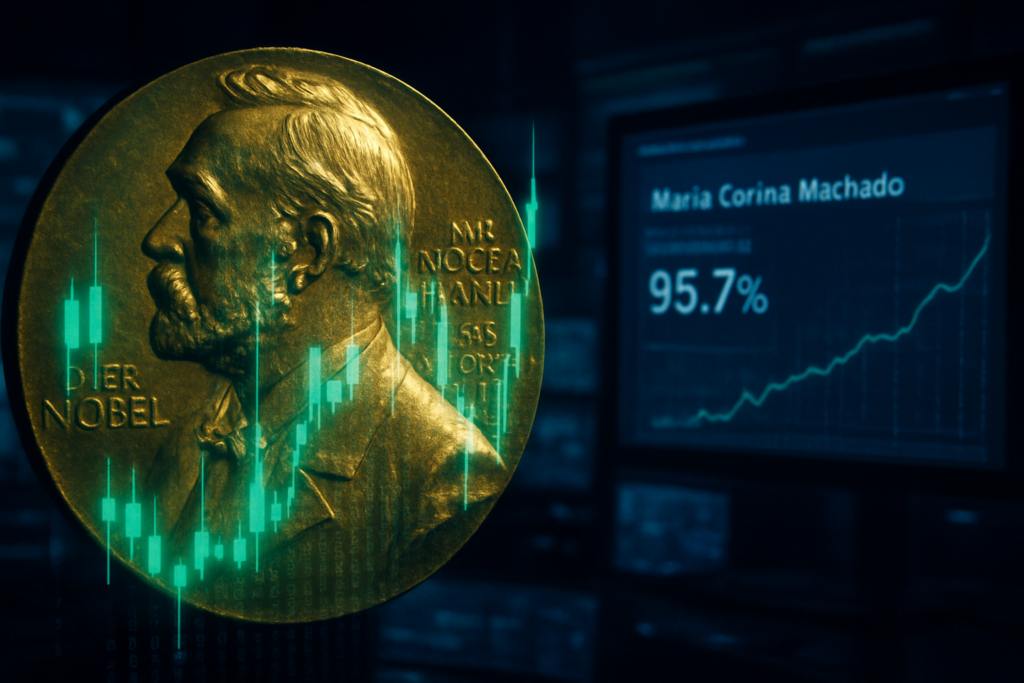
OSLO — In the high-stakes world of international diplomacy, few secrets are as guarded as the deliberations of the Norwegian Nobel Committee. For over a century, the 50-year seal of secrecy has been considered a fortress. But on October 10, 2025, that fortress was breached not by a disgruntled staffer or a whistleblower, but by the relentless, cold logic of a decentralized prediction market.
When Venezuelan opposition leader Maria Corina Machado was announced as the winner of the 2025 Nobel Peace Prize, the world cheered—but prediction market traders had already spent the last 11 hours celebrating. On Polymarket, the world’s largest decentralized forecasting platform, Machado’s odds had undergone a violent, vertical ascent from a 4% long-shot to a 73% mathematical certainty just hours before the official reveal in Oslo. This "leak in the odds" has since triggered a sweeping international investigation into systematic espionage and the future of institutional secrecy in the age of real-time information markets.
The Market: What's Being Predicted
The market in question, "Winner of the 2025 Nobel Peace Prize," was one of the most active non-political contracts on Polymarket last year. For months, the market was characterized by low liquidity and high uncertainty, with a diverse field of candidates including the UNRWA, the International Court of Justice, and several climate activists. Up until the evening of October 9, Machado was trading at roughly $0.04, reflecting a measly 4% probability of winning.
However, the dynamics shifted overnight. A massive influx of buy orders—totaling hundreds of thousands of dollars—slammed the Machado contract. Within a six-hour window, the price per share (which pays out $1.00 if the outcome is correct) soared to $0.73. Trading volume, which had been stagnant for weeks, exploded as "sharp" capital entered the fray. By the time the Norwegian Nobel Committee stepped to the podium, the market had effectively "solved" the prize, leaving the official announcement as a mere formality for the bettors who had already positioned themselves.
Why Traders Are Betting
The investigation, led by Nobel Institute Director Kristian Berg Harpviken, has focused on a handful of high-conviction accounts that "front-ran" the news. Forensic blockchain analysis highlighted three specific users: "6741", "dirtycup", and "GayPride".
Account "6741," a wallet created only 24 hours prior to the surge, successfully turned a $2,000 bet into a $53,000 windfall. "Dirtycup," a more established whale, wagered nearly $70,000 on Machado when her odds were still below 15%, netting a profit of approximately $30,000. These trades were characterized by "toxic flow"—informed capital that moves ahead of public news, usually indicating access to non-public information.
While initial theories suggested a human "mole" within the Nobel Committee or its small staff, the investigation's focus shifted toward "systematic espionage." Harpviken recently told Norwegian broadcaster TV2 that the Institute likely fell prey to a sophisticated cyber breach. Speculation has grown that intelligence agencies or sophisticated hacking groups may have intercepted digital communications between committee members, subsequently monetizing that intelligence on Polymarket to fund operations or simply capitalize on the breach.
Broader Context and Implications
This incident represents a watershed moment for prediction markets. Traditionally, markets like Polymarket have been praised for their ability to aggregate public information more efficiently than polls or pundits. However, the Nobel leak demonstrates that these markets can also act as "whistleblowers of information asymmetry," exposing when a secret has been compromised.
The real-world implications are unsettling for traditional institutions. If a century-old secret can be decoded by a few anonymous wallets on a blockchain, the "50-year seal" of the Nobel Committee becomes effectively obsolete. Critics argue that prediction markets incentivize corporate and political espionage, while proponents, including those at Alphabet Inc. (NASDAQ: GOOGL) and other data-centric firms, argue that these markets merely reflect an inevitable reality: in 2026, there is no such thing as a digital secret.
The Nobel Institute has since announced a partnership with cybersecurity firms, including CrowdStrike Holdings, Inc. (NASDAQ: CRWD), to conduct a comprehensive audit of their communication protocols. This move highlights how prediction markets are forcing a radical rethink of security even in non-financial sectors.
What to Watch Next
As we look toward the 2026 prize cycle, all eyes will be on the "Price of Secrecy." The Nobel Committee is expected to implement "analog-only" deliberation sessions, banning all digital devices from the room to prevent the kind of signal interception suspected in the Machado case.
Furthermore, the Norwegian government is under pressure to coordinate with international regulators to determine if this type of "insider trading" on decentralized platforms can be prosecuted. Watch for any movements from the U.S. Securities and Exchange Commission or European equivalents regarding the status of "event contracts" as financial instruments. If the investigation identifies the owners of the "6741" or "dirtycup" accounts, it could lead to a landmark legal battle over the definition of insider trading in a decentralized world.
Bottom Line
The 2025 Nobel Peace Prize leak investigation has proven that prediction markets are no longer just a hobby for political junkies—they are a disruptive force capable of shaking the foundations of global institutions. The Machado surge was a "smoking gun" that revealed a breach of secrecy before the victims even knew they had been compromised.
Ultimately, this saga tells us that prediction markets are the ultimate truth-seekers. They don't care about tradition, seals of secrecy, or diplomatic decorum; they only care about accuracy. While the Nobel Committee struggles to regain its aura of mystery, the traders on Polymarket are already looking toward the next "impossible" secret to solve. For now, the most likely outcome is that the era of the "big reveal" is over, replaced by a world where the odds always know the winner first.
This article is for informational purposes only and does not constitute financial or betting advice. Prediction market participation may be subject to legal restrictions in your jurisdiction.
PredictStreet focuses on covering the latest developments in prediction markets.
Visit the PredictStreet website at https://www.predictstreet.ai/.