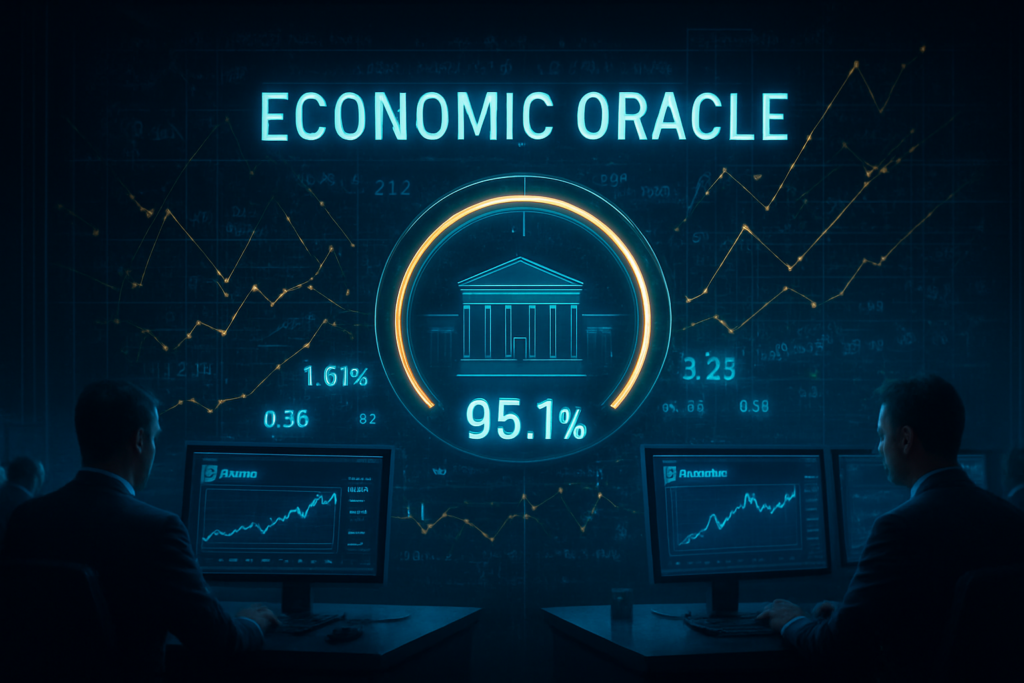
As the Federal Reserve prepares for its first policy meeting of 2026, the global financial community is looking past traditional bank reports and focusing on a new, high-speed indicator: the prediction market. With over $360 million in trading volume now concentrated on the outcome of the January 28, 2026, FOMC meeting, these platforms have officially transitioned from niche betting arenas into what analysts are calling the "Economic Oracle."
Current market odds reflect a decisive consensus, with a 95.1% probability of a "pause" (no change in rates). This surge in volume and precision comes as hedge funds and institutional liquidity providers increasingly use event-based contracts to hedge against macro volatility. What was once dismissed as a "prediction game" is now a cornerstone of the modern financial infrastructure, providing real-time sentiment that often moves faster than traditional federal funds futures.
The Market: What's Being Predicted
The focus of the financial world is currently fixed on the "Fed Decision: January 2026" contract. On Polymarket, the decentralized heavyweight, the specific contract for a rate hold has seen a staggering $363.2 million in volume. Parallel to this, Kalshi—the CFTC-regulated exchange—has reported record-breaking activity, with daily volumes across its broader suite of macro contracts reaching $465.9 million earlier this week.
Traders are specifically betting on whether the Federal Open Market Committee (FOMC) will maintain the current target rate, cut by 25 basis points, or—in a tail-risk scenario—hike rates. The liquidity in these markets has been bolstered by the entry of major brokerage firms. Interactive Brokers (NASDAQ: IBKR), through its ForecastEx exchange, has played a pivotal role by offering a "yield-enhanced" structure, where participants earn an incentive coupon of up to 3.8% APY on the collateral of their open positions, effectively paying institutions to provide market depth.
The resolution criteria are straightforward: the market settles based on the official target range announced by the Federal Reserve at the conclusion of its January 28 meeting. Unlike traditional futures, which can be influenced by complex technical factors and term premiums, these binary contracts offer a "pure" expression of probability that is easily digestible for retail and institutional investors alike.
Why Traders Are Betting
The primary driver behind the current 95% "pause" consensus is a string of "sticky" economic data released in early January. The December Consumer Price Index (CPI) printed at 2.7%, which, while stable, failed to show the continued cooling that would have justified a fourth consecutive rate cut. Furthermore, the January labor report showed non-farm payrolls adding a modest 66,000 jobs—just enough to keep the Fed from feeling an urgent need to stimulate the economy despite a 4.6% unemployment rate.
The shift in market participation is also a major factor. Quant-heavy firms such as Susquehanna International Group (SIG) and Jane Street have reportedly established dedicated prediction market desks. These "whales" are not just betting on the Fed; they are performing sophisticated arbitrage between prediction market odds and the CME Group (NASDAQ: CME) FedWatch tool.
"Prediction markets are the ultimate truth engine," says one macro trader at a Tier-1 hedge fund. "During the Fed's 10-day blackout period, when officials cannot speak to the press, these markets continue to process new global data in real-time. They aren't just predicting the Fed; they are front-running the Fed's own data-dependency."
Broader Context and Implications
The emergence of the "Economic Oracle" marks a significant evolution in how public sentiment and institutional risk are measured. Historically, economists relied on surveys or lagged data. Today, the aggregate wisdom of thousands of traders—incentivized by profit and loss—is proving to be a more accurate and responsive barometer.
This trend has not escaped the eyes of regulators. In New York, the introduction of the ORACLE Act (Oversight and Regulation of Activity for Contracts Linked to Events) represents a milestone in the legitimization of the sector. The bill seeks to formalize the role of these platforms as "utility" engines for the broader financial system, rather than mere gambling sites.
Furthermore, the historical accuracy of these markets has been impressive. Throughout 2025, prediction markets successfully anticipated three out of three Fed pivots several weeks before the mainstream financial press caught up. This "speed gap" is why firms like Saba Capital Management are now using Kalshi's CPI contracts to hedge inflation directly, bypassing the complexities of bond-market proxies.
What to Watch Next
As we approach the January 28 resolution date, volatility is expected to remain low unless a major exogenous shock occurs. However, the market will be hypersensitive to any "leaks" or late-breaking commentary from secondary Fed signals. The key milestone to watch is the January 22nd release of regional manufacturing data, which could provide a last-minute nudge to the odds if the numbers deviate significantly from expectations.
Beyond the January meeting, traders are already shifting their gaze to the March 2026 outlook. Early betting on Polymarket suggests a return to the "cut" cycle, with a 42% probability of a 25-basis-point reduction currently priced in for the spring. This suggests that while the market expects a pause now, the long-term trend remains focused on normalization.
Bottom Line
The $360 million volume in the January Fed market is more than just a number; it is a signal that the financial world has embraced a new way of processing information. Prediction markets have solved the "noise" problem of traditional forecasting by forcing participants to back their opinions with capital.
For the Federal Reserve, these markets provide a transparent feedback loop. For hedge funds, they provide a surgical tool for hedging macro risks. As we head toward the end of January, the 95% certainty of a pause serves as a testament to the efficiency of the "Economic Oracle." While the Fed remains data-dependent, the market has already crunched that data and rendered its verdict.
This article is for informational purposes only and does not constitute financial or betting advice. Prediction market participation may be subject to legal restrictions in your jurisdiction.
PredictStreet focuses on covering the latest developments in prediction markets.
Visit the PredictStreet website at https://www.predictstreet.ai/.