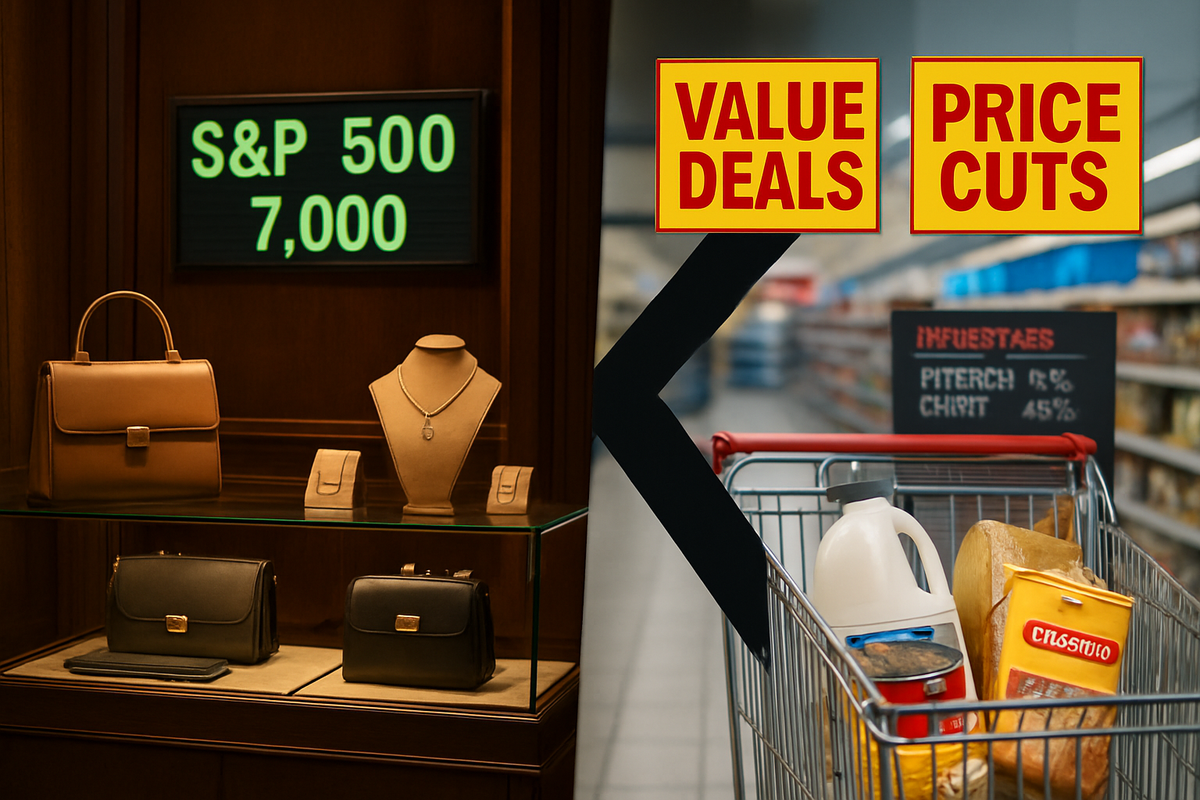
As of March 9, 2026, the United States economy presents a jarring paradox that has left analysts and policymakers grappling with a two-tiered reality. While the headline figures suggest a resilient national economy, the granular data reveals a widening "K-shaped" divide: a "wealth-effect" boom for the affluent and a "bunker-minded" survival mode for lower-income households. This divergence is no longer a temporary post-pandemic quirk but a structural fixture of the mid-2020s, driven by record-breaking asset prices on one hand and the crushing weight of cumulative inflation and high interest rates on the other.
The immediate implications are stark for the retail and financial sectors. High-end brands are reporting record margins as the top quintile of earners benefits from a surge in home equity and a stock market that recently crossed historic thresholds. Meanwhile, discount retailers and fast-food chains are engaged in a "race to the bottom" on pricing to capture the dwindling discretionary dollars of the bottom 40% of earners, who are now largely reliant on credit to sustain basic needs.
The Architecture of a Divided Economy
The current economic landscape was forged through a series of volatile events over the past 24 months. By early 2026, the S&P 500 index shattered the 7,000-point mark, a milestone that significantly bolstered the balance sheets of the "investing class." This "wealth effect"—where rising asset values encourage spending—has been further amplified by the One Big Beautiful Bill Act (OBBBA), a legislative package that included a significant increase in the State and Local Tax (SALT) deduction cap to $40,000. This policy shift effectively returned billions in disposable income to high-earning households in high-tax states, fueling a "Manhattan Renaissance" in luxury retail and experiential travel.
However, the lower arm of the "K" faced a much harsher climate. In April 2025, the "Liberation Day" tariffs—a 10% to 15% floor on all global imports—were enacted. Although the Supreme Court recently struck down certain provisions of these tariffs in February 2026, the "price tag shock" had already become embedded in the supply chain. For the average consumer, this meant that even as the rate of inflation slowed, the cumulative price increases since 2021 remained a permanent burden. By the start of March 2026, total U.S. credit card balances reached a staggering $1.27 trillion, with subprime delinquency rates hitting their highest levels since the 2008 financial crisis.
Winners and Losers in the Bifurcated Market
The stock market's performance reflects this divide, with a clear separation between companies catering to different ends of the income spectrum. LVMH Moët Hennessy Louis Vuitton (OTC: LVMUY) and Hermès International (OTC: HESAY) have emerged as dominant winners, reporting double-digit growth in their North American leather goods and jewelry segments. These firms have successfully maintained "pricing power," as their clientele remains largely insulated from the costs of borrowing. Similarly, JPMorgan Chase & Co. (NYSE: JPM) has seen its wealth management division's net income jump by 21%, capitalizing on the asset-heavy class’s need for sophisticated investment strategies in a high-yield environment.
In the travel sector, United Airlines Holdings, Inc. (NASDAQ: UAL) has pivoted aggressively toward premium cabin offerings, noting that high-income travelers are opting for luxury "experiential" trips despite higher ticket prices. On the other side of the ledger, Walmart Inc. (NYSE: WMT) has become a surprising winner, albeit for different reasons. Walmart’s recent earnings indicate a surge in "trade-down" traffic, as households earning over $100,000 migrate to the discounter for groceries to offset costs elsewhere. Conversely, McDonald’s Corporation (NYSE: MCD) has struggled to maintain its traditional base, leading to the late-2025 launch of a permanent "McValue" platform to lure back "exhausted" consumers who had begun to view fast food as an unaffordable luxury. Dollar General Corporation (NYSE: DG), while seeing high traffic, has cautioned that its core customer is increasingly "bunker-minded," purchasing only the barest essentials in smaller package sizes to make it to the next payday.
Broader Significance and Historical Precedents
This K-shaped recovery represents a significant departure from the "rising tide lifts all boats" philosophy that characterized late-20th-century economic expansions. It more closely mirrors the Gilded Age or the post-2008 recovery, but with the added complication of modern "tariff-flation." The ripple effects are being felt across the industry, particularly in the "middle-tier" of retail. Brands that occupy the space between value and luxury are finding themselves in a "no-man's land," unable to compete with Walmart on price or LVMH on prestige.
From a regulatory standpoint, the widening gap is putting pressure on the Federal Reserve. While the "wealth effect" keeps aggregate demand high—potentially keeping inflation sticky—the lower-income struggle suggests a need for rate cuts to ease the debt burden on households. This "dual-economy" dilemma makes the Fed’s job in 2026 exponentially more difficult than in previous cycles. Historically, such deep bifurcations have preceded shifts in consumer policy, and we are already seeing calls for renewed consumer subsidies or price controls on essential goods to mitigate the "tariff-shock" that hit in 2025.
The Path Ahead: Strategic Pivots and Scenarios
Looking toward the remainder of 2026, the short-term outlook depends heavily on the Federal Reserve's anticipated rate cuts in the second half of the year. If rates begin to descend, we may see the lower arm of the "K" stabilize as the "debt trap" of 21% to 27% credit card APRs begins to loosen. However, a "soft landing" for the lower-income consumer is far from guaranteed. Companies will likely continue to bifurcate their strategies: luxury brands will focus on "hyper-personalization" for the ultra-wealthy, while mass-market retailers will double down on private-label brands and aggressive discount loyalty programs.
A potential "black swan" for the upper arm of the recovery would be a significant correction in the housing market or a tech-led stock market retreat. Because the current spending at the top is so heavily reliant on the "wealth effect," any erosion in asset values could rapidly bridge the gap between the two arms—not by lifting the bottom, but by pulling the top down. Investors should also watch for the long-term impact of Gen Z's high delinquency rates, which could signal a generational shift in credit availability and consumption patterns.
Summary and Investor Outlook
The K-shaped recovery of 2026 is a tale of two Americas. For the affluent, it is an era of unprecedented wealth accumulation and "liberated" spending, supported by a booming stock market and favorable tax changes. For the lower-to-middle income brackets, it is a period of cumulative exhaustion, where the buffer of pandemic-era savings has vanished, replaced by high-interest debt and the residual sting of 2025’s trade policies.
Moving forward, the market will likely remain fragmented. Investors should prioritize companies with either absolute pricing power (luxury) or those that are best-in-class at delivering essential value (discount leaders). The key metrics to watch in the coming months will be credit card delinquency trends, particularly among prime borrowers, and the Fed’s appetite for interest rate relief. While the S&P 500 at 7,000 suggests a golden era, the fractures beneath the surface indicate that the consumer economy is walking a very thin line.
This content is intended for informational purposes only and is not financial advice.