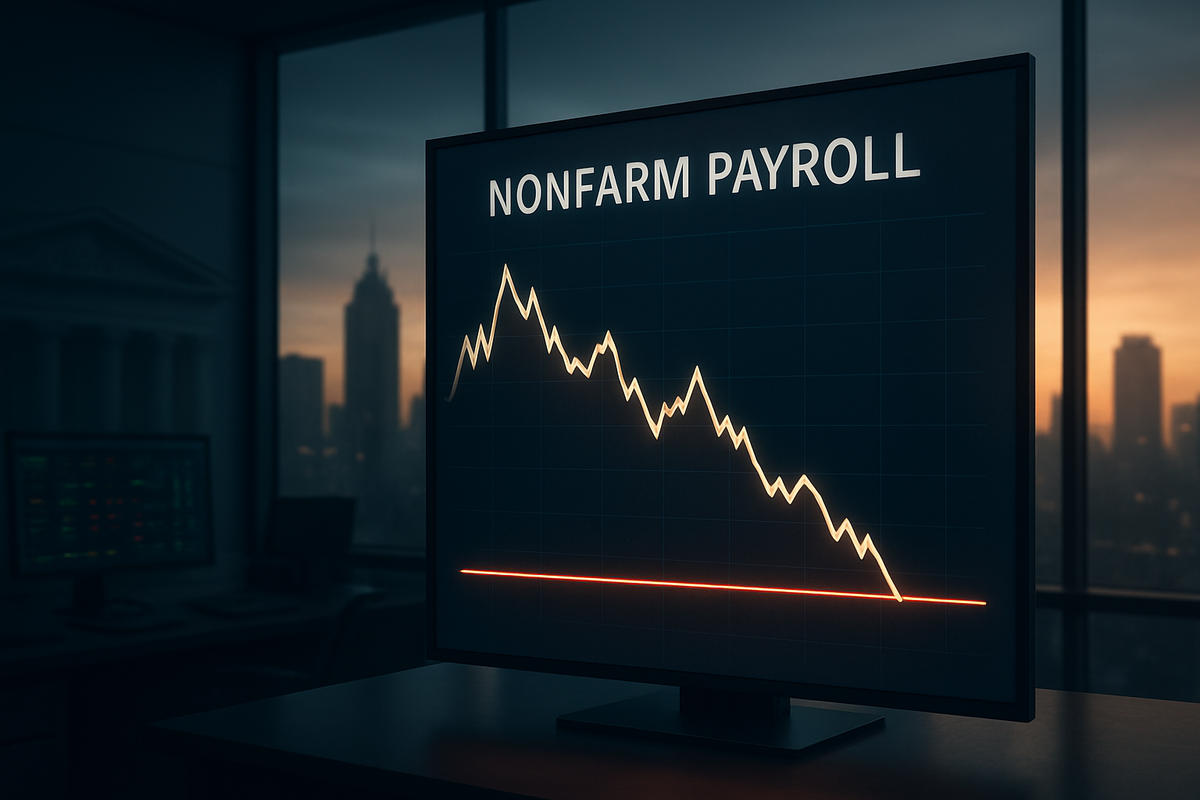
As the first quarter of 2026 draws to a close, Wall Street finds itself locked in a high-stakes waiting game. The upcoming April U.S. Jobs Report, which will detail labor market performance for the month of March, has become the primary focal point for investors, policymakers, and economists alike. With a consensus forecast of 124,000 nonfarm payroll additions, the market is bracing for what many fear could be the definitive signal of a cooling economy. This figure represents a critical "make-or-break" threshold that could either validate the Federal Reserve's "soft landing" narrative or confirm that a recession is no longer a distant threat, but an unfolding reality.
The immediate implications of this forecast are already rippling through the equity and bond markets. Following a volatile February that saw a meager 92,000 jobs added—the weakest showing since the post-pandemic recovery began—the 124,000 estimate is viewed by some as an optimistic "upper bound" rather than a floor. Interest rate expectations are shifting rapidly; while the Federal Reserve has maintained a target range of 3.50%–3.75%, the SPDR S&P 500 ETF Trust (NYSEARCA: SPY) has seen increased sensitivity to labor data as traders bet on whether the Fed will be forced to accelerate rate cuts to prevent a deeper economic contraction.
A Labor Market in Transition: The Path to 124,000
The road to this moment has been paved by a series of structural shifts and "low-hire, low-fire" dynamics that began in late 2025. Throughout the previous year, the U.S. labor market exhibited a surprising resilience that defied high interest rates, but by early 2026, the "essential" consumer buffer began to crack. Benchmark revisions by the Bureau of Labor Statistics recently wiped out 124,000 previously reported jobs from 2025 data, suggesting the economy was weaker than initially perceived. This adjustment, combined with a surge in corporate "efficiency drives," has set a somber tone for the March data.
Key players in this drama include the Federal Reserve, currently led by Chair Jerome Powell whose term is set to expire in May 2026. This lame-duck period for the Fed leadership has added a layer of uncertainty to monetary policy, as the central bank remains hesitant to cut rates further while inflation (PCE) remains sticky between 2.7% and 3.1%. Stakeholders in the healthcare and social assistance sectors are also under the microscope; in January 2026, these sectors alone accounted for nearly the entirety of job growth, masking a stagnant private sector. If the April report shows that even healthcare hiring is slowing down, the 124,000 forecast will likely be missed by a wide margin.
Initial market reactions to the preview have been defensive. Yields on the 10-year Treasury have fluctuated as investors seek safety, and volatility indices have trended upward. The "stagflation" narrative—slow growth coupled with persistent inflation—is no longer a fringe theory, but a central component of the April forecast analysis.
Winners and Losers in a Cooling Economy
The financial sector is currently at the epicenter of the labor market's cooling. Major investment banks are preemptively trimming headcounts to preserve profit margins in a low-growth environment. Morgan Stanley (NYSE: MS) recently announced plans to eliminate 2,500 positions, while Goldman Sachs Group Inc. (NYSE: GS) and JPMorgan Chase & Co. (NYSE: JPM) have implemented stringent hiring freezes outside of their AI and technology divisions. While these cuts hurt labor statistics, they are intended to protect shareholder value and bottom-line stability, potentially making these "efficient" banks relative winners if they can manage the downturn without systemic defaults.
Conversely, consumer-facing companies are facing a daunting outlook. As wage growth slows and recession fears dampen consumer confidence, companies tied to discretionary spending are seeing their margins squeezed. Tesla, Inc. (NASDAQ: TSLA) and Ford Motor Company (NYSE: F) are already grappling with reduced production forecasts as high financing costs and a weakening job market deter buyers from big-ticket purchases. Similarly, retail and hospitality giants like Starbucks Corporation (NASDAQ: SBUX) and Chipotle Mexican Grill (NYSE: CMG) are finding it difficult to pass on costs to "choiceful" shoppers who are increasingly prioritizing essentials over premium experiences.
Technology remains a wild card. Firms like Amazon.com, Inc. (NASDAQ: AMZN) continue to benefit from cloud and AI infrastructure demand, but their logistics and retail arms are susceptible to the same labor and consumer headwinds facing the broader economy. Meanwhile, fintech players like Block Inc. (NYSE: SQ) have already undergone massive restructuring, cutting thousands of jobs to lean into a more automated future. For these companies, the 124,000 payroll figure is a benchmark for the health of their primary customer: the small business and the gig worker.
The Broader Significance: A Post-Powell Pivot?
The April 2026 Jobs Report is more than just a monthly statistic; it represents a historical pivot point. Since the inflation shocks of 2022, the Federal Reserve has used a robust labor market as a shield, allowing them to keep rates "higher for longer." If the 124,000 forecast is met or missed, that shield will effectively be shattered. This event fits into a broader trend of "stagflationary" pressures that have haunted the 2020s, drawing comparisons to the late 1970s when the Fed was forced to balance high prices against a deteriorating employment landscape.
The ripple effects extend beyond U.S. borders. A significant slowdown in the American labor market typically leads to a weaker dollar, impacting global trade balances and the valuation of multinational competitors. Furthermore, the regulatory environment is shifting; with a new Fed Chair expected by mid-2026, the market is speculating on whether a more "dovish" successor will prioritize employment over the 2% inflation target, potentially leading to a paradigm shift in how the U.S. manages its dual mandate.
Historical precedents, such as the cooling period of 2019 or the pre-recession jitters of 2007, suggest that when the labor market begins to "hollow out"—where growth is concentrated in only one or two sectors like healthcare—a broader correction is often imminent. The 124,000 figure is widely seen as the "breakeven" point required to keep up with population growth; anything significantly lower would signal a rise in the unemployment rate toward the feared 5% mark.
What Comes Next: The May FOMC and the Summer Slowdown
In the short term, all eyes are on the first Friday of April. If the NFP print comes in at or above 124,000, the market may see a "relief rally," as it would suggest the economy is bending but not breaking. However, a significant miss (below 100,000) would likely trigger an immediate re-pricing of interest rate futures, forcing the Federal Reserve to consider a "jumbo" 50-basis-point cut at their May meeting to get ahead of the curve.
Long-term, companies will likely continue their pivot toward automation and AI to mitigate labor costs. This strategic adaptation is required because, regardless of the April report's outcome, the era of "cheap labor" and "easy hiring" appears to be over for this cycle. Market opportunities may emerge in defensive sectors—such as utilities or consumer staples—and in "efficiency" tech firms that help enterprises do more with fewer employees.
Scenario planning is now the priority for institutional investors. A "bull case" scenario involves the 124,000 figure being met alongside cooling inflation, allowing for a controlled descent in rates. The "bear case" involves a sub-100k print and sticky inflation, a scenario that would leave the Fed with no good options and could lead to a protracted market downturn through the summer of 2026.
Wrap-Up: The Stakes of the Spring
The upcoming April 2026 Jobs Report is the most anticipated economic data point of the year so far. The 124,000 payroll forecast is the line in the sand that separates a managed slowdown from a potential recession. For investors, the takeaway is clear: the labor market is no longer the indestructible engine of growth it once was. The concentration of job gains in healthcare and the aggressive headcount reductions at firms like Morgan Stanley (NYSE: MS) and FedEx Corporation (NYSE: FDX) point to an economy that is reaching its limits.
Moving forward, the market is likely to remain highly sensitive to any signs of labor market deterioration. Investors should watch for the "quit rate" and wage growth figures within the report, as these will provide deeper insights into whether workers are losing their bargaining power. As the Jerome Powell era at the Federal Reserve nears its conclusion, the 124,000 nonfarm payroll figure will serve as the final report card for a historic period of monetary policy.
In the coming months, the focus will shift from "how high will rates go?" to "how fast will they fall?" The answer to that question will be written in the payroll numbers released this April.
This content is intended for informational purposes only and is not financial advice