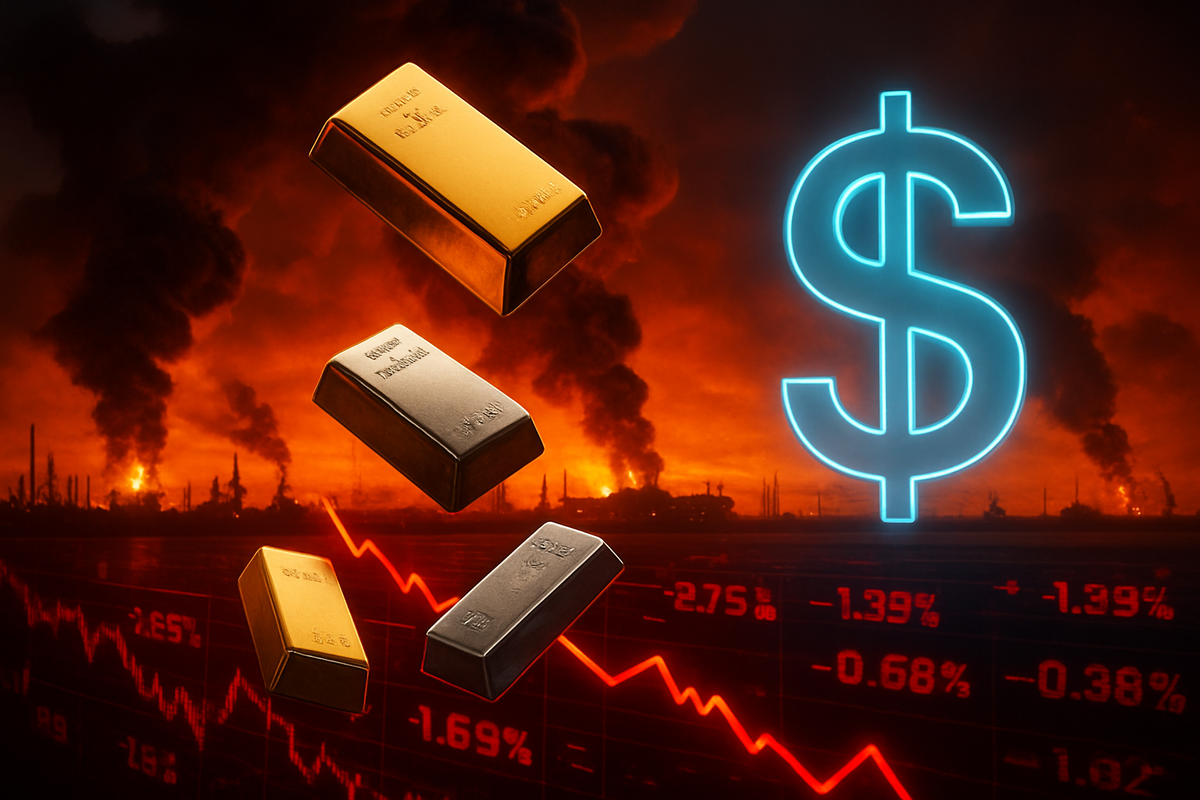
As of March 19, 2026, the global financial landscape is witnessing a defiance of historical logic. While the intensifying conflict between the United States and Iran has pushed the Middle East to the brink of a total regional war, the traditional "safe-haven" assets of gold and silver are experiencing a violent sell-off. In a typical cycle of geopolitical instability, precious metals serve as the ultimate insurance policy; however, the current escalation has triggered a unique set of economic feedback loops that are punishing bullion investors while rewarding the U.S. Dollar.
The immediate implications of this "Geopolitical Paradox" are profound for global portfolios. As energy prices skyrocket following the disruption of maritime trade in the Persian Gulf, the narrative in Washington and Wall Street has shifted from "geopolitical risk" to "inflationary persistence." This shift has emboldened the Federal Reserve to maintain a restrictive monetary stance, driving the U.S. Dollar to multi-year highs. For the average investor, the message is clear: in the 2026 economy, the strength of the greenback and the weight of interest rates are currently more influential than the fear of a widening war.
The current crisis reached a fever pitch following "Operation Epic Fury," a combined U.S.-Israeli military campaign launched on February 28, 2026. The operation, aimed at neutralizing Iran’s nuclear and ballistic capabilities, led to the reported assassination of Iran’s Supreme Leader, triggering an immediate and aggressive counter-response known as "Operation Martyr Soleimani II." Iranian forces responded with massive drone and missile swarms targeting regional infrastructure, most notably causing the effective closure of the Strait of Hormuz. With 20% of the world’s oil and liquefied natural gas (LNG) transit halted, Brent crude prices surged to nearly $120 per barrel in early March.
Initially, precious metals reacted exactly as textbooks predicted. Gold spot prices briefly eclipsed $5,400 per ounce, and silver reached a staggering $97 per ounce as panic gripped the markets in the first week of March. However, as the smoke cleared on the first phase of the conflict, the economic reality of $5.00-per-gallon gasoline in the U.S. began to set in. Market participants quickly realized that this conflict was not just a security threat, but a massive inflationary shock that would force central banks to keep interest rates high for much longer than previously anticipated.
On March 18, 2026, the Federal Reserve held interest rates steady at 3.5%–3.75%, with Chair Jerome Powell signaling that the "energy-driven inflation tax" necessitated a delay in any planned cuts. This "higher-for-longer" stance sent U.S. 10-year Treasury yields climbing toward 4.22%. As yields rose, the opportunity cost of holding non-interest-bearing assets like gold became too high for many institutional desks. By this morning, gold had retreated to the $4,800 range, while silver tumbled more than 11% in a single week to settle near $77 per ounce.
The primary victims of this paradox are the major precious metal producers who, despite record revenues in 2025, are now seeing their valuations compressed by the falling spot prices. Newmont Corp (NYSE: NEM) and Barrick Gold (NYSE: GOLD) have both seen significant volatility; while they remain well above their 2024 levels, the recent correction has wiped out billions in market cap in a matter of days. Similarly, silver-heavy plays like Pan American Silver (NASDAQ: PAAS) and Wheaton Precious Metals (NYSE: WPM) have struggled as silver's industrial and monetary appeal is overshadowed by the surging U.S. Dollar.
Conversely, the "war winners" are found in the defense and energy sectors, which have effectively hijacked the safe-haven bid. Defense giants like Lockheed Martin (NYSE: LMT) and RTX Corporation (NYSE: RTX) have seen their stock prices reach all-time highs as the demand for missile defense systems and precision munitions reaches a decade-peak. These companies are viewed as safer bets because their revenues are directly tied to the escalation of the conflict, unlike gold, which relies on the stability of the dollar to maintain its value.
In the energy sector, the supply crunch has been a massive tailwind for Western supermajors. ExxonMobil (NYSE: XOM) and Chevron (NYSE: CVX) have hit record highs this week as they benefit from higher realized oil prices and their relative insulation from the chaos in the Persian Gulf. Furthermore, oilfield services provider Halliburton (NYSE: HAL) is gaining traction as investors speculate on the eventual need for massive infrastructure reconstruction and increased domestic drilling to offset Middle Eastern losses.
This event fits into a broader shift in how global markets react to crisis in a post-inflationary world. Historically, gold was the "fear barometer," but in 2026, the U.S. Dollar Index (DXY) has taken over that role. The "Geopolitical Paradox" highlights that when a conflict creates a supply-side inflation shock, the resulting hawkishness from the Federal Reserve can actually suppress the very assets that usually benefit from chaos. This is a significant departure from the stagflationary era of the 1970s, as the current U.S. economy remains more resilient, allowing the Fed to lean harder on the interest rate lever.
The ripple effects are being felt across all asset classes. Emerging markets are under immense pressure as the rising dollar makes their dollar-denominated debt increasingly expensive to service. Furthermore, the regulatory environment is shifting, with the U.S. government considering emergency energy subsidies and increased oversight of commodity trading to prevent further price gouging. This mirrors historical precedents like the 1973 oil embargo, but with the added complexity of modern algorithmic trading that can accelerate a sell-off in metals within milliseconds of a Fed announcement.
The current situation also underscores the "dollar smile" theory: the USD wins when the U.S. economy is performing exceptionally well, and it wins during times of extreme global stress. Because this conflict is both a global stressor and a catalyst for higher U.S. rates, the dollar is receiving a double-boost. This leaves little room for gold and silver to breathe, as the two metals are priced in the very currency that is currently being weaponized by the economic climate.
Looking ahead, the short-term outlook for gold and silver remains bearish as long as the Strait of Hormuz remains closed and oil prices stay above the $110 threshold. Investors should prepare for continued volatility as the "higher-for-longer" narrative becomes the dominant market force. A potential strategic pivot for precious metal investors may involve moving toward "gold-linked" equities with high dividend yields, which can provide some income to offset the lack of spot price appreciation in a high-rate environment.
There is, however, a scenario where the trend reverses. If the conflict escalates to a point where global growth is severely crippled—leading to a "hard landing" or a systemic credit event—the Fed might be forced to pivot and cut rates despite high inflation. In such a "black swan" scenario, the dollar could lose its luster as a liquidity haven, and gold could see a secondary spike to new all-time highs. For now, the market is betting on the Fed's resolve and the dollar's dominance.
In summary, the "Geopolitical Paradox" of 2026 is a stark reminder that market dynamics are never static. The intensifying US-Iran war has indeed created fear, but that fear has manifested as a flight to the U.S. Dollar rather than gold or silver. The primary driver is the inflationary impact of $120 oil, which has handcuffed the Federal Reserve to a high-interest-rate policy, making non-yielding metals a less attractive harbor during this particular storm.
Investors moving forward should keep a close eye on the U.S. Dollar Index and 10-year Treasury yields as the primary indicators for precious metal price movements, rather than focusing solely on battlefield reports. While the fundamental case for gold remains as a long-term store of value, the immediate "King Dollar" environment is a formidable obstacle. The coming months will test the resilience of the global economy and determine whether this paradox is a temporary market quirk or a permanent shift in how we price risk in an era of constant conflict.
This content is intended for informational purposes only and is not financial advice.