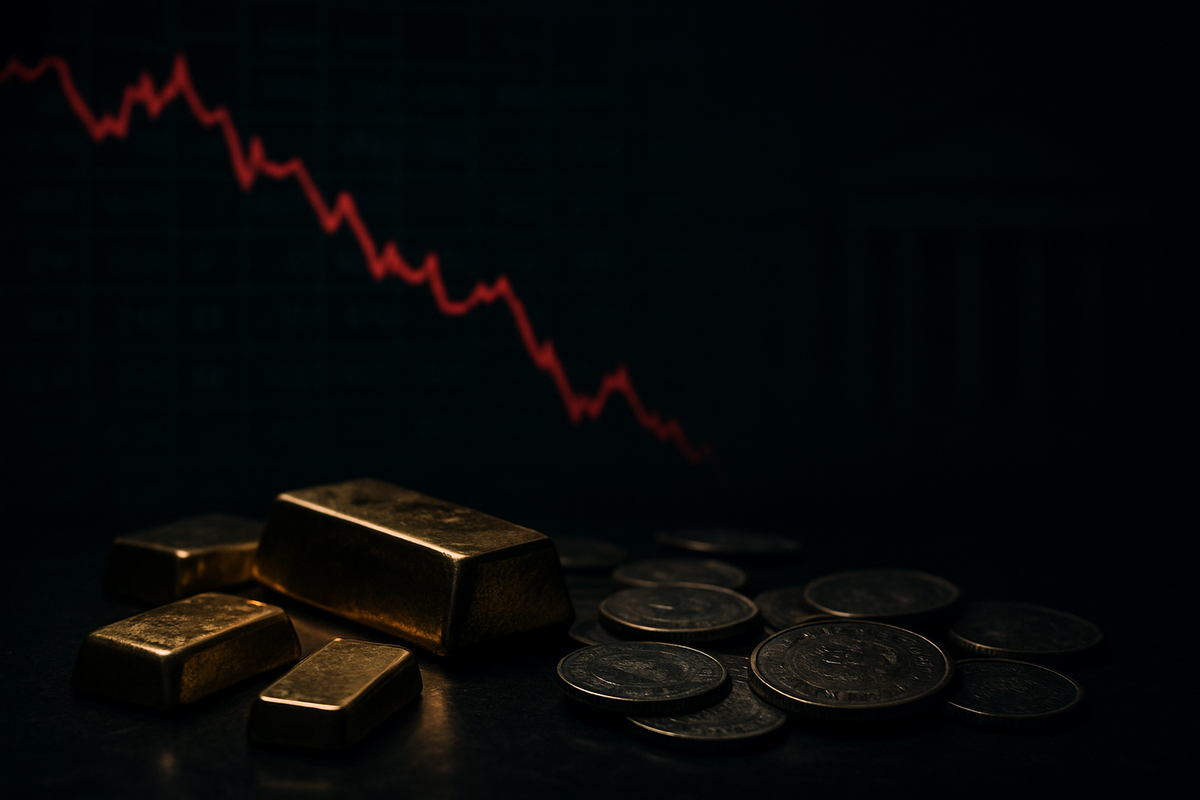
A wave of selling has crashed over the precious metals sector today, as London-listed mining stocks endure one of their most bruising sessions in recent memory. The sell-off, triggered by a surprisingly hawkish outlook from the U.S. Federal Reserve, has sent shockwaves through the City, wiping billions off the market capitalization of the world’s leading silver and gold producers.
As of midday trading on March 19, 2026, the carnage is widespread. Heavyweights such as Fresnillo Plc (LSE:FRES) have seen their share prices crater by as much as 8.3%, while West African gold specialist Endeavour Mining Plc (LSE:EDV) is trailing closely with a 7.3% decline. This aggressive retreat comes as investors scramble to reassess the valuation of mining assets in a "higher-for-longer" interest rate environment that has suddenly turned the tide against non-yielding commodities.
The 'Hawkish Hold' That Shook the Markets
The primary catalyst for today’s volatility was the conclusion of the Federal Open Market Committee (FOMC) meeting on March 18. While the Fed opted to hold interest rates steady, the accompanying Summary of Economic Projections—the infamous "dot plot"—revealed a far more aggressive stance than the market had anticipated. Fed Chair Jerome Powell signaled that the central bank remains wary of "sticky" inflation, fueled in part by volatile energy prices and geopolitical tensions in the Middle East. Consequently, the Fed has signaled only one potential rate cut for the remainder of 2026, shattering investor hopes for a more dovish pivot this spring.
The immediate reaction in the commodities market was swift and severe. Gold, which had been flirting with record territory above the $5,000 per ounce mark earlier this year, plummeted toward the $4,800 level as the U.S. Dollar Index (DXY) surged to a three-month high. Silver faced even harsher treatment, dropping into the $70–$80 per ounce range as speculative positions were liquidated in the wake of the Fed’s announcement. The spike in the 10-year Treasury yield to approximately 4.22% has further diminished the allure of precious metals, which do not offer a yield to investors.
Mining stocks, which often act as a leveraged play on the underlying metal prices, have felt the brunt of this macro shift. The selling pressure began during the Asian session and intensified as London markets opened, with high-beta silver producers bearing the heaviest losses. The combination of falling spot prices and rising operational costs—particularly with crude oil trading above $100 a barrel—has created a "perfect storm" for the sector's margins, leading to the aggressive de-risking observed across trading desks today.
Winners and Losers in the Mining Rout
While the headline losses are concentrated in pure-play precious metals miners, the impact is being felt across the entire natural resources landscape. Fresnillo Plc (LSE:FRES) stands out as the day’s biggest loser among the blue chips; the Mexican silver giant was already under pressure following a recent downgrade in its 2026 production guidance due to narrower-than-expected veins at several key mines. Today’s 8.3% drop reflects a compounding of those operational concerns with the macroeconomic downturn in silver prices.
The pain has not been restricted to the large caps. Mid-cap miners, which often lack the diversified revenue streams of their larger peers, are also seeing significant red screens. Atalaya Mining Plc (LSE:ATYM) and Pan African Resources Plc (LSE:PAF) are both down significantly, as investors pull back from "growth" stories in the mining space to favor cash preservation. For these smaller players, the prospect of sustained high interest rates raises the cost of capital for future exploration and development projects, potentially delaying the next generation of mine supply.
Even the diversified majors have not been immune to the contagion. Anglo American (LSE:AAL) and Rio Tinto (LSE:RIO) are both trading in the red, despite their heavy exposure to industrial metals like copper and iron ore. While Rio Tinto recently reported strong copper production growth, the broader sentiment shift against the mining sector—driven by softening industrial data from major economies and the Fed’s restrictive stance—has pulled even these diversified giants lower. Anglo American, currently navigating a complex transformation following its merger activities earlier in the year, faces additional pressure as its diamond and platinum group metal (PGM) segments remain sensitive to global luxury demand and interest rate fluctuations.
Industry Trends and the End of the 2025 Rally
This sell-off marks a definitive turning point for a sector that enjoyed a historic bull run throughout 2025. Last year, a combination of central bank buying and "safe haven" demand pushed gold and silver to astronomical heights. However, today’s price action suggests that the "easy money" phase of the cycle has concluded. The market is now entering a period of consolidation where fundamental cost management will be more important than simple exposure to the underlying metal.
The ripple effects of the Fed’s hawkishness are likely to extend into corporate boardrooms. Over the past year, many miners have used their record cash flows to increase dividends and engage in aggressive share buybacks. If the current price correction persists, companies may be forced to pivot back toward balance sheet fortification. This is particularly relevant for firms like Endeavour Mining Plc (LSE:EDV), which is currently in the midst of an ambitious 2026–2030 exploration strategy. A prolonged downturn in gold prices could force a prioritization of existing assets over greenfield discovery.
Historically, periods of rapid interest rate hikes or "hawkish holds" have led to technical washouts in the mining sector. Today’s event mirrors the "taper tantrum" dynamics of previous cycles, where the initial shock of a hawkish Fed leads to margin liquidations. However, the current environment is unique due to the sustained high price of energy. With oil prices remaining elevated, miners are facing a "margin squeeze" where their product prices are falling while their primary input costs (fuel and electricity) remain stubbornly high.
What Lies Ahead: Strategic Pivots and Market Opportunities
In the short term, the market will be looking for a floor in gold and silver prices. Technical analysts are watching the $4,750 level for gold and the $70 level for silver; a breach below these could trigger a second wave of systematic selling. For the mining companies, the next few months will be a test of operational efficiency. Investors will likely rotate away from high-cost producers and toward those with "tier-one" assets that can remain profitable even at lower price points.
We may also see a shift in the M&A (mergers and acquisitions) landscape. If valuations for mid-cap players like Atalaya and Pan African Resources remain depressed, they may become attractive targets for the diversified majors looking to bolster their precious metals pipelines at a discount. The "Anglo Teck" era for Anglo American (LSE:AAL) has already signaled a move toward massive consolidation in the industry; today's sell-off could provide the catalyst for the next round of deals as larger companies look to use their relatively stronger balance sheets to acquire distressed assets.
The long-term outlook remains tethered to the Federal Reserve's battle with inflation. If the Fed successfully engineers a "soft landing" and eventually begins to cut rates in late 2026 or 2027, the mining sector could see a rapid recovery. However, for now, the mantra for mining investors is "caution." The market has moved from a phase of speculative exuberance into one of cold, hard macroeconomic reality.
Conclusion and Investor Takeaway
The significant sell-off in precious metals mining stocks on March 19, 2026, serves as a stark reminder of the sector's sensitivity to central bank policy. The heavy losses sustained by Fresnillo Plc (LSE:FRES) and Endeavour Mining Plc (LSE:EDV), alongside the broader retreat of diversified majors like Rio Tinto (LSE:RIO), reflect a fundamental repricing of risk. As the Federal Reserve maintains its hawkish stance, the tailwinds that propelled gold and silver to record highs in 2025 have effectively stalled.
Moving forward, the market will likely differentiate between miners based on their cost curves and geographic stability. Investors should watch for the upcoming Q1 production reports to see how these companies are managing the twin pressures of falling metal prices and high energy costs. While the immediate outlook is clouded by the Fed’s "higher-for-longer" rhetoric, the structural demand for metals—particularly those tied to the green energy transition—remains a potent long-term narrative.
In the coming months, the key indicator for a potential sector rebound will be a cooling of the U.S. Dollar and a stabilization of Treasury yields. Until then, the mining industry must navigate a challenging landscape of heightened volatility and shifting investor expectations. For those with a long-term horizon, today’s carnage may eventually be viewed as a painful but necessary correction in an otherwise robust secular cycle for hard assets.
This content is intended for informational purposes only and is not financial advice.