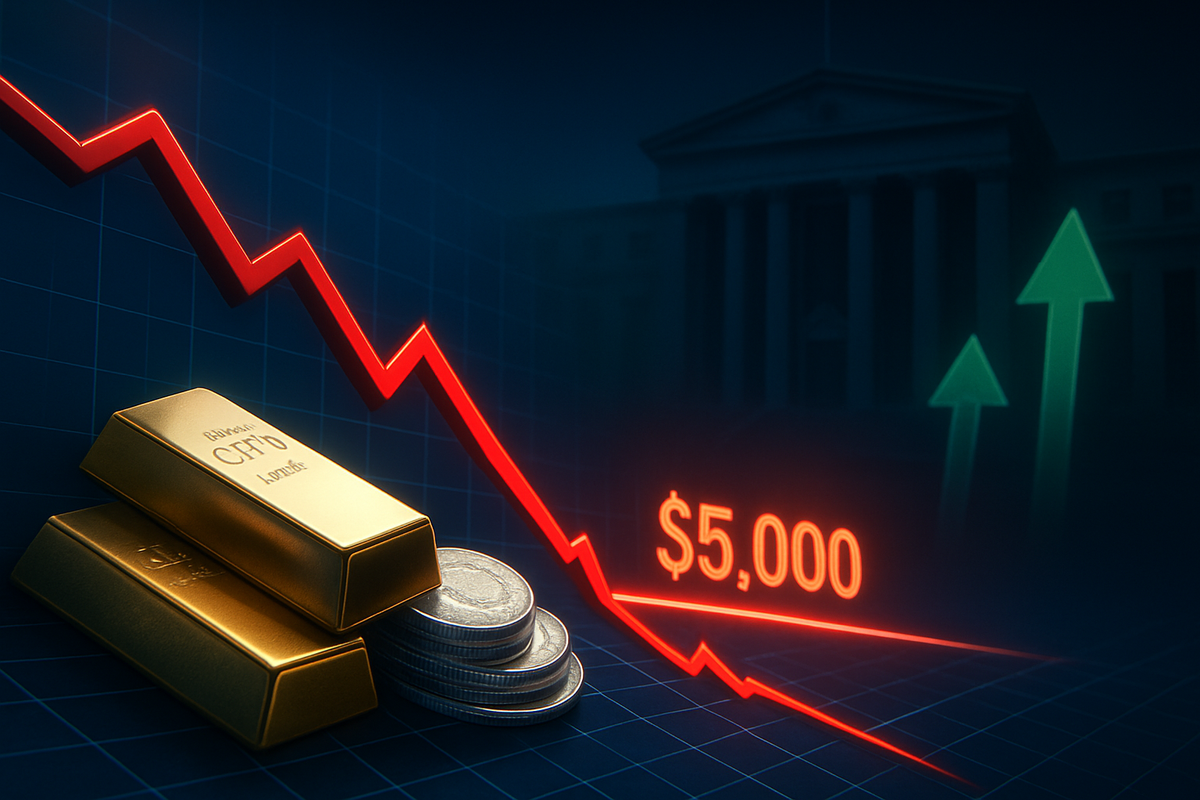
The multi-year bull run in precious metals faced a brutal reckoning this week as gold prices shattered the critical $5,000 support level and silver underwent a massive 8% liquidation. The sell-off, which has sent shockwaves through global commodities desks, was ignited by a "perfect storm" of hotter-than-expected inflation data and a Federal Reserve that has signaled it is in no hurry to ease its restrictive monetary policy.
As of March 19, 2026, the psychological floor for gold has given way, marking a dramatic reversal from the record highs seen earlier this year. With the U.S. dollar surging and real yields climbing, the appeal of non-yielding bullion has withered. Investors who once viewed gold as a safe haven against geopolitical instability are now grappling with a new reality: a "higher-for-longer" interest rate environment that makes the opportunity cost of holding metals increasingly difficult to justify.
The Perfect Storm: PPI Spikes and the Fed's Pivot
The catalyst for the current rout began on March 16, 2026, when spot gold prices "cracked," falling below the $5,000 mark to trade near $4,960 per ounce. This followed an even more violent move in the silver market on March 3, where a mechanical liquidation event saw prices plunge over 8% in a single trading session, eventually settling below $80. The downward pressure culminated on March 18, following the release of the U.S. Producer Price Index (PPI) and the conclusion of the Federal Open Market Committee (FOMC) meeting.
The February PPI data, released on the morning of March 18, shocked markets with a 0.7% month-over-month increase—more than double the 0.3% analysts had forecasted. This spike, driven largely by a 6% surge in unprocessed energy materials amid the ongoing conflict in the Middle East, pushed annual wholesale inflation to 3.4%. Hours later, Fed Chair Jerome Powell delivered the final blow. While the Fed maintained interest rates in the 3.50%–3.75% range, the updated "dot plot" revealed a stark shift: officials now project zero or perhaps only one rate cut for the remainder of 2026, a sharp pivot from the three cuts previously anticipated.
Market participants, led by major institutional funds and algorithmic trading platforms, reacted by aggressively unwinding long positions in precious metals. The U.S. Dollar Index (DXY) climbed toward 106.00, and 10-year Treasury yields moved higher, creating a hostile environment for bullion. The timeline of this rout reflects a shift from speculative buying to a defensive posture as the "inflation-hedging" narrative was overtaken by the reality of rising real returns in debt markets.
Miners in the Crosshairs: Winners and Losers
The equity markets have not been spared, with major mining companies seeing significant intraday volatility. Newmont Corporation (NYSE: NEM), the world’s largest gold producer, has seen its shares under pressure as the spot price drop directly impacts its projected margins for the second quarter. Similarly, Barrick Gold (NYSE: GOLD), which had been gaining favor with analysts earlier in the year, faced a sharp correction as investors recalibrated the value of its "Tier One" assets in a sub-$5,000 gold environment.
Silver-focused miners were hit even harder due to the metal's higher beta. First Majestic Silver (NYSE: AG) and Pan American Silver (NYSE: PAAS) both saw double-digit percentage declines this week, as the 8% drop in the underlying commodity triggered stop-loss orders across the sector. Hecla Mining (NYSE: HL), the oldest precious metals miner in the U.S., also saw its stock retreat despite its reputation for operational efficiency. Conversely, streaming companies like Wheaton Precious Metals (NYSE: WPM) may offer some relative stability due to their lower-risk business models, though they are not immune to the sector-wide downdraft.
The "winners" in this scenario are predominantly found in the currency and fixed-income sectors. Large-cap banks and financial institutions that benefit from higher-for-longer interest rates and a stronger dollar have seen an influx of capital. Furthermore, short-sellers in exchange-traded funds like the SPDR Gold Shares (NYSEARCA:GLD) and the iShares Silver Trust (NYSEARCA:SLV) have capitalized on the technical breakdown of the $5,000 and $85 levels, respectively.
A Return to Macro Fundamentals
This event fits into a broader industry trend where the "de-dollarization" and "inflation-protection" narratives that propelled gold to $5,500 are being tested by the sheer gravity of U.S. monetary policy. Historically, gold has struggled when real yields (the nominal interest rate minus inflation) are positive and rising. By signaling a "hawkish hold," the Fed has effectively pushed real yields into a territory that makes the 0% yield of gold and silver unattractive to institutional treasurers.
The current situation bears a striking resemblance to the market dynamics of the early 1980s, where aggressive Fed action eventually broke the back of commodity inflation. However, the current "dual-mandate nightmare"—a cooling labor market coupled with energy-driven inflation—makes the Fed's task significantly more complex. The potential ripple effects are significant; if precious metals continue to slide, it could signal a broader cooling in commodity markets, potentially providing the very "disinflation" the Fed is seeking, albeit at the cost of significant market pain for miners and emerging market economies.
The Road Ahead: Support or Further Slide?
In the short term, technical analysts are looking for gold to find a bottom near $4,850, a previous level of resistance that may now act as support. However, if the March PPI is followed by a hot Consumer Price Index (CPI) reading, the pressure on bullion could intensify. Strategic pivots will be required for mining companies, who may need to focus on high-grade "sweet spots" in their mines to maintain profitability if prices stagnate at these lower levels.
Long-term, the outlook for gold and silver remains tied to the Fed’s ability to engineer a "soft landing." If the restrictive rates eventually trigger a recession, the narrative could quickly flip back to gold as a haven of last resort. For now, the market is in a "wait-and-see" mode, watching for any signs of cracks in the labor market that might force the Fed to abandon its hawkish stance before the September meeting.
Navigating the New Gold Reality
The recent rout in gold and silver serves as a stark reminder that even the most powerful bull markets are not immune to the influence of the Federal Reserve. The break below $5,000 for gold and the 8% plummet in silver are clear signals that the "higher-for-longer" interest rate regime is the dominant force in global finance as we move through 2026.
Investors should watch the U.S. Dollar Index and real yields closely in the coming months. As long as the Fed remains committed to its hawkish hold, precious metals will likely remain under pressure. The key takeaway for the market is one of caution: the peak in inflation may be in the past, but the path to normalization is proving to be far more volatile than many had anticipated.
This content is intended for informational purposes only and is not financial advice.