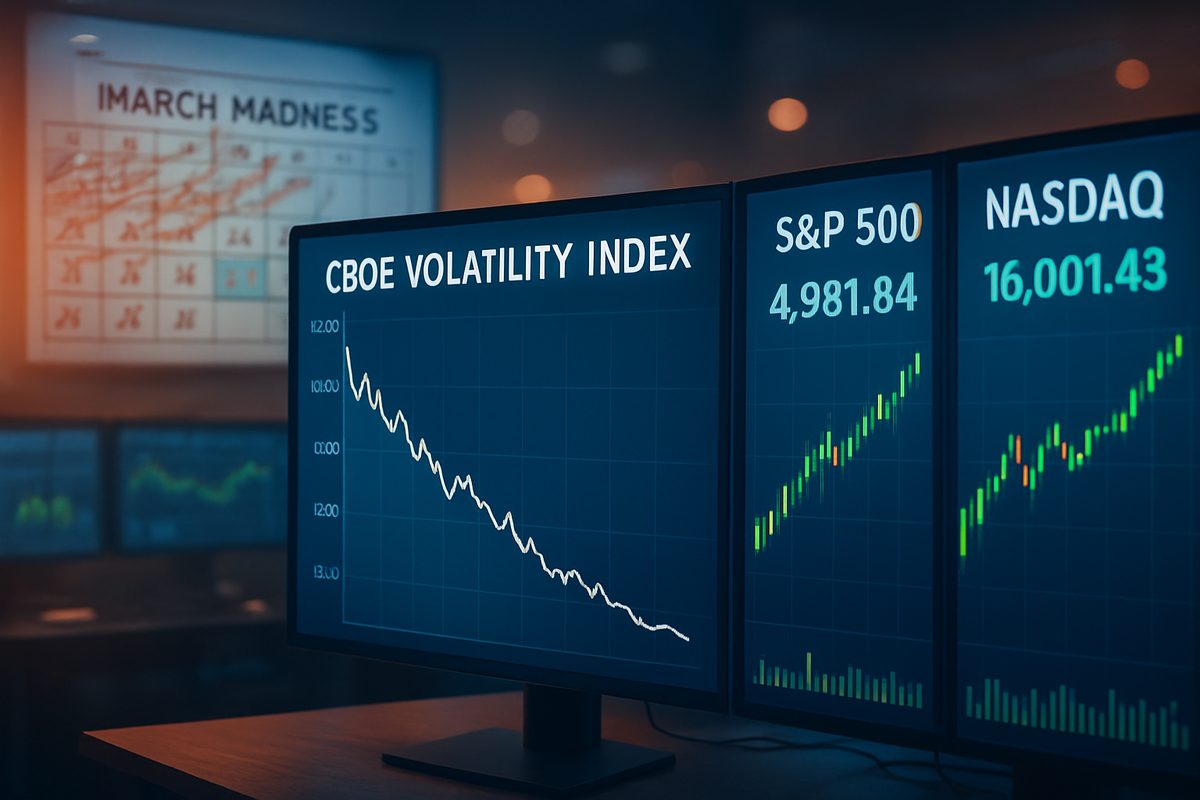
The CBOE Volatility Index (VIX), often referred to as the stock market's "fear gauge," experienced a sharp decline on Tuesday, March 17, 2026, falling 13.5% as investors embraced a broad market rebound. This sudden drop marks a significant shift in sentiment, offering a long-awaited reprieve from the "March Madness" that has gripped global markets since the start of the month. The reprieve comes as the Federal Open Market Committee (FOMC) begins its highly anticipated two-day policy meeting, with traders betting that the central bank’s upcoming economic projections will signal a "soft landing" remains firmly on track.
The cooling of the VIX to levels not seen in weeks suggests that the localized panic—fueled by concerns over "sticky" inflation and geopolitical friction in the energy sector—is being replaced by a calculated return to risk. While the broader indices like the SPDR S&P 500 ETF Trust (NYSEArca:SPY) saw strong gains, the real story lies in the collapse of the volatility premium, which had been bloated by a series of hotter-than-expected Producer Price Index (PPI) prints earlier in the month.
A Seasonal Reset: From Peak Fear to Calculated Risk
The 13.5% plunge in the VIX did not happen in a vacuum. The month of March 2026 began with a period of intense turbulence, characterized by a "triple threat" of macro-economic pressures. First, the PPI data released in the second week of March suggested that inflation in the services sector was proving harder to dislodge than analysts had projected in late 2025. This sent the VIX spiking toward the 27.30 level, its highest point since the minor regional banking scare of late 2025. Second, uncertainty surrounding the expiration of a federal Continuing Resolution (CR) and the looming shadow of debt ceiling negotiations in Washington D.C. added a layer of fiscal anxiety that dampened institutional buying.
However, the narrative began to shift as the market entered the week of March 16. Today’s rebound was catalyzed by a combination of resilient housing data and a perception that the Federal Reserve, led by Chairman Jerome Powell, would maintain its "simultaneous hold" policy rather than pivot back toward aggressive tightening. Housing Starts and Building Permits data released this morning at 8:30 AM ET showed unexpected strength in the multi-family sector, signaling that the "real economy" is absorbing current interest rates of 3.0%–3.25% better than feared. As the FOMC convened for Day 1 of its March session, the "pre-Fed" positioning saw a massive unwinding of defensive hedges, leading to the rapid contraction in VIX futures.
Winners and Losers: The Shifting Tides of Volatility
The primary beneficiaries of today's volatility collapse are the mega-cap growth stocks that dominate the major indices. Companies like NVIDIA (NASDAQ: NVDA) and Microsoft (NASDAQ: MSFT) saw significant inflows as the "AI Infrastructure" trade regained its footing. Investors who had sidelined cash during the early March spike returned to the market, viewing the 13.5% drop in the VIX as a "green light" for the next leg of the AI supercycle. Furthermore, the exchange operator itself, Cboe Global Markets (BATS:CBOE), remains a unique winner in this environment; while the index it manages fell, the high trading volume associated with the massive unwinding of options positions continues to bolster its transactional revenue.
On the losing side of the ledger are the holders of volatility-linked products. The ProShares Ultra VIX Short-Term Futures ETF (NYSEArca:UVXY) and the 2x Long VIX Futures ETFs saw devastating double-digit losses today, punishing tactical traders who had bet on a sustained March crash. These products, which are sensitive to the "roll yield" and the shift from backwardation back into contango, served as a stark reminder of the risks inherent in timing market fear. Additionally, safe-haven assets like gold and long-duration Treasuries saw a slight cooling as the "fear premium" evaporated, particularly during the 20-Year Bond Auction at 1:00 PM ET, which showed steady, if unspectacular, demand.
Broader Significance: The New Normal of 'Controlled Burns'
Today’s move highlights a growing trend in the 2026 market: the "controlled burn" of volatility. Unlike the 2020 COVID-19 crash, where the VIX hit 82.69, or the 2023 banking crisis, the current "March Madness" appears more structural than systemic. The market is currently navigating a transition from a world of cheap money to a "high-for-longer" productivity-driven era. This event fits into the broader industry trend where volatility is compressed not by central bank intervention alone, but by the massive liquidity of the "AI-Pipes and Power" trade, where industrial bellwethers like Steel Dynamics (NASDAQ: STLD) are providing mid-quarter guidance that suggests robust infrastructure demand.
The historical precedent for this kind of "relief rally" often precedes "Quadruple Witching" Friday—the simultaneous expiration of market index futures and options. By flushing out the "fear" on the Tuesday before expiration, institutional players may be setting the stage for a more orderly rebalancing of portfolios. Furthermore, the 13.5% drop serves as a regulatory signal that despite fiscal friction in Washington, the private credit and equity markets remain liquid enough to absorb macro shocks without requiring emergency liquidity facilities.
Looking Ahead: The Post-Fed Landscape
In the short term, all eyes remain fixed on tomorrow’s FOMC press conference and the release of the "dot plot." If the Fed confirms the market’s hope for a stabilized rate environment through the end of 2026, the VIX could settle into a new "basement" range of 14–16. However, the long-term challenge remains the "fiscal cliff" looming in the second half of the year. Strategic pivots may be required if upcoming earnings from consumer giants like Lululemon Athletica (NASDAQ: LULU) or enterprise software firms like DocuSign (NASDAQ: DOCU) suggest that the high-interest-rate environment is finally beginning to erode the "sticky" consumer demand that has been the economy's backbone.
Investors should also watch for potential "tail-risk" events as we move into the April tax season. Historically, the liquidity drain associated with tax payments can cause secondary spikes in volatility. The 13.5% drop today provides a cushion, but it does not mean the market is entirely out of the woods. The transition to "clean-firm" power and the massive capital requirements for the energy transition remain potential flashpoints for market-wide pricing adjustments.
Summary and Market Outlook
The 13.5% decline in the VIX on March 17, 2026, represents a vital "pressure release valve" for a market that was becoming dangerously overheated with anxiety. By shaking off the "March Madness" early, the indices have cleared a path for a potential spring rally, provided the Federal Reserve does not deliver a hawkish surprise on Wednesday. The key takeaway for investors is that while volatility remains a persistent feature of the 2026 landscape, the underlying structural strength of the tech and industrial sectors is providing a floor that was absent in previous decades.
Moving forward, the market appears poised for a period of "selective growth." The era of "rising tides lifting all boats" has been replaced by a more disciplined environment where winners are separated by their exposure to the AI infrastructure and energy renaissance. Investors should remain vigilant, watching for the FOMC’s updated inflation targets and the resolution of the federal funding debates, but for today, the "fear gauge" has retreated, and Wall Street is breathing a collective sigh of relief.
This content is intended for informational purposes only and is not financial advice.