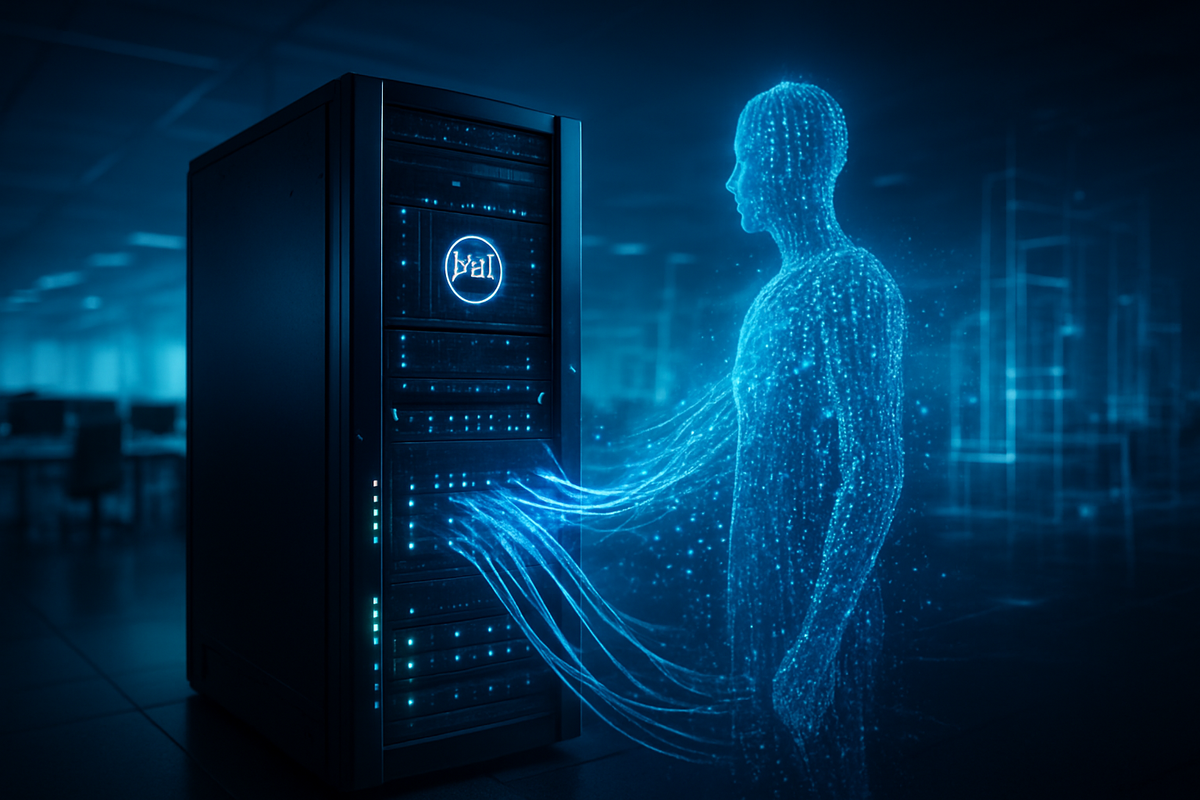
In a move that underscores the brutal efficiency required to lead the artificial intelligence (AI) arms race, Dell Technologies (NYSE: DELL) has confirmed a systematic reduction of approximately 11,000 employees over the course of its fiscal year 2026. This 10% workforce reduction, revealed in recent regulatory filings as of March 17, 2026, marks the culmination of a multi-year restructuring effort designed to shed legacy weight and pivot the company’s entire operational focus toward high-growth AI server markets.
The immediate implications are clear: Dell is prioritizing margin protection and agility over headcount. By streamlining its global workforce to roughly 97,000 employees, the Texas-based tech giant is betting that a leaner organization can more effectively navigate the high-volume, lower-margin reality of the AI hardware business. While the human cost is significant, Wall Street has signaled its approval, with Dell’s stock surging nearly 30% following its latest earnings blowout, as investors reward the company’s ability to maintain resilient operating margins despite heavy investment in next-generation infrastructure.
The Anatomy of a 'Quiet Efficiency' Move
The reduction of 11,000 roles in fiscal 2026 was not a single, catastrophic event, but rather a series of "quiet efficiency" measures executed throughout the year. According to Dell’s mid-March 10-K filing, the company incurred approximately $569 million in severance expenses to facilitate these departures. This follows a similar 13,000-person cut in fiscal 2025, representing a two-year transformation that has seen nearly 20% of the company's workforce exit. Management has characterized the strategy as a necessary "flattening" of the organization to eliminate redundancies in its traditional PC and storage divisions, while simultaneously reallocating capital toward specialized R&D and AI-centric sales teams.
The timeline of this transition reached a fever pitch in the fourth quarter of fiscal 2026 (ended January 30, 2026), when Dell’s "AI Factory" strategy began to deliver unprecedented scale. The company reported record full-year revenue of $113.5 billion, driven by a 342% year-over-year explosion in AI-optimized server shipments. By the time the cuts were finalized in early 2026, Dell had already built a staggering $43 billion backlog for its AI servers, proving that the demand for its hardware was growing even as its internal headcount shrank.
Key stakeholders, including CEO Michael Dell and COO Jeff Clarke, have been vocal about the necessity of this pivot. Clarke recently noted that the company is "limiting external hiring" and "reorganizing sales teams" to better align with the complex, multi-billion dollar enterprise deals that define the AI era. While industry analysts initially feared that such deep cuts might hamper innovation, the record-breaking product cycles for the PowerEdge XE9680 and subsequent AI models have largely silenced critics.
Winners, Losers, and the Margin Battle
The primary winner in this strategic realignment appears to be Dell Technologies itself, at least in the eyes of the public markets. By reducing its operating expenses (OpEx) through workforce cuts, Dell managed to keep its operating margins steady at roughly 7.2%, effectively offsetting a 220-basis-point drop in gross margins caused by rising component costs for high-bandwidth memory and Nvidia (NASDAQ: NVDA) GPUs. This fiscal discipline has allowed Dell to authorize an additional $10 billion for share repurchases and hike its dividend by 20%, cementing its status as a "shareholder-first" AI play.
However, the competitive landscape reveals a more nuanced picture. Super Micro Computer (NASDAQ: SMCI), once the darling of the AI server boom, has emerged as a temporary "loser" in the margin war. While SMCI maintains a slight edge in speed-to-market, its gross margins have been hammered down to the 6% range as it struggles to match Dell’s supply chain scale and enterprise support capabilities. In contrast, Hewlett Packard Enterprise (NYSE: HPE) has taken a different route, prioritizing high-margin networking and software through its acquisition of Juniper Networks. While HPE's AI server backlog of $5 billion trails Dell’s $43 billion, HPE maintains a significantly higher gross margin profile (36.6%), making it the choice for more conservative, value-oriented investors.
The broader "loser" in this scenario is the legacy IT worker. As Dell and its peers automate internal processes and shift focus to AI, the demand for traditional hardware sales and maintenance roles is evaporating. Conversely, companies providing the "picks and shovels" of the AI era, such as Nvidia and specialized cooling partners like Vertiv (NYSE: VRT), continue to benefit from Dell’s massive procurement volumes.
The Broader Shift: From Commodity Hardware to AI Infrastructure
Dell’s restructuring is a microcosm of a larger trend sweeping the technology sector in 2026: the "Great Re-Platforming." For decades, Dell was defined by its ability to sell PCs and storage arrays at scale. Today, that business model is being cannibalized by the need for massive, liquid-cooled AI clusters. This transition mirrors the cloud migration of the 2010s, but with much higher capital intensity and faster product obsolescence cycles.
Historically, tech giants like IBM (NYSE: IBM) and Cisco (NASDAQ: CSCO) faced similar "pivot or perish" moments. Dell’s approach—using workforce reductions as a tactical lever to fund a massive pivot—is a strategy that has been validated by the performance of Meta Platforms (NASDAQ: META) during its "Year of Efficiency" in 2023. By cutting deep and early, Dell has avoided the "zombie company" trap that often catches legacy hardware makers during major technological shifts.
Regulatory and policy implications are also beginning to surface. As Dell and others reduce their workforce in favor of AI-driven automation and specialized talent, there is growing political scrutiny regarding the "AI-driven job displacement" narrative. However, from a market perspective, these moves are seen as essential for survival in a world where the speed of compute is the ultimate competitive advantage.
The Roadmap to Fiscal 2027
Looking ahead to the remainder of 2026 and the start of fiscal 2027, Dell faces the challenge of execution. With a $43 billion backlog, the company’s primary hurdle is no longer demand, but supply chain logistics. Management has projected that AI server revenue will nearly double again to $50 billion in the coming year. To achieve this, Dell must successfully integrate its leaner workforce with new AI-driven internal tools to manage the surge in complexity without ballooning its cost base again.
Short-term risks include potential component shortages—specifically for the next generation of AI chips—and the possibility of a "digestive period" where enterprises slow down their hardware spending to focus on software implementation. However, the long-term opportunity remains immense. Dell is positioning itself not just as a hardware vendor, but as an "AI Factory" partner that provides the full stack of sovereign AI infrastructure for nations and corporations alike.
Strategic pivots may yet occur in the cooling and power management sectors. As AI clusters become more power-hungry, Dell is expected to increase its M&A activity in liquid cooling and edge computing companies to differentiate its offerings from commodity competitors.
Investor Verdict: Efficiency in the Age of Intelligence
As of mid-March 2026, Dell Technologies has successfully navigated a high-wire act: cutting its workforce by 10% without derailing its record-breaking growth in the AI sector. The key takeaway for investors is that Dell is no longer a "boring" PC company; it is a high-performance infrastructure engine that has mastered the art of operational efficiency. The company’s ability to generate $11.2 billion in cash flow while undergoing such a massive structural shift is a testament to Michael Dell's long-term vision.
Moving forward, the market will be watching two things closely: gross margin stabilization and the conversion of the $43 billion backlog into recognized revenue. If Dell can prove that its "leaner" organization can handle the massive scale of the AI decade without a return to aggressive hiring, the stock's recent re-rating may only be the beginning. For now, Dell stands as a blueprint for how legacy tech can reinvent itself through disciplined "quiet efficiency."
This content is intended for informational purposes only and is not financial advice.