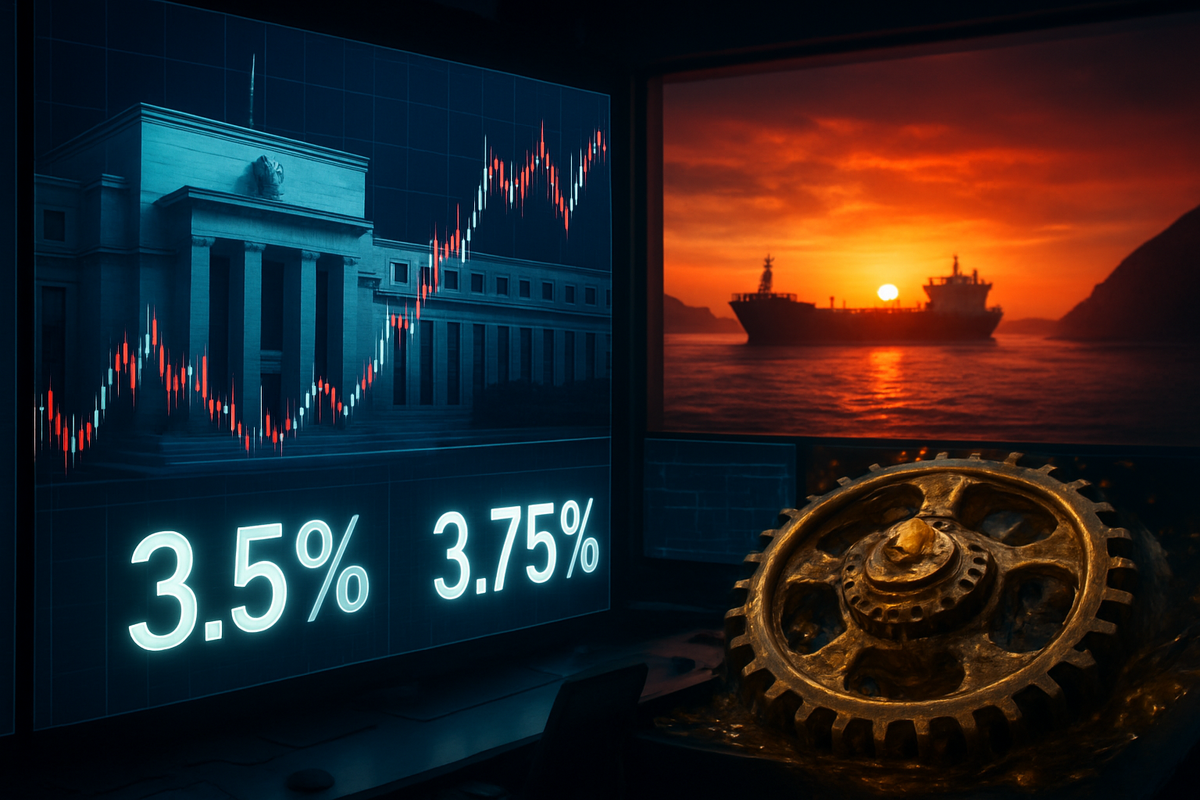
As the Federal Open Market Committee (FOMC) prepares to convene for its March 17–18, 2026, meeting, the financial world is bracing for a "hawkish pause." Despite a massive geopolitical shock that has sent oil prices skyrocketing past $100 per barrel and a stubborn core inflation rate that refuses to retreat toward the 2% target, the Federal Reserve is widely expected to maintain the federal funds rate in its current range of 3.5% to 3.75%. Market participants, as tracked by the CME FedWatch Tool, have priced in a staggering 99.2% probability of no change, reflecting a central bank that is currently paralyzed by the conflicting forces of a potential energy-driven recession and a persistent inflationary spiral.
The immediate implications for the market are profound. Investors are grappling with a "policy trap" where the Fed lacks the room to cut rates to support a softening labor market—which lost 92,000 jobs in February—because doing so could further ignite price pressures fueled by the "2026 Energy War." The current environment has triggered a significant shift in asset allocation, as the traditional "flight to safety" into Treasuries has been upended by rising yields, leaving the U.S. Dollar as the primary refuge for global capital.
The 2026 Energy Shock and the Road to the March Meeting
The primary catalyst for the Fed’s current dilemma is "Operation Epic Fury," a joint U.S.-Israeli military strike on February 28, 2026, that targeted high-level Iranian leadership. The subsequent retaliation by Tehran led to a near-total blockade of the Strait of Hormuz, a chokepoint responsible for 20% of the world’s oil and liquefied natural gas (LNG) trade. In the weeks leading up to this meeting, Brent crude prices surged from a stable $75 per barrel to an intraday peak of $126.50, marking the most violent supply shock since the 1970s. This surge has directly impacted the Consumer Price Index (CPI) and added "cost-push" pressure to an already fragile economic recovery.
Compounding the energy crisis is the latest data on the Federal Reserve's preferred inflation metric. The Core Personal Consumption Expenditures (PCE) index rose 3.1% year-over-year in January 2026, with a month-over-month increase of 0.4%. This "sticky" inflation is being driven by persistent demand in the services sector and elevated housing costs, which have not responded as quickly to previous rate hikes as the Fed had hoped. Analysts at Goldman Sachs (NYSE: GS) and JPMorgan Chase (NYSE: JPM) have been forced to scrap their earlier predictions of multiple rate cuts in 2026, now suggesting that a single cut in December is the most optimistic scenario.
The initial market reaction to these events was one of extreme volatility. During the first week of March, the S&P 500 and Nasdaq Composite (INDEXNASDAQ: .IXIC) saw significant mid-week slides as the reality of a prolonged conflict set in. The CBOE Volatility Index (VIX) spiked to 30.0, reflecting a transition from "buying the dip" to aggressive defensive hedging. Paradoxically, gold—a traditional safe haven—saw an initial record spike to $5,420 before dropping as institutional investors sold "paper gold" to meet margin calls in a liquidity-starved equity market.
Winners and Losers in a High-Energy, High-Rate Environment
In the energy sector, the current crisis has created a stark divergence. U.S.-based upstream producers like ConocoPhillips (NYSE: COP) and Occidental Petroleum (NYSE: OXY) have emerged as clear winners. With heavy exposure to the Permian Basin and insulation from Middle Eastern shipping disruptions, these companies are reaping the benefits of $100+ oil prices without the immediate operational risks facing their global peers. Conversely, "super-majors" such as ExxonMobil (NYSE: XOM) and Chevron (NYSE: CVX) face a dual reality: while their valuations have reached record highs, they have had to evacuate personnel from regional hubs and face significant threats to their global LNG supply chains.
The financial sector is facing severe headwinds. Major U.S. banks, including Wells Fargo (NYSE: WFC) and Citigroup (NYSE: C), have seen their stock prices pressured as investors worry about the impact of "stagflation"—low growth combined with high inflation—on loan demand and credit quality. Furthermore, these institutions are dealing with direct geopolitical threats to their Middle Eastern operations. JPMorgan Chase (NYSE: JPM) recently reported a significant uptick in defensive hedging by its institutional clients, signaling a lack of confidence in a near-term market recovery.
The logistics and transportation industry is perhaps the hardest hit by the Strait of Hormuz blockade. Shipping giants like A.P. Moller-Maersk (OTCPK:AMKBY) and Hapag-Lloyd have been forced to reroute vessels around the Cape of Good Hope. This detour adds weeks to transit times and millions of dollars in fuel costs, which will inevitably be passed down to consumers, further fueling the inflationary fire. Meanwhile, energy-intensive companies in the airline and discretionary retail sectors are seeing their margins evaporate under the weight of surging fuel surcharges and a consumer base that is increasingly squeezed by high prices at the pump.
A New Era of Geopolitical Macroeconomics
The current situation fits into a broader trend where geopolitics has replaced pandemic-era supply chain issues as the primary driver of market volatility. The 2026 Energy War represents a fundamental shift in the global energy map, forcing a rapid—and expensive—re-evaluation of energy security. This event has also brought the Fed’s mandate into sharp focus: can the central bank truly control inflation when the primary drivers are external, geopolitical shocks rather than internal demand?
Historically, this period draws comparisons to the 1973 oil embargo, but with a modern twist. In 2026, the global economy is far more interconnected, and the "sticky" nature of core PCE inflation suggests that the underlying price pressures are more structural than transitory. This has significant regulatory and policy implications, as the U.S. government has already been forced to release 400 million barrels from the Strategic Petroleum Reserve (SPR) to stabilize prices—a move that some critics argue is a temporary band-aid on a deep geopolitical wound.
The "flight to safety" behavior in March 2026 has also challenged traditional economic theories. The rise in the 10-year Treasury yield to 4.26% during a crisis—usually a time when yields fall—indicates that investors are more afraid of inflation eroding their returns than they are of equity market volatility. This shift suggests that the "Fed Put"—the idea that the Federal Reserve will always step in to support markets—may be dead, or at least on an extended hiatus as long as inflation remains well above the 2% target.
Strategic Pivots and the Path Forward
Looking ahead, the Fed faces two primary scenarios. In the first, the geopolitical tensions in the Middle East de-escalate relatively quickly, allowing oil prices to stabilize and core inflation to begin a slow descent. In this case, the Fed could potentially begin a modest easing cycle toward the end of 2026. However, if the blockade of the Strait of Hormuz persists, the U.S. economy could enter a period of "stagflation" that hasn't been seen in decades, potentially forcing the Fed to keep rates "higher for longer" even in the face of a recession.
In the short term, companies will need to adapt their strategies to a world of $100 oil and 4% interest rates. For many, this means a renewed focus on "reshoring" and regional supply chains to avoid the risks of international maritime chokepoints. For investors, the challenge will be finding "inflation-hardened" assets. Strategic pivots into domestic energy production, defense technology, and high-yield, short-duration fixed income may become the dominant themes for the remainder of 2026.
Market opportunities may emerge in the renewable energy sector, as the current crisis provides the strongest argument yet for a faster transition away from fossil fuel dependency. However, the capital-intensive nature of these projects means they will face higher financing costs due to the Fed’s commitment to high interest rates. The "green transition" may ironically be slowed by the very energy crisis that makes it necessary.
Wrap-Up: What to Watch in the Coming Months
The March 2026 FOMC meeting marks a critical juncture for the global economy. The Federal Reserve is attempting to walk a tightrope between an energy-driven inflationary surge and a cooling domestic labor market. While the decision to hold rates steady is almost certain, the language in the FOMC statement and Chair Jerome Powell's subsequent press conference will be scrutinized for any hint of how the Fed views the balance of risks.
Investors should move forward with caution, keeping a close eye on the duration of the Strait of Hormuz blockade and the subsequent "second-round effects" of high energy prices on consumer spending. The resilience of the U.S. consumer has been a hallmark of the post-pandemic era, but $120 oil and persistent 3% core inflation represent a formidable challenge.
In the coming months, the key indicators to watch will be the monthly PCE reports and the stability of the 10-year Treasury yield. If inflation shows any sign of accelerating despite the Fed’s restrictive stance, the "pause" may eventually give way to further rate hikes—a scenario that few in the market are currently prepared for. For now, the world waits as the Fed navigates one of the most complex economic landscapes in modern history.
This content is intended for informational purposes only and is not financial advice.