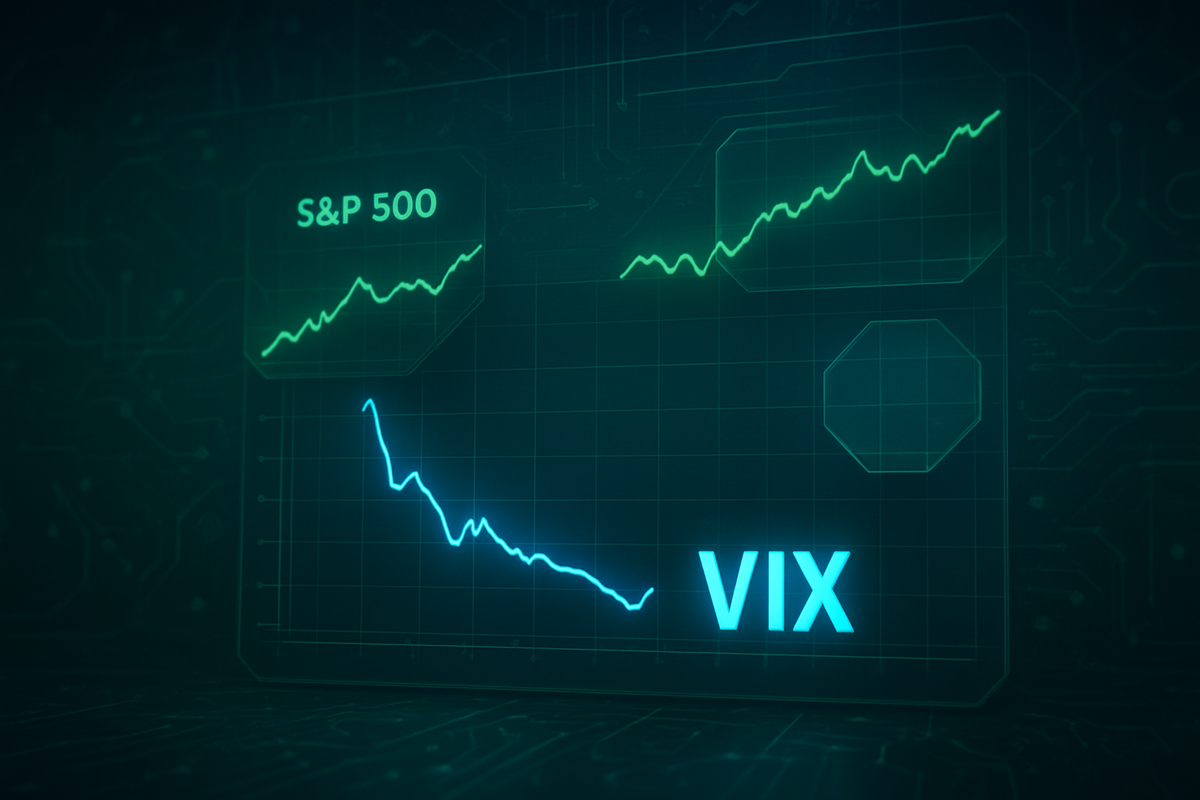
NEW YORK — On this Thursday, February 26, 2026, the financial markets are breathing a collective sigh of relief as the CBOE Volatility Index (CBOE:VIX) continues its steady descent, marking a significant shift in investor sentiment. For the second consecutive session, the S&P 500, the tech-heavy Nasdaq Composite, and the Dow Jones Industrial Average have all advanced firmly into the green. This momentum follows a pivotal quarterly report from the semiconductor powerhouse Nvidia (Nasdaq:NVDA), which appears to have extinguished lingering doubts regarding the longevity of the artificial intelligence (AI) super-cycle.
While the "fear gauge" has softened to levels not seen since earlier this month, the undercurrent of the market remains cautious. Traders report that while immediate panic has subsided, "downside protection" remains notably expensive. The persistent demand for put options and structured hedging products suggests that while the current rally is welcomed, institutional investors are not yet ready to dismantle their safety nets as they navigate a high-valuation environment in early 2026.
The Post-Nvidia "Volatility Crush" and the Path to Recovery
The market’s current trajectory was set in motion late yesterday, February 25, 2026, when Nvidia Corporation (Nasdaq:NVDA) released its fourth-quarter fiscal results. Leading up to the announcement, the VIX had spiked nearly 18%, crossing the psychological 20.00 threshold as investors braced for potential signs of "AI Capex Fatigue." Market participants were concerned that the massive infrastructure spending by "hyperscalers" might finally be slowing down. However, Nvidia’s robust guidance and record-breaking revenue figures acted as a catalyst for a massive "volatility crush," where the premium on uncertainty vanished almost instantly.
The timeline of the past 48 hours illustrates a classic relief rally. On the morning of February 25, the indices were flat-to-down as the Put-Call ratio hit a seasonal high of 1.25, indicating extreme defensiveness. Following the post-market earnings beat, the Nasdaq opened this morning with a gap up, gaining 1.8% in early trading. By mid-day today, February 26, the S&P 500 has reclaimed its 50-day moving average, a technical milestone that has drawn trend-following quantitative funds back into the fold.
Key stakeholders, including major institutional asset managers like BlackRock and Vanguard, have noted that the "quality" of this rally is superior to the speculative fever of 2024. The current advance is driven by realized earnings and tangible ROI from AI integrations rather than mere hype. This fundamental backing is why the VIX has retreated so gracefully today, settling back toward the 16.50 range after its brief dalliance with "fear" territory earlier in the week.
Winners and Losers in the New AI Hierarchy
The primary benefactor of this week’s market action is undoubtedly Nvidia, but the ripple effects have bolstered the entire "AI Trinity"—Microsoft (Nasdaq:MSFT), Alphabet (Nasdaq:GOOGL), and Amazon (Nasdaq:AMZN). Microsoft has seen a 2.4% jump today as investors gain confidence that its multi-billion dollar Azure AI investments are being met with sustained corporate demand. Similarly, Alphabet’s stock has found a fresh bid, as the market interprets Nvidia's data center growth as a proxy for the continued expansion of Google’s proprietary LLM (Large Language Model) infrastructure.
On the winning side of the volatility shift are also specialized ETFs designed for this "hedged bull" environment. The Invesco S&P 500 Low Volatility ETF (NYSE: SPLV) has seen record inflows today as investors look to maintain equity exposure without the stomach-churning swings seen in the first half of February. Furthermore, companies providing the power and cooling infrastructure for AI data centers, such as Vertiv Holdings (NYSE: VRT), have seen their shares outpace the broader indices, emerging as the "silent winners" of the current Capex cycle.
Conversely, the "losers" in this environment are legacy hardware manufacturers and software firms that have failed to demonstrate a clear path to AI monetization. Companies still mired in the "transition phase" are finding it difficult to attract capital as investors rotate into proven winners. Additionally, short-sellers who bet on a significant post-Nvidia correction have faced a brutal "gamma squeeze," forced to cover their positions as the indices moved against them, further fueling the upward momentum observed today.
Analyzing the Significance: Is the Volatility Floor Rising?
The significance of today's market action extends beyond a simple two-day rally. It signals a shift in the "volatility regime" for 2026. Historically, a VIX in the 12-15 range was common during bull markets; however, in this era of high-speed AI trading and geopolitical complexity, a VIX floor of 17-19 seems to be the new normal. The fact that downside protection remains elevated despite the S&P 500 hitting new weekly highs suggests that the "buy the dip" mentality has been replaced by a "buy the dip, but bring an umbrella" strategy.
This event also highlights the receding fears of a "valuation bubble" pop. By proving that the growth in AI infrastructure is backed by real corporate spending, the tech giants have validated their premium multiples. This fits into the broader industry trend of "AI Maturity," where the market no longer reacts to every new chatbot announcement but instead focuses on the efficiency gains and revenue growth reported in 10-K filings. The regulatory landscape also remains a factor, as the current administration’s focus on AI safety has actually provided a "moat" for the largest players, who are the only ones capable of meeting stringent compliance costs.
Comparisons are already being drawn to the post-dot-com recovery, but with a crucial difference: the balance sheets of 2026’s leaders are fortress-like. Unlike the early 2000s, today’s tech leaders are highly profitable and are returning record amounts of capital to shareholders via buybacks and dividends. This financial strength acts as a natural stabilizer for the VIX, preventing the kind of runaway volatility that characterized previous tech cycles.
What Comes Next: Strategic Pivots in a High-Hedge Environment
As we look toward the remainder of the first half of 2026, the primary challenge for investors will be managing the "cost of protection." With the Put-Call ratio remaining stubbornly high, the "theta decay" on protective puts is beginning to eat into net returns. Strategic pivots are already occurring, with many hedge funds moving toward "collar" strategies—selling covered calls to fund the purchase of puts—effectively capping their upside to ensure they don’t get burned by a sudden reversal.
In the short term, the market will turn its attention to the upcoming Federal Reserve meeting. If the "Nvidia effect" leads to a broader productivity-led economic boom, it may complicate the Fed’s path toward interest rate normalization. Investors should watch for a potential "rotation trade" out of the Mag-7 and into mid-cap stocks that are just beginning to implement the AI tools developed by the giants. This could broaden the rally and further suppress the VIX as the market's breadth improves.
Long-term, the sustainability of this recovery depends on whether the "AI ROI" can spread to non-tech sectors like healthcare and manufacturing. If companies in those sectors start reporting significant margin expansion due to AI integration, the current rally could transform into a multi-year secular bull market. However, if the "AI Capex" doesn't translate into broader economic productivity, the demand for downside protection will only intensify, potentially leading to a more volatile second half of the year.
Summary and Investor Outlook
The events of February 26, 2026, mark a definitive moment of resilience for the global markets. The "fear gauge" has retreated, not because risks have vanished, but because the market’s core growth thesis—driven by artificial intelligence—has been battle-tested and confirmed. The S&P 500's recovery demonstrates that even in a high-interest-rate environment, innovation remains the ultimate driver of equity value.
Moving forward, the key takeaway for investors is that "fear" and "growth" are no longer mutually exclusive. You can have a rallying market alongside an elevated VIX and high demand for hedges. This "new normal" requires a more sophisticated approach to portfolio construction, prioritizing companies with strong cash flows and clear AI roadmaps while maintaining a disciplined approach to risk management.
Investors should closely monitor the VIX's behavior in the coming months. If it fails to drop below the 15 level even on up days, it will be a clear sign that the market is bracing for a "tail risk" event later in the year. For now, the "volatility crush" is the story of the day, providing a much-needed window of stability for a market that has spent the last year searching for its footing in the age of intelligence.
This content is intended for informational purposes only and is not financial advice.