As the financial markets move into the final days of February 2026, all eyes are turning toward the upcoming spring earnings cycle for the two primary "bellwethers" of the artificial intelligence (AI) hardware trade: Advanced Micro Devices (NASDAQ: AMD) and Super Micro Computer (NASDAQ: SMCI). These reports, covering the first quarter of 2026 for AMD and the third fiscal quarter for SuperMicro, are set to arrive at a pivotal moment. With the world’s largest technology companies recently committing to a staggering $650 billion in combined capital expenditures (Capex) for the 2026 calendar year, the market is seeking proof that this massive infrastructure spend is translating into sustainable, high-margin revenue for the primary hardware providers.
The stakes for these upcoming results have been heightened by a growing sense of market discernment. While the "AI trade" of 2024 and 2025 was characterized by broad-based enthusiasm and a "buy everything" mentality, early 2026 has introduced a more skeptical lens. Investors are no longer satisfied with general AI growth; they are now demanding specific evidence of return on investment (ROI) and operational efficiency. For AMD and SuperMicro, these earnings will serve as a critical check on whether the "AI supercycle" is entering a phase of sustained industrialization or if the hardware build-out is beginning to outpace actual software utilization.
The Road to the 2026 Hardware Checkpoint
The upcoming earnings releases follow a period of intense technological escalation and strategic shifts within the semiconductor and data center sectors. Leading up to this point, the "Big Four" hyperscalers—Amazon (NASDAQ: AMZN), Alphabet (NASDAQ: GOOGL), Meta Platforms (NASDAQ: META), and Microsoft (NASDAQ: MSFT)—announced a massive 60% year-over-year surge in their 2026 infrastructure budgets. This spending spree is largely targeted at the next generation of generative AI models and "superintelligence labs," requiring unprecedented levels of compute power and thermal management.
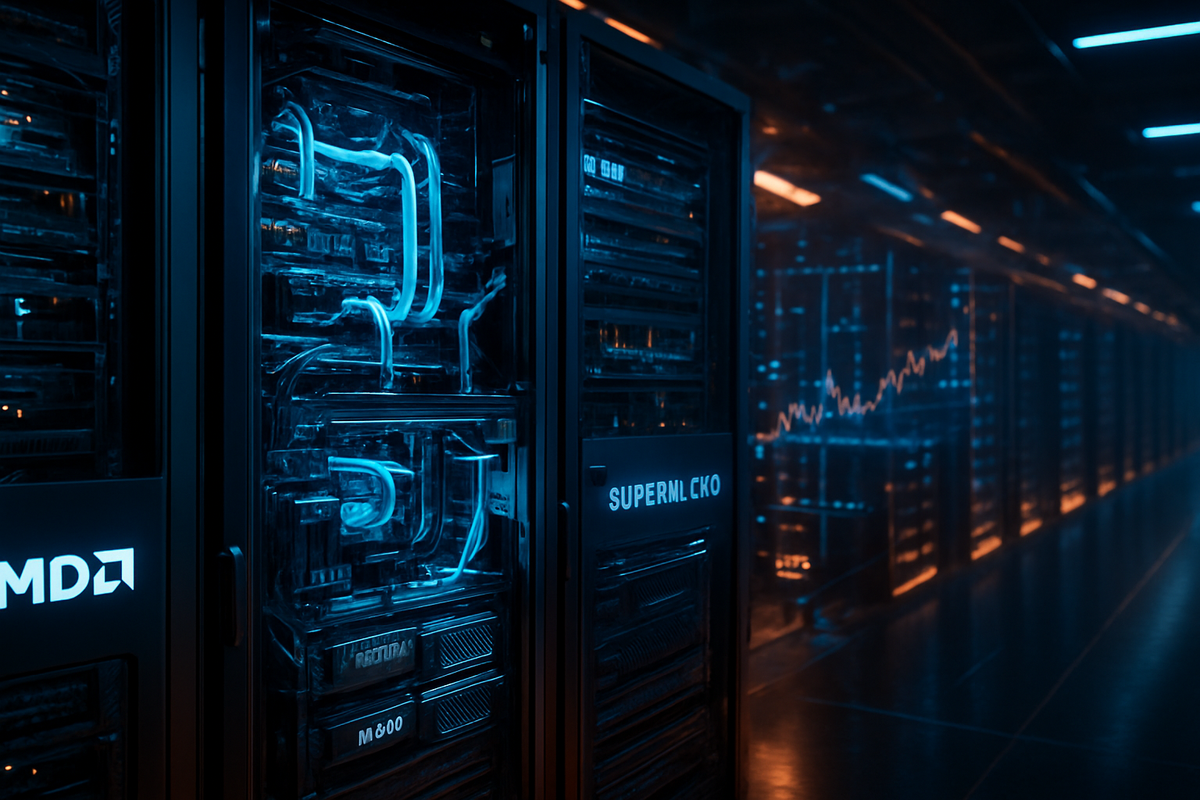
The timeline leading into this earnings season has been marked by several key developments. Throughout late 2025, Advanced Micro Devices successfully ramped up production of its MI350 series, positioning the "Helios" platform as a direct rival to NVIDIA’s (NASDAQ: NVDA) dominant Blackwell architecture. More recently, reports have surfaced of a 1-gigawatt GPU deployment scheduled for the second half of 2026 involving AMD’s highly anticipated MI400 series, which features next-generation HBM4 memory. Simultaneously, Super Micro Computer has solidified its position by scaling its "Direct Liquid Cooling" (DLC-2) manufacturing capacity to 3,000 racks per month, addressing the critical power and cooling bottlenecks that have plagued the industry.
Initial market reactions to the 2026 Capex announcements were positive, yet tempered by concerns over margin compression. For instance, when SuperMicro reported its preliminary results earlier this month, the stock experienced significant volatility despite a revenue beat, as investors focused on the narrowing gap between production costs and aggressive pricing strategies. This dynamic has set the stage for a "show-me" quarter, where the primary stakeholders—ranging from institutional asset managers to semiconductor foundry partners—will look for clarity on the pricing power of these hardware giants in an increasingly competitive landscape.
Identifying the Winners and Losers in the AI Rack
The outcome of these earnings reports will create a ripple effect across the technology ecosystem, with clear winners and losers likely to emerge. Advanced Micro Devices stands as a potential major winner if it can demonstrate that its MI300 and MI350 series are capturing a larger share of the hyperscaler budget away from the market leader. A strong report from AMD would validate its status as a viable "second source" for AI chips, providing a boost not only to its own stock but also to its primary manufacturing partner, Taiwan Semiconductor Manufacturing Company (NYSE: TSM). Conversely, any sign of a sequential slowdown in AMD’s data center revenue could signal that NVIDIA’s grip on the market remains unbreakable, potentially leading to a sharp re-rating of AMD’s current valuation.
Super Micro Computer occupies a more complex position. As an integrator that packages chips into finished server racks, its success is a direct reflection of "on-the-ground" deployment speed. A positive earnings surprise from SuperMicro would benefit the entire supply chain of component providers, including memory makers like Micron Technology (NASDAQ: MU) and power management firms. However, SuperMicro’s aggressive pursuit of market share has invited competition from traditional enterprise server giants like Dell Technologies (NYSE: DELL) and Hewlett Packard Enterprise (NYSE: HPE). If SuperMicro’s margins continue to contract despite record revenue, it may signal that the AI server market is becoming "commoditized," which would be a bearish signal for the company but potentially a win for the hyperscalers who are looking to lower their infrastructure costs.
Broad Implications for the AI Capital Cycle
The broader significance of the AMD and SuperMicro earnings lies in their role as barometers for the health of the global AI capital expenditure cycle. This event fits into a historical pattern where massive infrastructure builds—similar to the fiber-optic build-out of the late 1990s or the mobile transition of the early 2010s—reach a point of maximum intensity before settling into a more mature growth phase. The 2026 Capex surge represents a historical anomaly in terms of the sheer volume of capital being deployed into a single technological shift.
Potential ripple effects extend beyond hardware into the regulatory and sovereign spheres. If these companies report continued triple-digit growth, it will likely accelerate the "Sovereign AI" trend, where nation-states invest in domestic compute clusters to ensure data and technological independence. However, the intensity of this spending is also drawing increased scrutiny from regulators concerned about the energy consumption of massive data centers. A report showing a high adoption rate of SuperMicro's liquid cooling technology could mitigate some of these environmental concerns, whereas a failure to address efficiency could invite tighter policy restrictions on data center expansion.
Furthermore, these results will offer a critical comparison to previous market cycles. In 2024, the market was driven by the "scarcity" of AI chips. In early 2026, the narrative has shifted to "scaling." The market is now looking for evidence that the transition from training large language models (LLMs) to the "inference" phase—where AI is actually used by billions of end-users—is generating enough software revenue to justify the $650 billion hardware bill.
Looking Forward: Strategy and Scenarios
Looking ahead, the next several months will be defined by how well these companies navigate the transition to next-generation architectures. For AMD, the upcoming launch of the MI400 series in mid-2026 represents a critical strategic pivot. If the MI400 achieves the rumored 19.6 TB/s bandwidth and 432GB of HBM4 memory, it could fundamentally alter the competitive dynamics of the industry, potentially forcing NVIDIA to accelerate its own roadmap.
Short-term opportunities will likely center on the expansion of "Edge AI," where compute power is moved closer to the user. Both AMD and SuperMicro have begun diversifying their product lines to include more compact, power-efficient AI systems designed for regional data centers and corporate offices. However, the challenge will be maintaining execution in a global supply chain that remains fragile. Potential bottlenecks in the production of HBM4 memory or specialized liquid cooling components could cap the growth of even the most successful companies.
In a worst-case scenario where hyperscalers begin to pull back on spending due to lackluster AI software monetization, these hardware companies would be forced to undergo significant restructuring. Conversely, if the 1-gigawatt deployments rumored for late 2026 come to fruition, we may be witnessing the birth of a multi-trillion dollar industrial compute sector that functions much like a modern utility.
Wrap-Up: What to Watch in the Coming Months
The upcoming earnings for AMD and SuperMicro are more than just financial reports; they are a stress test for the entire AI investment thesis. The key takeaways for investors will be the sustainability of data center growth, the trajectory of gross margins, and the specific guidance for the second half of 2026. As the market transitions from speculative hope to operational reality, the "bellwether" status of these two firms has never been more relevant.
Moving forward, the market will likely reward companies that can demonstrate a clear path to efficiency and scalability. The "AI hardware trade" in early 2026 has become a game of execution and thermal management as much as it is about raw compute power. Investors should watch closely for any mentions of "utilization rates" from the hyperscalers and "backlog conversion" from the hardware providers. In the coming months, these metrics will provide the clearest signal as to whether the AI revolution is continuing its upward trajectory or if it is approaching a temporary plateau.
This content is intended for informational purposes only and is not financial advice.