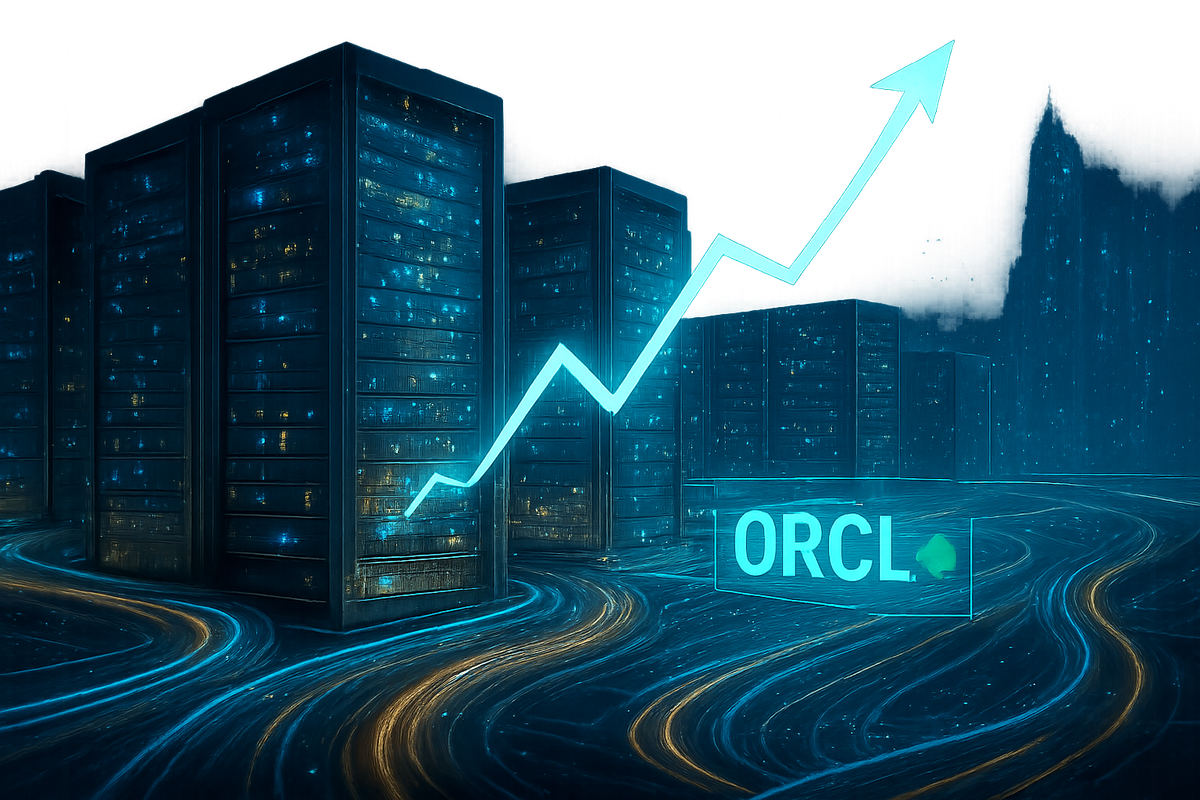
Shares of Oracle Corporation (NYSE: ORCL) experienced a notable rebound this week after Oppenheimer analysts upgraded the technology giant to "Outperform," signaling a potential end to the stock’s recent period of intense volatility. The upgrade, issued on February 25, 2026, comes at a pivotal moment for the company as it aggressively pivots from its legacy database roots to becoming a cornerstone of the global artificial intelligence (AI) infrastructure.
The market's positive reaction reflects growing confidence in Oracle's ability to monetize its massive cloud backlog and navigate the high-stakes capital expenditure race currently defining the technology sector. By citing a "valuation too attractive to ignore" and durable momentum in cloud infrastructure, analysts have refocused investor attention on Oracle’s long-term growth trajectory as a specialized alternative to traditional hyperscale providers.
A Strategic Pivot and a Valuation Reset
On Wednesday, February 25, Oppenheimer analyst Brian Schwartz and his team raised their rating on Oracle (NYSE: ORCL) from "Perform" to "Outperform," setting a new price target of $185. This target implies an approximate 25% upside from current levels. The upgrade followed a brutal several-month period for Oracle shareholders; the stock had plummeted roughly 56% from its September 2025 peak of $328 to a low near $146 in early 2026. This "valuation reset" saw the company’s forward price-to-earnings (P/E) multiple contract from a lofty 40x to a more modest 19x, a level Oppenheimer argued significantly under-discounts the company’s future earnings potential.
The primary catalyst for the upgrade is the accelerating adoption of Oracle Cloud Infrastructure (OCI). Oppenheimer highlighted Oracle’s unique position as a "durable AI winner," benefiting from massive commitments by industry titans such as OpenAI, NVIDIA (NASDAQ: NVDA), and Meta Platforms (NASDAQ: META). Despite broader market concerns regarding "CapEx panic"—the fear that tech companies are overspending on AI data centers—Oracle has demonstrated a massive backlog of contracted demand. The company entered 2026 with a record $523 billion in Remaining Performance Obligations (RPO), providing a level of revenue visibility that few competitors can match.
Oracle’s stock responded immediately to the news, rising as much as 4% during the trading session on February 25 before closing at $147.89. This movement suggests a shift in investor sentiment, moving away from fears of debt-heavy expansion and toward the realization of Oracle's high-performance computing (HPC) advantages. The upgrade also comes on the heels of Oracle’s successful execution of a massive $25 billion eight-part bond offering in early February, which was met with record-breaking demand, signaling that credit markets remain highly receptive to the company's AI-focused roadmap.
Winners and Losers in the AI Infrastructure Race
The resurgence of Oracle (NYSE: ORCL) creates a complex dynamic among the "hyperscaler" elite. While Oracle remains the fifth-largest global cloud provider with approximately 3% market share, its rapid growth in high-performance niches poses a direct challenge to leaders like Amazon (NASDAQ: AMZN) Web Services (AWS) and Microsoft (NASDAQ: MSFT) Azure. Oracle’s specialized RDMA (Remote Direct Memory Access) networking—a technical requirement for training large language models—has allowed it to capture high-value contracts that might have otherwise gone to the larger players.
The biggest winners from Oracle’s continued expansion are likely the hardware and silicon providers. NVIDIA (NASDAQ: NVDA) remains a crucial partner, as Oracle’s massive data center buildouts require tens of thousands of H-series and B-series GPUs. Additionally, enterprise software clients who have long relied on Oracle databases are finding the transition to OCI more seamless than moving to rival clouds, reinforcing Oracle’s "sticky" ecosystem.
Conversely, legacy on-premise hardware providers may continue to see pressure as Oracle successfully migrates its massive installed base to the cloud. While AWS and Google Cloud (NASDAQ: GOOGL) continue to lead in total scale, Oracle’s ability to offer lower-cost, high-performance specialized clusters for AI training is carving out a "premium boutique" position in the market that forces competitors to rethink their pricing and technical architectures for AI workloads.
Broadening the Horizon: AI CapEx and the Debt War Chest
Oracle’s recent moves fit into a broader industry trend where "Big Tech" is increasingly defined by its willingness to deploy massive amounts of capital into physical infrastructure. The company’s $25 billion bond sale in early February 2026—part of a larger $45–$50 billion funding strategy—reflects a "go big or go home" approach to the AI era. This debt-fueled expansion was initially a source of investor anxiety, but the Oppenheimer upgrade suggests that the market is beginning to view this spending as a necessary prerequisite for capturing the $300 billion, five-year contract Oracle recently secured with OpenAI.
Historically, such massive capital raises were viewed with skepticism, reminiscent of the fiber-optic buildouts of the late 1990s. However, the key difference today is the presence of pre-signed, multi-billion dollar contracts (RPO) that guarantee usage of the capacity being built. Oracle’s move signals that the competitive landscape for AI is no longer just about software; it is about who can secure the land, power, and chips to build the "AI factories" of the future.
Furthermore, Oracle’s success in the debt markets—drawing $129 billion in orders for its $25 billion bond sale—sets a precedent for other technology companies looking to fund their own AI transitions. It demonstrates that despite high interest rates relative to the previous decade, there is an insatiable appetite for high-quality corporate debt from technology leaders who can prove a direct link between capital spending and future cash flow.
The Road Ahead: Scaling the "AI Factory"
In the short term, Oracle (NYSE: ORCL) must execute flawlessly on its data center delivery timeline. With over $500 billion in backlogged orders, the primary risk has shifted from "demand" to "execution." Investors will be looking for updates on the speed of GPU cluster deployments and the efficiency of power procurement—a growing bottleneck in the data center industry. Any delays in bringing new capacity online could dampen the momentum generated by the Oppenheimer upgrade.
Looking further out, Oracle's challenge will be to maintain its margin profile while servicing its expanded debt load. Analysts expect Oracle to be an "upper-echelon EPS compounder," with potential for earnings per share to double by fiscal year 2030. Achieving this will require Oracle to move beyond just providing infrastructure (IaaS) and successfully cross-sell its AI-integrated applications and autonomous database services.
Potential strategic pivots could include deeper integrations with other cloud providers. Oracle has already shown a willingness to be "pragmatically multi-cloud," partnering with Microsoft and Google to allow their services to run on OCI. Continued expansion of these "interconnect" agreements could further solidify Oracle’s role as the indispensable backbone of the enterprise AI world, even as it competes for the same customers.
A New Chapter for a Tech Titan
The Oppenheimer upgrade serves as a powerful validation of Oracle’s (NYSE: ORCL) aggressive, multi-year transformation. By successfully navigating a significant valuation correction and securing the capital necessary for global expansion, Oracle has positioned itself not just as a survivor of the legacy software era, but as a primary architect of the AI economy. The combination of a massive $523 billion backlog and a technical edge in high-performance networking provides a formidable moat against smaller competitors.
As the market moves forward, investors should keep a close eye on Oracle’s quarterly capital expenditure reports and its progress in converting its RPO into recognized revenue. The ability of the company to manage its new debt load while sustaining its dividend and growth targets will be the ultimate test of its 2026 strategy. For now, the "outperform" rating reflects a growing consensus that the bottom is in, and the "AI war chest" is ready to be deployed.
In the coming months, watch for announcements regarding new mega-scale data centers and further partnership expansions with AI leaders. If Oracle can deliver the capacity it has promised, it may well lead the next leg of the technology sector's growth cycle.
This content is intended for informational purposes only and is not financial advice.