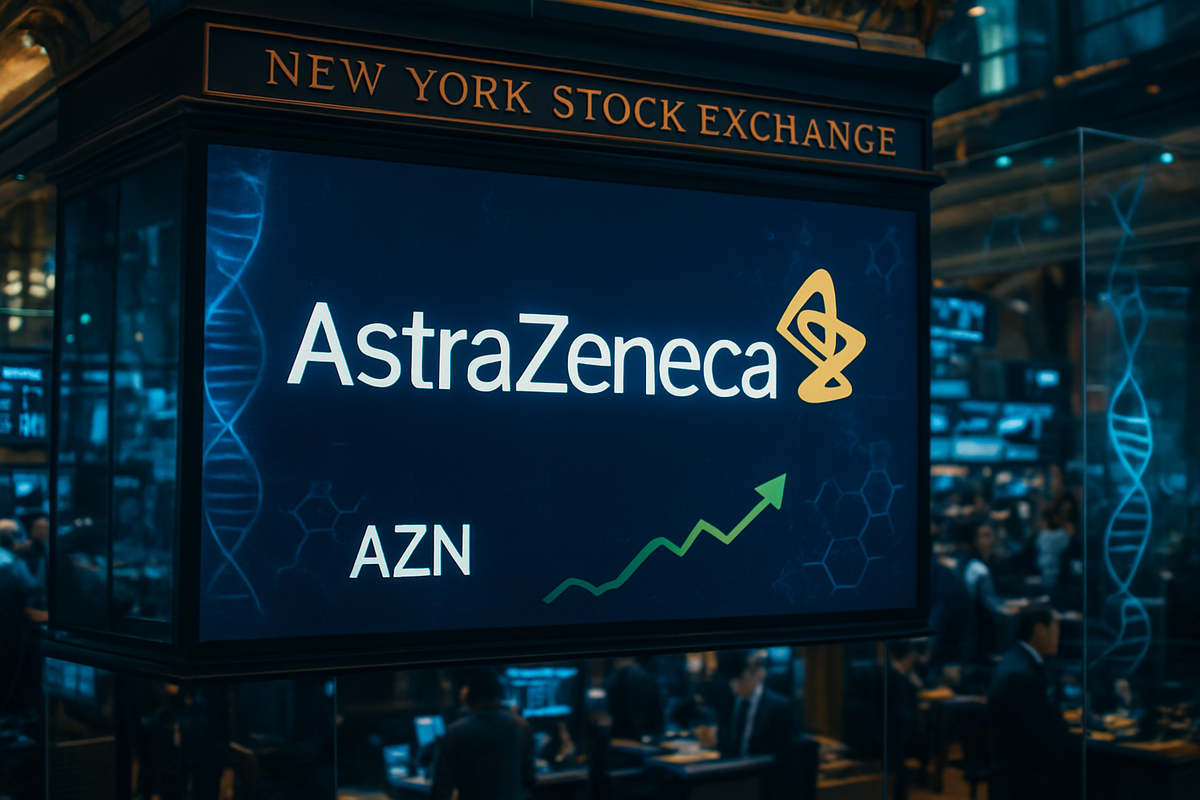
On February 2, 2026, AstraZeneca PLC (NYSE: AZN) officially rang the opening bell at the New York Stock Exchange, marking the completion of its high-profile transition from the Nasdaq. The move signals a major structural shift for the UK-based pharmaceutical leader, as it moves away from its long-standing American Depositary Share (ADS) program to a direct listing of its ordinary shares. By "harmonizing" its global share structure across New York, London, and Stockholm, the company has removed layers of administrative complexity and positioned itself for direct engagement with the world’s largest pool of institutional capital.
The transition, effective just three weeks ago, has already yielded tangible market results. For investors, the most immediate change was a structural "re-basing" of the share price, as the previous 2-for-1 ADS ratio was replaced by a 1:1 ordinary share listing. This move has effectively simplified the company's equity story, eliminating the "pass-through" fees associated with depositary banks and allowing global investors to trade the same security regardless of the exchange. In the weeks following the move, AstraZeneca’s stock has shown significant momentum, buoyed by both the listing change and a robust year-end earnings report that underscored the company's aggressive growth trajectory toward 2030.
A Seamless Transition: From ADSs to Ordinary Shares
The move to the "Big Board" was meticulously choreographed to ensure minimal disruption for existing shareholders. On the final trading day of January 2026, AstraZeneca concluded its tenure on the Nasdaq, where it had traded as an ADS since its inception in the U.S. markets. Under the old structure, two ADSs represented one ordinary share. With the move to the New York Stock Exchange (NYSE), the company eliminated this intermediary layer. For every two ADSs previously held, investors received one ordinary share of AstraZeneca PLC (NYSE: AZN). While this caused the nominal share price to effectively "double"—jumping from the mid-$90s to approximately $188 on day one—the underlying market capitalization of the company, valued at nearly $294 billion at the time of the transfer, remained unchanged.
The primary architect of this move, AstraZeneca Chair Michel Demaré, characterized the shift as a necessary evolution for a "global company in a global industry." By listing ordinary shares directly, AstraZeneca removed the need for a depositary bank—formerly Deutsche Bank AG (NYSE: DB)—to act as a middleman. This removal of the ADS structure is a direct benefit to shareholders, who no longer face the small but persistent custody and dividend distribution fees that are standard in the ADR (American Depositary Receipt) market.
The timeline leading up to the February 2 debut was driven by a broader corporate strategy to simplify the company’s "cap table" and financial reporting. For years, the 2:1 ratio and the ADS structure created minor but cumulative friction for U.S.-based institutional investors, such as large pension funds and insurance companies, some of which have internal mandates preferring direct equity over depositary receipts. The initial market reaction was overwhelmingly positive; on its first day of trading on the NYSE, AZN shares climbed over 1.5%, a rare feat for a transfer of this magnitude. NYSE President Lynn Martin welcomed the pharmaceutical giant, noting that it represented the largest company transfer by market capitalization in the exchange's history.
The Winners and Losers of the Big Board Move
The most obvious winner in this corporate migration is the Intercontinental Exchange, Inc. (NYSE: ICE), the parent company of the New York Stock Exchange. Winning a "mega-cap" transfer like AstraZeneca is a significant prestige boost for the NYSE, which has been in a fierce, decades-long battle with Nasdaq, Inc. (NASDAQ: NDAQ) to attract the world’s largest healthcare and technology companies. While the Nasdaq remains the traditional home for many biotech and tech firms, the NYSE’s reputation for deep liquidity and its specialist-driven trading model proved to be a stronger draw for AstraZeneca’s massive global float.
Institutional and retail investors also emerge as winners. By trading ordinary shares directly, investors gain a more transparent view of the company’s value and avoid the "leakage" of administrative fees. Furthermore, the move facilitates easier price discovery; since the shares in New York are now fungible with those on the London Stock Exchange (LSE: AZN) and Nasdaq Stockholm (STO: AZN), arbitrage opportunities are reduced, and the "global" price of AstraZeneca becomes more unified.
On the losing side of the ledger, the Nasdaq (NASDAQ: NDAQ) suffers the loss of one of its most valuable healthcare listings, a blow to its total market capitalization and trading volume metrics. Additionally, depositary banks like Deutsche Bank (NYSE: DB) lose the lucrative service and custody fees associated with managing a massive ADR program for a company of AstraZeneca's size. While the transition was smooth, some retail investors on brokerage platforms experienced brief confusion during the first week of February, as some automated tracking tools failed to immediately adjust for the 2:1 ratio change, leading to erroneous reports of "100% gains" that were actually just reflections of the share consolidation.
Harmonization as a Global Trend in Big Pharma
AstraZeneca’s decision to harmonize its listing reflects a broader trend among European multinational corporations seeking to simplify their presence in U.S. markets. Traditionally, non-U.S. companies used ADRs as a "bridge" to reach American investors. However, as global capital markets become more integrated and digital trading infrastructure improves, the "bridge" is increasingly seen as a toll road. By moving to a direct listing of ordinary shares, AstraZeneca is following the path of other global icons that have sought to unify their share classes to improve liquidity and reduce corporate overhead.
This move has significant ripple effects on competitors. Fellow pharmaceutical titans like GSK plc (NYSE: GSK) and Sanofi (NASDAQ: SNY) will undoubtedly be watching AstraZeneca’s transition closely. If AstraZeneca continues to see enhanced institutional inflow and tighter trading spreads as a result of its NYSE listing, it may spark a "domino effect" where other European giants delist their ADRs in favor of direct ordinary share listings on the Big Board.
Furthermore, the timing of the move is strategic. AstraZeneca has set an ambitious target of reaching $80 billion in annual revenue by 2030. Achieving this will likely require significant mergers and acquisitions (M&A). Having a harmonized, highly liquid share structure on the NYSE provides the company with a more potent "acquisition currency." It is far easier to negotiate a multi-billion dollar stock-swap deal when the shares being offered are a single, globally recognized ordinary share class rather than a complex depositary receipt.
What Comes Next for the AstraZeneca Growth Engine
In the short term, the market is already rewarding AstraZeneca’s streamlined structure. Just days after the NYSE move, on February 10, the company released its Full Year 2025 results, reporting a robust $58.7 billion in revenue and an 11% growth in Core EPS. This fundamental strength, combined with the "halo effect" of the NYSE listing, propelled the stock to a new 52-week high of $212.71 on February 18. Analysts from firms like Barclays (NYSE: BCS) and Citigroup (NYSE: C) have maintained "Overweight" and "Buy" ratings, respectively, noting that the new listing structure should continue to attract fresh institutional capital throughout the first half of 2026.
Looking further ahead, the "harmonized" AstraZeneca is now better positioned to capitalize on its burgeoning drug pipeline. The company recently highlighted its success with the Matterhorn Phase III trial for Imfinzi and a $1.2 billion deal in the injectable obesity drug space. These high-growth areas require massive R&D investment, and the NYSE provides the most robust environment for raising the necessary capital. Investors should watch for the company’s potential inclusion in more NYSE-weighted indices, which could trigger further passive buying from ETFs and mutual funds that track the "Big Board" specifically.
The primary challenge moving forward will be navigating the potential for increased volatility that comes with a high-profile NYSE listing. As a central figure on the world's most watched exchange, AstraZeneca will face even greater scrutiny from activist investors and U.S. regulators. However, the company's leadership appears confident that the transparency and efficiency gained from the Feb 2 move will far outweigh these challenges.
Summary: A New Chapter for a Global Leader
AstraZeneca’s transition to the New York Stock Exchange on February 2, 2026, marks the end of the ADS era for the company and the beginning of a more unified, global approach to its capital structure. By eliminating the 2:1 ratio and moving to a direct listing of ordinary shares, the company has lowered costs for investors and simplified its equity story at a time of rapid fundamental growth.
Key takeaways for investors include:
- Price Adjustment: The current share price (approx. $205) reflects the new 1:1 ratio, which is double the old ADS-based price.
- Cost Savings: The elimination of ADS fees is a direct, long-term benefit to shareholders.
- Liquidity: The move provides direct access to the world’s largest pool of healthcare-focused institutional capital.
- Strategic Intent: This move is a precursor to AstraZeneca’s "Road to $80 Billion" revenue goal by 2030, providing better M&A currency and global visibility.
As the dust settles on this historic transfer, the market is no longer looking at AstraZeneca as a "foreign company with a U.S. depositary." It is now a truly global entity, trading the same shares on the NYSE as it does in London and Stockholm, unified and ready for its next decade of expansion.
This content is intended for informational purposes only and is not financial advice. Investing in the stock market involves risk, including the loss of principal. Please consult with a qualified financial advisor before making any investment decisions.