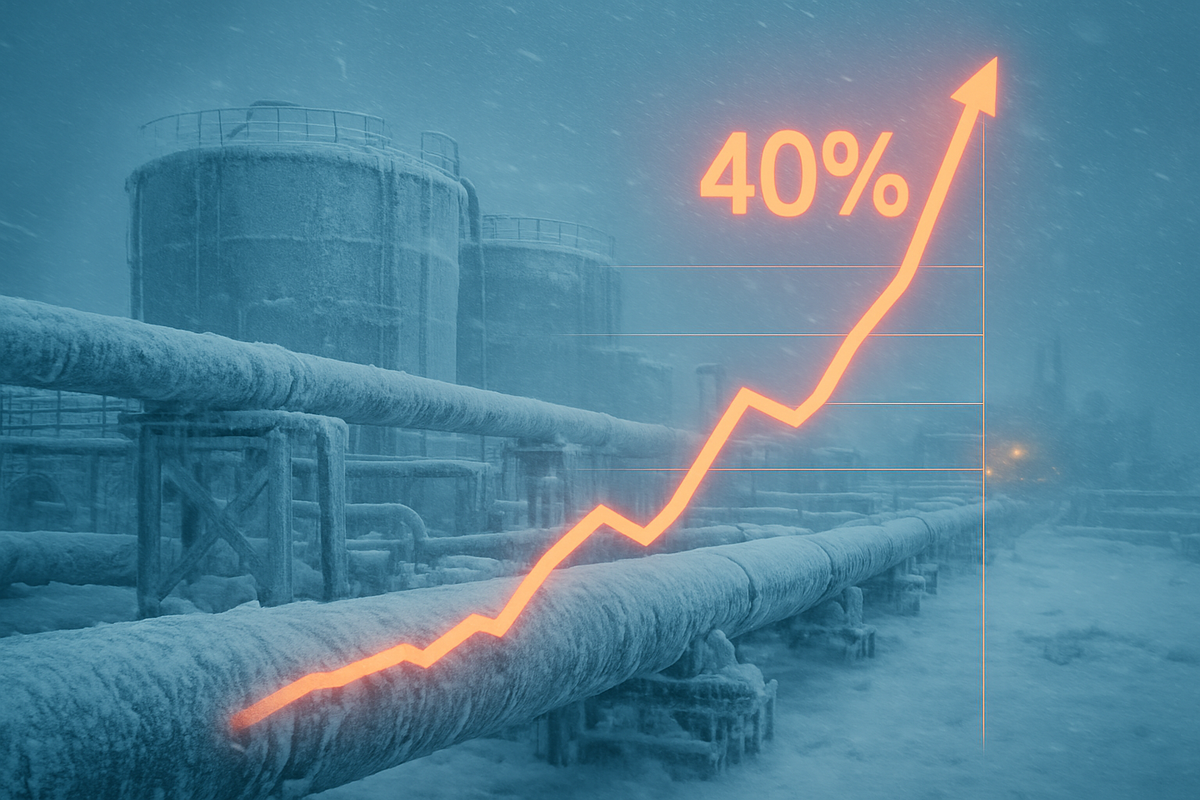
The U.S. Energy Information Administration (EIA) has sent shockwaves through the energy markets with the release of its February 2026 Short-Term Energy Outlook (STEO), significantly upwardly revising near-term natural gas price forecasts by a staggering 40%. The revision comes in the wake of "Winter Storm Fern," an aggressive Arctic blast in late January that crippled production and forced a historic reliance on underground reserves. With inventory levels plummeting, the federal agency now projects that the Henry Hub spot price will average $4.60 per million British thermal units (MMBtu) in February and $4.12/MMBtu in March—a sharp departure from the sub-$3.00 levels anticipated just two months ago.
The fallout from the storm has effectively erased the supply surplus that characterized much of 2025. For the week ending January 30, 2026, the EIA confirmed a net withdrawal of 360 billion cubic feet (Bcf) from storage, marking the single largest weekly draw in the history of the Weekly Natural Gas Storage Report. As of February 25, 2026, the market is grappling with the reality of an undersupplied system, with total inventories expected to fall below 1.9 trillion cubic feet (Tcf) by the end of March—the lowest end-of-season level in years.
Frozen Out: The Anatomy of a Record-Breaking Storage Withdrawal
The crisis was precipitated by Winter Storm Fern, which swept across the United States between January 23 and January 27, 2026. The storm delivered a "perfect storm" of extreme cold and infrastructure vulnerability. At its peak on January 26, approximately 18.3 Bcf/d of natural gas production was knocked offline due to "freeze-offs," where liquids in the gas stream freeze at the wellhead or in gathering lines. This represented a massive 17% of the total U.S. gas supply lost in a single day. The Permian Basin was hit particularly hard, accounting for nearly half of those losses as temperatures in Texas plummeted well below historical norms.
The timeline of the event shows a rapid escalation from a standard winter chill to a national energy emergency. By January 28, the spot price at the Henry Hub had briefly surged to an eye-watering $30.72/MMBtu as utilities scrambled for any available molecules to keep heating systems operational. The massive 360 Bcf withdrawal for the week ending January 30 was necessary to bridge the gap between crippled production and record-high residential and commercial demand. This draw exceeded the five-year average for that week by 89%, fundamentally altering the trajectory of domestic energy pricing for the remainder of the year.
Market Repercussions: The Corporate Winners and Losers of the Freeze
The sudden price spike has created a stark divide between energy producers and consumers. EQT Corporation (NYSE: EQT), the largest natural gas producer in the United States, emerged as one of the primary beneficiaries of the volatility. By entering 2026 with a significant portion of its production unhedged, EQT was able to capture the full upside of the January and February price spikes. Reports suggest the company realized a windfall of nearly $1 billion in February alone. In the wake of the storm, EQT has since moved to lock in these gains, increasing its 2026 hedging profile from 7% to 25% to protect against potential spring price corrections.
Other Appalachian producers like Antero Resources (NYSE: AR) also saw significant stock appreciation as investors rotated into "gassy" equities with exposure to the Northeast's high-demand markets. Conversely, the situation was more complex for LNG exporters like Cheniere Energy (NYSE: LNG). While the company successfully loaded its first cargo from the Corpus Christi Stage 3 (Train 1) expansion in early February, the domestic price surge narrowed the "arbitrage" window—the profit margin between cheap U.S. gas and expensive overseas markets. However, the global demand for reliability meant that Cheniere’s volumes remained at record highs even as domestic costs climbed.
On the losing end of the ledger were energy-intensive industrial firms and regulated utilities that did not have sufficient storage or long-term supply contracts. These companies were forced to buy gas on the emergency spot market, costs that will eventually be passed on to consumers in the form of significantly higher utility bills throughout the spring and summer of 2026.
A Structural Shift: Why 'Fern' Changed the Natural Gas Narrative
The events of early 2026 highlight a significant structural shift in the U.S. energy market. For years, the market had become accustomed to a "supply-first" mentality driven by the shale revolution. However, Winter Storm Fern demonstrated that even with massive reserves, the infrastructure remains vulnerable to extreme weather events. This event mirrors previous freezes like Winter Storm Uri in 2021, but with a more globally integrated market, the stakes are now much higher. The ripple effects are being felt by competitors and partners alike, as the reliability of U.S. gas as a "bridge fuel" is once again under the microscope.
Furthermore, the 40% hike in the EIA’s STEO reflects a recognition that supply cannot simply "turn on" at the flip of a switch. With storage levels forecasted to remain below 1.9 Tcf by the end of the withdrawal season, the "buffer" that usually prevents price volatility has been severely eroded. This tightness is likely to persist as the industry enters the "shoulder season" of spring, where maintenance schedules and storage injections will compete for limited production.
Looking Forward: Production Hurdles and the Permian Recovery
Despite the short-term chaos, the long-term outlook for U.S. natural gas remains anchored by the Permian Basin. The EIA projects that the Permian will contribute 1.4 Bcf/d of incremental production growth throughout 2026. Much of this is "associated gas"—gas produced as a byproduct of oil drilling. As oil prices remain stable, this gas will continue to flow into the market, though the pace of recovery from the January freeze-offs has been slower than some analysts anticipated due to damaged equipment and lingering logistics issues.
The second half of 2026 is expected to bring some relief as new pipeline capacity, including the completion of several major takeaway projects in West Texas, comes online. This infrastructure is critical for moderating prices and ensuring that the Permian can meet both domestic demand and the growing needs of the Gulf Coast LNG export terminals. For investors, the focus will now shift to how quickly these projects can reach full capacity and whether the industry can rebuild its storage cushion before the summer cooling season begins.
Conclusion: Navigating a Re-Balanced Energy Market
The EIA’s February 2026 STEO serves as a sobering reminder of the volatility inherent in the energy sector. Winter Storm Fern did more than just break storage records; it re-indexed the market's expectations for what natural gas should cost in a post-transition economy. The 360 Bcf withdrawal in a single week is a historical outlier that will be studied by traders and policymakers for years to come.
As the market moves forward, investors should keep a close eye on weekly storage reports and the pace of Permian production growth. The key takeaway is that the "safety net" of high inventory has been removed, making the market hypersensitive to any further supply disruptions. While the immediate crisis of the storm has passed, the financial impact—reflected in the EIA's 40% price forecast hike—will linger for months, rewarding disciplined producers while putting pressure on the broader economy.
This content is intended for informational purposes only and is not financial advice