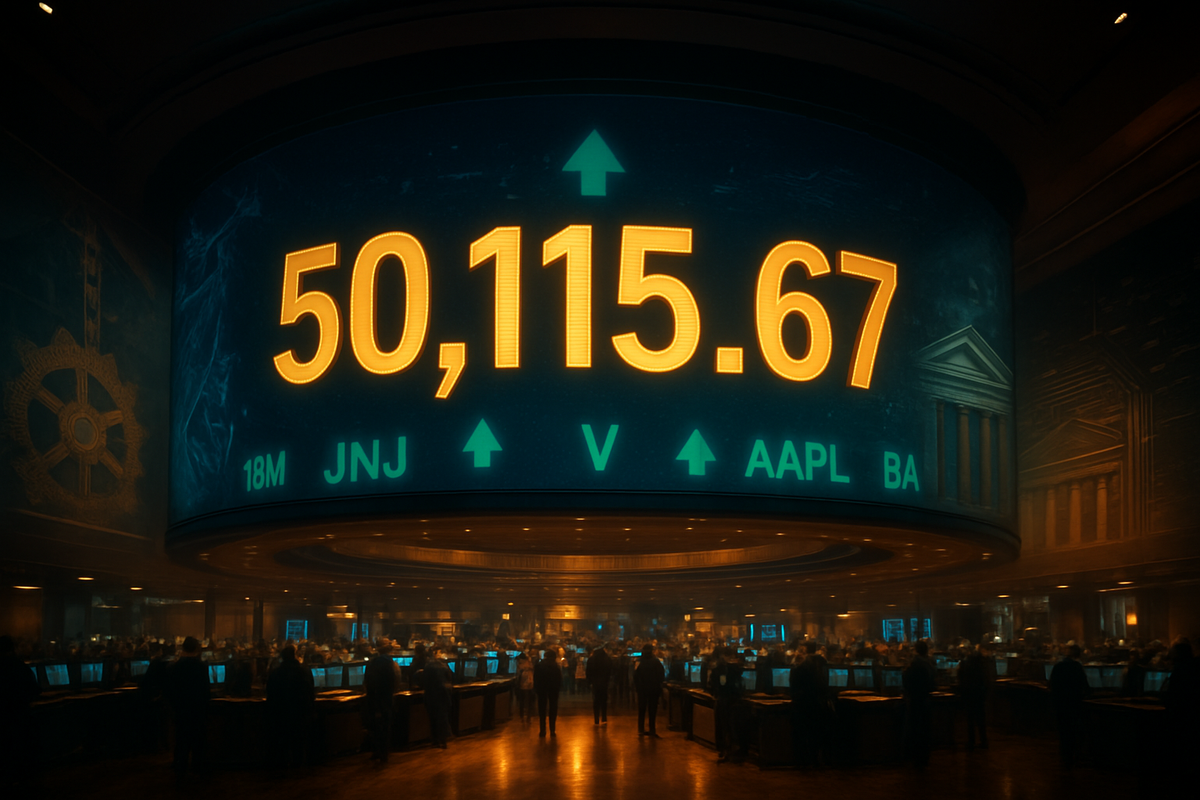
On February 6, 2026, the financial world witnessed a watershed moment as the Dow Jones Industrial Average (DJIA) eclipsed the 50,000-point mark for the first time in its 130-year history. This monumental achievement, closing at 50,115.67, represents more than just a psychological victory; it signals a fundamental shift in the engine of the American economy. While previous rallies were often criticized for being "top-heavy" and overly reliant on a handful of technology giants, the climb to 50,000 has been defined by a "Blue-Chip Renaissance" that has seen industrials, financials, and consumer staples reclaim their roles as market leaders.
The immediate implications of the 50,000-point breach are profound for investor sentiment. Crossing such a significant round number often triggers a "fear of missing out" (FOMO) among retail investors and institutional rebalancing that can provide a floor for future support. As the index consolidated above this level through late February 2026, market participants began to view the milestone as a validation of the "soft landing" narrative that many economists doubted just two years ago. The broadening of the rally suggests that the U.S. economy is firing on all cylinders, transitioning from a narrow AI-centric boom to a more sustainable, diversified expansion.
The surge to 50,000 was punctuated by a dramatic "melt-up" session on February 6, where the blue-chip index jumped over 1,200 points in a single day. This final push was catalyzed by a combination of a stellar consumer sentiment report and a series of robust earnings beats from the index's industrial heavyweights. The timeline leading to this moment was a study in resilience: after first touching 40,000 in May 2024, the Dow faced a turbulent 2025, including a sharp "Liberation Day" correction in April that saw the index retreat nearly 20% to the 37,000 level. However, a pivot in Federal Reserve policy during the latter half of 2025 provided the necessary tailwinds to reignite the bull market.
Key stakeholders, including major institutional asset managers and pension funds, have spent the last six months rotating capital into the Dow’s price-weighted components. Unlike the S&P 500, which is market-cap weighted, the Dow’s unique structure means that high-priced stocks have a disproportionate impact. This led to a focused effort by traders to bid up traditional value names that had lagged during the 2023–2024 tech frenzy. The initial market reaction to the 50,000 close was one of jubilation on the floor of the New York Stock Exchange, though it was quickly followed by a sober assessment of whether such valuations are sustainable in a "higher-for-longer" interest rate environment.
The journey to 50,000 created a clear set of winners, most notably Goldman Sachs Group Inc. (NYSE: GS), which ascended to become the most influential stock in the index. As the price-weighted leader, Goldman's climb toward $1,000 per share was a primary driver of the index’s gains, fueled by a resurgence in global merger and acquisition activity and a favorable yield curve. Similarly, Caterpillar Inc. (NYSE: CAT) emerged as a massive winner, gaining nearly 60% through 2025 and early 2026. The industrial giant benefited from a massive build-out of power infrastructure required to support AI data centers, proving that the "AI trade" has moved beyond software into physical hardware and energy.
Conversely, the path was not kind to all components. UnitedHealth Group (NYSE: UNH), once the undisputed heavyweight of the Dow, saw its influence wane as it became the worst performer of 2025. Surging medical costs and regulatory pressures in the Medicare Advantage space saw the stock drop over 30%, dragging on the index during its mid-2025 struggle. Even tech titan Microsoft Corp. (NASDAQ: MSFT), while still a powerhouse, began to lag the broader Dow in early 2026 as "AI realism" set in. Investors started demanding more tangible bottom-line results from AI investments, leading to a rotation out of high-multiple software stocks and into "old economy" stalwarts like Walmart Inc. (NYSE: WMT), which recently surpassed a $1 trillion market capitalization.
This event fits into a broader industry trend known as the "Great Rotation." After years of dominance by the "Magnificent Seven," the market finally reached a saturation point with tech valuations. The significance of Dow 50,000 lies in its confirmation that value stocks—those in the industrial, financial, and energy sectors—are no longer the "forgotten" middle child of the market. Historically, the Dow has taken progressively less time to cross 10,000-point thresholds: while it took 103 years to reach 10,000, the jump from 40,000 to 50,000 took less than two years, illustrating the accelerating pace of modern capital markets and the impact of systemic liquidity.
Regulatory and policy shifts have also played a crucial role. The Federal Reserve’s decision to implement three rate cuts in late 2025—bringing the federal funds rate down to the 3.50%–3.75% range—lowered the discount rate and boosted the present value of future earnings for blue-chip companies. This policy shift, combined with the 2024 inclusion of Nvidia (NASDAQ: NVDA) into the index (replacing the struggling Intel (NASDAQ: INTC)), modernized the Dow’s composition. The ripple effect has been felt by competitors and partners alike; as Chevron (NYSE: CVX) and JPMorgan Chase & Co. (NYSE: JPM) hit multi-year highs, the cost of capital for the entire industrial and banking sectors has shifted, encouraging more aggressive corporate investment.
As the market enters this new 50,000-plus era, the short-term outlook suggests a period of consolidation. History shows that major psychological barriers are rarely crossed and held on the first attempt without some "back-and-filling." Market participants are now looking toward the Federal Reserve’s next move under the potential leadership of a new Chair, with names like Kevin Warsh circulating in the news. The strategic pivot for many companies will now focus on efficiency and returning capital to shareholders through dividends and buybacks to justify their elevated stock prices.
Potential challenges loom on the horizon, specifically the threat of "sticky" inflation that could prevent the Fed from further easing. If the 10-year Treasury yield climbs back toward 5%, the high-priced components of the Dow could see a swift re-rating. However, the emergence of a broader bull market provides a cushion that didn't exist two years ago. Investors should prepare for a scenario where the Dow trades in a wide range—perhaps between 48,000 and 52,000—as it digests the gains of the last 18 months and waits for the next major economic catalyst.
The Dow eclipsing 50,000 is a testament to the enduring strength of the American corporate sector and its ability to adapt to changing monetary landscapes. The key takeaway for investors is that the rally has finally "democratized" across sectors, reducing the systemic risk of a single-sector collapse. Moving forward, the market’s health will likely be judged not by the performance of a few tech darlings, but by the steady earnings growth of the 30 components that make up this historic index.
In the coming months, investors should keep a close eye on the performance of financial stocks like American Express (NYSE: AXP) and the industrial outlook for Boeing Co. (NYSE: BA) and Salesforce Inc. (NYSE: CRM). As the "Blue-Chip Renaissance" continues, the focus will remain on whether these companies can maintain their momentum in a post-peak AI hype cycle. While 50,000 is a milestone to be celebrated, the real work for the market begins now: proving that this new floor is built on solid economic foundations rather than just psychological optimism.
This content is intended for informational purposes only and is not financial advice.