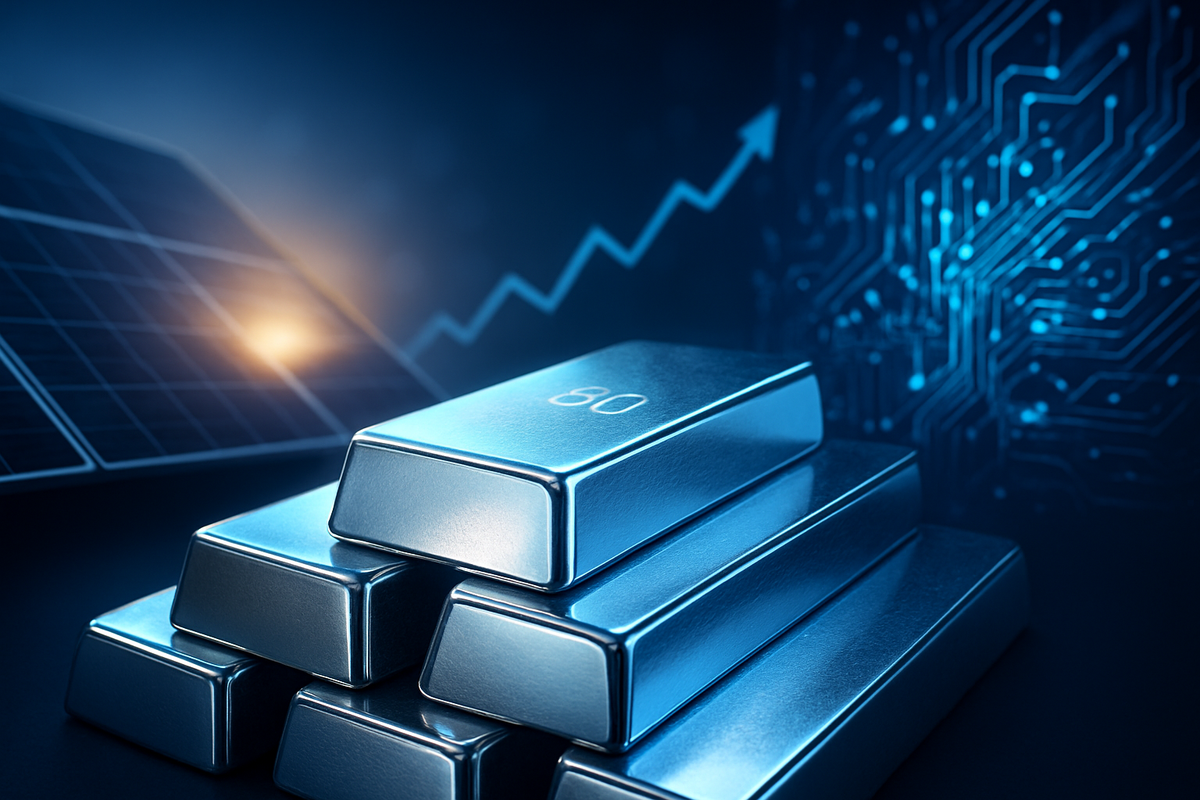
February 25, 2026 — The silver market has entered a transformative era, cementing its status as the "indispensable metal" of the 2020s. After a period of historic volatility that saw prices touch triple digits before a sharp correction, silver has successfully reclaimed the $80 per ounce threshold this month. This price action represents a significant outperformance of gold on a percentage basis, driven by a tightening "squeeze" scenario where physical supply can no longer keep pace with the insatiable demand from the green energy and artificial intelligence sectors.
The current market environment is defined by a paradox: while speculative fervor cooled following a late-January "flash crash," the underlying industrial fundamentals have never been stronger. As of late February 2026, the silver market is navigating its sixth consecutive year of structural deficit, leaving manufacturers in the solar and electronics industries scrambling to secure long-term contracts for the metal. With the gold-silver ratio compressing toward historic lows, investors are increasingly viewing silver not just as a monetary hedge, but as a critical industrial commodity whose supply chain is at a breaking point.
The Great Rebound: From the January Crash to $80 Stability
The journey to $80 per ounce was anything but linear. In late January 2026, silver experienced a speculative surge that pushed spot prices to an all-time high of $121.64 per ounce, fueled by retail investor enthusiasm and a massive short-covering event. However, the peak was short-lived; a combination of a hawkish shift from the Federal Reserve and a rebound in the U.S. Dollar Index triggered a "flash crash," with silver plummeting 36% to a low of approximately $75.00 per ounce within a single week.
The recovery from that bottom has been swift and resilient. Throughout mid-February, silver staged a "fundamental reset," climbing back to $80.00–$85.00 per ounce. Unlike the January spike, analysts at J.P. Morgan (NYSE: JPM) and Goldman Sachs (NYSE: GS) suggest this current level is supported by physical demand rather than purely speculative leverage. This rebound has been particularly notable when compared to gold; while gold has seen impressive gains to reach $5,000 per ounce, silver’s 2025-2026 trajectory has yielded nearly double the percentage returns for investors, as the gold-silver ratio dipped below 62:1.
Winners and Losers in a High-Price Environment
The primary beneficiaries of the silver surge are the primary miners and royalty companies. First Majestic Silver (NYSE: AG) and Pan American Silver (NASDAQ: PAAS) have seen their margins expand exponentially, despite rising labor and energy costs. These companies are now prioritizing the development of high-grade deposits that were previously considered uneconomical. Meanwhile, streaming giant Wheaton Precious Metals (NYSE: WPM) has capitalized on its fixed-cost contracts, providing shareholders with significant leverage to the rising spot price without the direct operational risks of mining.
On the losing side of the equation are the industrial consumers who rely on silver for its unmatched conductivity. Solar panel manufacturers like JinkoSolar (NYSE: JKS) and First Solar (NASDAQ: FSLR) are facing a cost-of-goods-sold crisis. Silver paste now accounts for nearly 30% of the total cost of a solar cell, forcing these companies to accelerate "thrifting" initiatives. Some manufacturers have begun experimenting with copper-plated cells to bypass silver entirely, though these technologies remain in the early stages of mass-market adoption. Similarly, the consumer electronics sector is feeling the pinch, as high silver prices add incremental costs to everything from smartphones to high-performance AI servers.
A Structural Deficit Meets the AI Revolution
The silver market is currently facing a projected supply shortfall of 67 million ounces for 2026. This deficit is the culmination of years of stagnant mine supply; since roughly 70% of silver is produced as a byproduct of lead, zinc, and copper mining, major producers like Hecla Mining (NYSE: HL) and Coeur Mining (NYSE: CDE) cannot easily ramp up production in response to price signals alone. Furthermore, global silver inventories in LBMA and COMEX vaults have been depleted to levels not seen in over two decades, leaving very little "buffer" to absorb sudden demand spikes.
While solar demand has historically been the primary driver of silver's industrial use, 2026 has seen the emergence of a new heavyweight: AI data centers. Silver’s superior thermal and electrical properties make it essential for the high-performance computing components required by the AI revolution. Experts estimate that data center infrastructure and 5G expansion could consume over 350 million ounces globally by the end of the year. This shift suggests that even if the solar industry successfully reduces its silver intensity, the "slack" will be immediately taken up by the next generation of high-tech infrastructure, keeping the market in a state of perpetual tightness.
The Road to $100: Scenarios and Strategic Pivots
Looking ahead, the market is bracing for a potential move toward $100 per ounce if supply chain disruptions persist. In the short term, the market will likely see a surge in silver recycling, as high prices incentivize the recovery of metal from old electronics and jewelry. However, recycling alone is unlikely to bridge the massive gap created by industrial demand. Investors should watch for strategic pivots among industrial users; if silver remains above $80, we may see major automotive and tech firms entering into direct "offtake" agreements with miners to guarantee supply, bypassing the open market entirely.
Potential challenges include a global economic slowdown, which could temper industrial demand, or a major technological breakthrough in silver substitution. However, given the current pace of electrification and the AI boom, most analysts remain bullish. The "silver squeeze" of 2026 is no longer a fringe theory but a market reality, as the transition from a speculative asset to a strategic industrial metal is now nearly complete.
Market Wrap-Up and Final Thoughts
The silver market in February 2026 serves as a case study in the power of structural deficits. After surviving a 36% price correction, the metal's recovery to $80 per ounce underscores the fact that industrial necessity is now the primary driver of value. For the first time in modern history, the "poor man's gold" is proving to be a more critical component of the global economy than gold itself, outperforming its yellow counterpart as the world scrambles to secure the materials necessary for the 21st-century energy and data transition.
For investors, the coming months will require a focus on inventory levels and mining output reports. As the gold-silver ratio continues to challenge historical norms, the focus will remain on whether miners like First Majestic and Pan American can bring new supply to market fast enough to satisfy a world that is increasingly "silver-hungry." The $80 level appears to be the new floor, and the path to triple digits is paved with the wires of solar farms and the processors of AI supercomputers.
This content is intended for informational purposes only and is not financial advice.