The semiconductor industry has found its new North Star in Dallas. Texas Instruments (NASDAQ: TXN), the global leader in analog and embedded processing, has sent a clear signal to the markets that the long-awaited recovery in the industrial and automotive sectors is finally here. Following its late-January earnings report and a blockbuster acquisition in early February, the company has pivoted from a period of defensive capital expenditure to an aggressive growth phase that analysts are already labeling the "Harvest Year."
The immediate implication of Texas Instruments' (NASDAQ: TXN) robust Q1 2026 guidance is a wholesale shift in investor sentiment regarding the broader analog chip market. After nearly two years of inventory gluts and sluggish demand in non-AI sectors, TI’s forecast of sequential revenue growth during a typically weak seasonal quarter has provided a "green shoot" that the entire industry has been waiting for. This optimism was further cemented by the company’s $7.5 billion acquisition of Silicon Laboratories (NASDAQ: SLAB), signaling a strategic expansion into the burgeoning Edge AI and wireless connectivity markets.
A Seasonal Surprise and a Strategic Strike
On January 27, 2026, Texas Instruments (NASDAQ: TXN) reported its fourth-quarter 2025 financial results, which initially appeared underwhelming. The company posted revenue of $4.42 billion and earnings per share (EPS) of $1.27, both slightly missing consensus estimates. However, the market quickly looked past the trailing data to the company’s forward-looking guidance. TI projected Q1 2026 revenue between $4.32 billion and $4.68 billion—a midpoint of $4.5 billion that shattered analyst expectations of $4.4 billion. Most significantly, this represented the first time in roughly 15 years that the company guided for sequential growth in the first quarter, a period that usually sees a pullback in orders.
The timeline of this resurgence accelerated in early February 2026, when Texas Instruments (NASDAQ: TXN) announced a definitive agreement to acquire Silicon Laboratories (NASDAQ: SLAB) for $231 per share in an all-cash transaction. This move was designed to fortify TI’s portfolio in the high-growth "Edge AI" and IoT sectors. Management noted that they intend to migrate Silicon Labs' production from external foundries to TI’s own state-of-the-art 300mm wafer fabs, a move expected to generate $450 million in annual cost savings within the next three years.
Initial market reactions were swift and decisive. Shares of Texas Instruments (NASDAQ: TXN) jumped nearly 9% in the week following the guidance update, reaching multi-year highs near the $213 level. Key stakeholders, including long-term institutional investors, pointed to the stabilization of the industrial and automotive end-markets as the catalyst. After 18 months of cautious "just-in-case" inventory management by global manufacturers, the order books at TI began to reflect a return to "just-in-time" replenishment, signaling that the supply chain's "digestive period" had ended.
Sector Winners and the Foundry Squeeze
The primary winner in this new landscape is undoubtedly Texas Instruments (NASDAQ: TXN), which is now reaping the benefits of its controversial multi-billion dollar investment in internal manufacturing capacity. By owning its fabs, TI can undercut competitors on price while maintaining higher margins, a competitive "moat" that is becoming increasingly difficult for fabless or "fab-lite" companies to cross. Silicon Laboratories (NASDAQ: SLAB) shareholders also emerged as winners, securing a premium valuation in an all-cash deal that values their technology at a peak multiple.
Conversely, the shift represents a potential challenge for external semiconductor foundries like Taiwan Semiconductor Manufacturing Company (NYSE: TSMC) and GlobalFoundries (NASDAQ: GFS). As TI internalizes the production of its newly acquired Silicon Labs assets, these foundries lose a high-margin customer. Furthermore, smaller analog competitors that lack the scale to build their own 300mm facilities may find themselves caught in a price war. Firms like ON Semiconductor (NASDAQ: ON) and NXP Semiconductors (NASDAQ: NXPI), which have significant exposure to the automotive market, are being forced to accelerate their own manufacturing efficiencies to keep pace with TI's "Harvest Year" strategy.
Analog Devices (NASDAQ: ADI) stands as a "neutral-to-positive" peer. While it competes directly with TI, the general uplift in the industrial sector has lifted ADI's stock as well. Analysts suggest that the "tide is rising for all boats" in the analog space, but TI’s internal manufacturing gives it a distinct advantage in the event of another macro-economic tightening.
The 300mm Hegemony and AI Power Trends
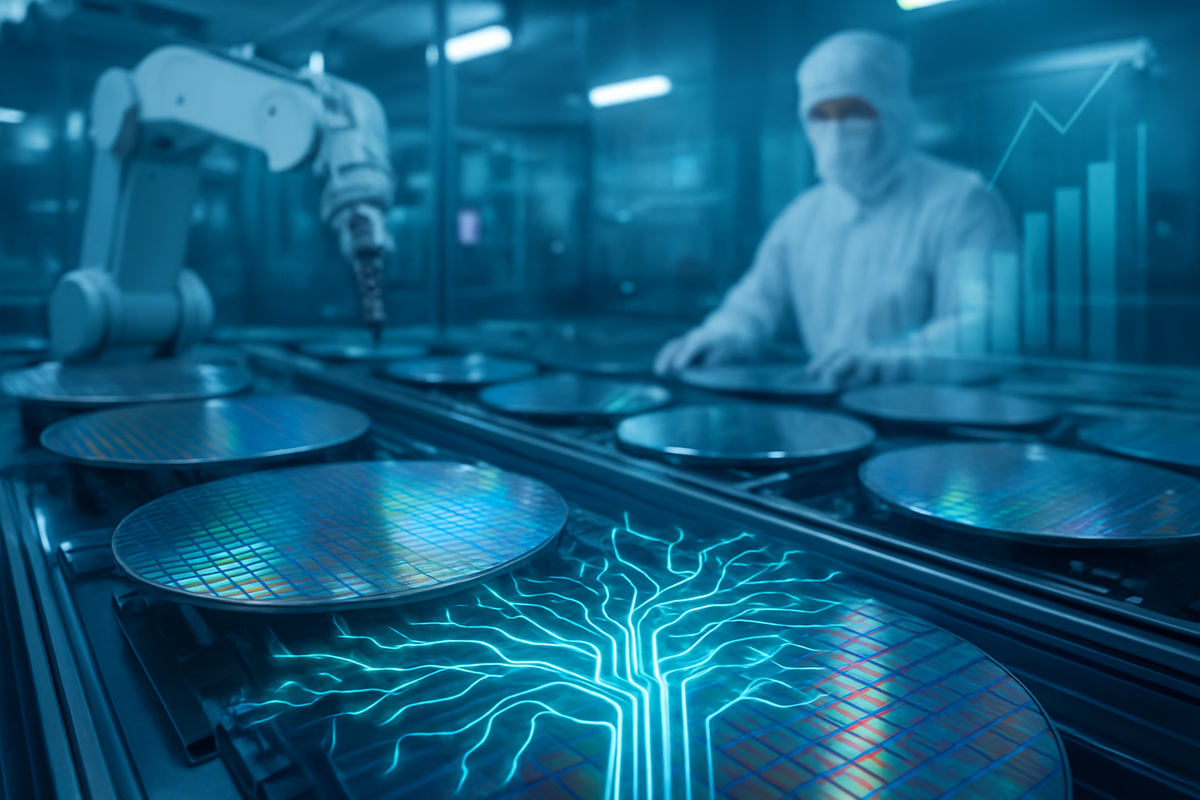
The significance of TI’s guidance fits into a much broader trend: the dominance of 300mm manufacturing in the analog world. For decades, analog chips were made on older 200mm wafers, but TI’s shift to 300mm allows for 2.3 times more chips per wafer, providing a structural 40% cost advantage over the previous generation. This move is being viewed as a historical precedent, similar to the shift from 6-inch to 8-inch wafers in the early 2000s, where those who invested early dominated the subsequent decade of market share.
Furthermore, the "AI Revolution" is finally trickling down from the data center to the power grid and the factory floor. While Nvidia (NASDAQ: NVDA) dominates the training of AI models, companies like Texas Instruments (NASDAQ: TXN) provide the sophisticated power management and signal chain chips that allow AI-enabled devices to operate efficiently. The integration of Silicon Labs’ Edge AI technology suggests that TI is positioning itself as the "nervous system" of the AI-connected world, bridging the gap between digital intelligence and physical hardware.
Regulatory and policy implications are also at play. With the U.S. government continuing to incentivize domestic semiconductor manufacturing through the CHIPS Act, TI’s focus on building capacity in Texas and Utah aligns perfectly with national security interests. This domestic footprint reduces geopolitical risk compared to competitors who remain heavily reliant on Asian supply chains, a factor that is increasingly being priced into stock valuations.
The Road Ahead: Integration and Utilization
Looking toward the remainder of 2026, the primary challenge for Texas Instruments (NASDAQ: TXN) will be the seamless integration of Silicon Laboratories (NASDAQ: SLAB). While the technical synergies are clear, shifting a fabless company’s entire product line to internal manufacturing is a massive logistical undertaking. Investors will be watching for any "hiccups" in the migration process that could lead to short-term supply disruptions.
In the long term, the market will focus on "factory utilization." TI has spent years building expensive cleanrooms; now, it must fill them with orders. If the industrial recovery falters later in 2026, the high fixed costs of these facilities could become a drag on earnings. However, most strategists believe the current cycle is just beginning, with opportunities in electric vehicle (EV) charging infrastructure and green energy storage providing a long-term "tail" for analog demand.
Potential strategic pivots may involve further acquisitions in the software layer of the semiconductor stack. As chips become more complex, the software tools used to program them become a key differentiator. With its balance sheet strengthened by the recent recovery, TI may look to add software-centric firms to its portfolio to provide more "turnkey" solutions for its industrial customers.
A New Cycle for the Market Bellwether
The turnaround at Texas Instruments (NASDAQ: TXN) serves as a definitive end-cap to the post-pandemic semiconductor volatility. By guiding for a record-breaking Q1 and securing a major acquisition, TI has transitioned from a defensive posture to a period of aggressive market share capture. The key takeaway for investors is that the "analog winter" is over, replaced by a "Harvest Year" characterized by rising margins and technological consolidation.
As we move forward into 2026, the semiconductor market is no longer just about high-end GPUs; it is about the "invisible" chips that power every aspect of our lives. Texas Instruments' (NASDAQ: TXN) ability to manufacture these components more cheaply and efficiently than anyone else in the world makes it the undeniable leader of this new cycle.
Investors should closely monitor the company's capital expenditure reports and utilization rates in the coming months. If TI can maintain its 300mm cost advantage while successfully absorbing the Silicon Labs portfolio, it will likely set the pace for the entire technology sector for years to come. The era of the "smart" physical world has arrived, and it is being built on Texas Instruments' silicon.
This content is intended for informational purposes only and is not financial advice