The US stock market staged a definitive recovery on Tuesday, February 24, 2026, as a duo of upbeat economic reports provided the "soft landing" narrative with much-needed oxygen. Following a bruising Monday session that saw major indices retreat on fears of trade volatility and cooling tech demand, the release of stronger-than-expected private payroll data and a jump in consumer sentiment reignited investor appetite for risk. By midday, the S&P 500 and the Nasdaq Composite had erased the previous day's losses, reinforcing the "Turnaround Tuesday" phenomenon that has historically characterized market behavior during periods of high-stakes uncertainty.
The rally was largely catalyzed by the ADP National Employment Report, which showed private sector hiring accelerating well beyond analysts' forecasts, and a headline print from The Conference Board indicating that consumer confidence has climbed to its highest level since mid-2025. This double-shot of positive data suggests that while the broader economy is in a "late-cycle" transition, the fundamental pillars of labor and spending remain resilient enough to stave off the immediate threat of a recession.
Resilient Labor and Optimistic Consumers Drive the Rebound
The market's sharp U-turn followed a "Bloody Monday" on February 23, where the Dow Jones Industrial Average dropped over 600 points amid escalating rhetoric regarding global trade tariffs and a temporary cooling in the AI-infrastructure trade. However, the mood shifted early Tuesday morning when the ADP Research Institute reported that private employers added 195,000 jobs in February. This figure blew past the consensus estimate of 145,000 and marked a significant acceleration from January’s tepid growth of just 22,000 jobs. The strength was particularly concentrated in the services sector, which continues to defy the gravity of elevated interest rates.
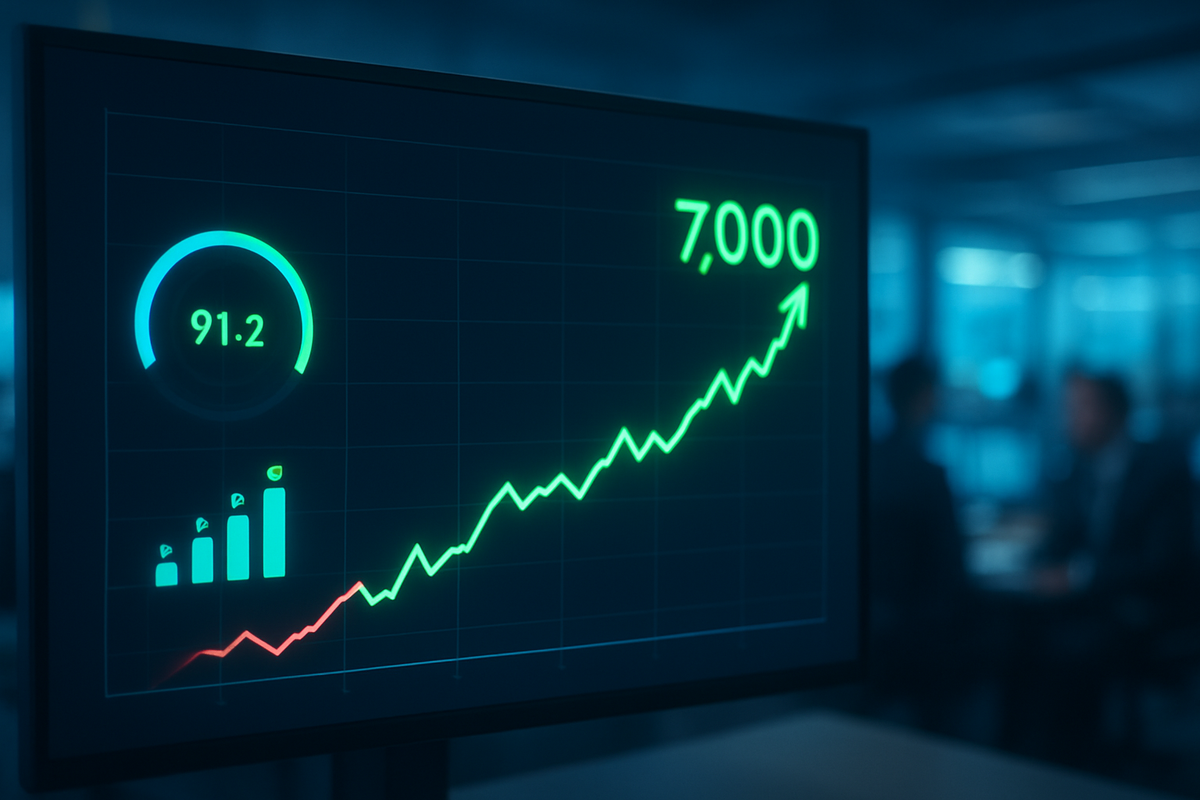
Shortly after the opening bell, the optimism was bolstered by The Conference Board’s Consumer Confidence Index, which printed at 91.2 for February. This surpassed the projected 89.5 and represented a steady climb from January’s 89.0. Market participants were particularly heartened by the "Present Situation" component of the index, which rose to 146.4, suggesting that despite persistent concerns over "sticky" inflation, the American consumer currently feels secure in their employment and income levels. This "beat-and-raise" scenario for the economy effectively silenced the bears who had spent the previous 24 hours calling for a more aggressive market correction.
The timeline of today’s rally followed a classic "Turnaround Tuesday" script. After a jittery pre-market session, the ADP data provided an initial floor for equity futures. Once the Consumer Confidence data hit the tape at 10:00 AM ET, institutional buying programs kicked into high gear. The technology and industrial sectors led the charge, with the Nasdaq Composite climbing 1.1% by the early afternoon, while the S&P 500 rose 0.8%, reclaiming the 7,000-point psychological threshold it had briefly surrendered on Monday.
Tech Titans and Retail Giants Lead the Charge
The primary beneficiaries of Tuesday’s relief rally were the high-growth technology names that bore the brunt of Monday’s selling. Nvidia Corp. (Nasdaq: NVDA), the poster child for the 2025 AI boom, saw its shares jump 2.4% as investors realized that a strong labor market equates to continued corporate spending on enterprise AI solutions. Similarly, Microsoft Corp. (Nasdaq: MSFT) and Alphabet Inc. (Nasdaq: GOOGL) posted gains of 1.5% and 1.2%, respectively, as the consumer confidence data suggested that the digital advertising and cloud services markets remain on firm footing.
In the retail and consumer discretionary space, the 91.2 confidence reading provided a massive tailwind for companies reliant on middle-class spending. Amazon.com Inc. (Nasdaq: AMZN) rose 1.8%, while Walmart Inc. (NYSE: WMT) saw a 0.9% bump as the data eased fears of a consumer "strike" in the face of 3.0% CPI inflation. Financial institutions also joined the winner's circle, with JPMorgan Chase & Co. (NYSE: JPM) and The Goldman Sachs Group, Inc. (NYSE: GS) gaining ground as the strong ADP report reduced the likelihood of a "hard landing" credit event, even if it means the Federal Reserve might keep interest rates at the 3.0%-3.25% range for longer than some doves had hoped.
On the losing side, traditional defensive plays and "bond proxies" such as utilities and consumer staples underperformed as capital rotated back into growth. Duke Energy Corp. (NYSE: DUK) and The Procter & Gamble Co. (NYSE: PG) traded flat to slightly lower, as the "risk-on" sentiment made their stable dividends less attractive relative to the rebounding tech sector. Furthermore, companies with heavy exposure to international trade sensitive to the ongoing tariff discussions remained under pressure, though the broader market tide eventually lifted most boats.
Historical Patterns and the Late-Cycle Context
The "Turnaround Tuesday" phenomenon is more than just Wall Street superstition; it is a documented trend where markets frequently reverse a downward move from Monday as weekend anxieties are processed and institutional "dip-buyers" re-enter the fray. Today’s action fits this historical precedent perfectly. Historically, the S&P 500’s average Tuesday gain has outperformed all other weekdays since 1980, and today’s 0.8% rise underscores the persistence of this trend in the volatile 2026 market environment.
In a broader sense, this rally highlights the "divergence" currently defining the 2026 economy. While the headline Consumer Confidence index is rising, the "Expectations Index" (looking six months ahead) remains stubbornly near the 72.0 level. Historically, a sustained reading below 80 in expectations has been a reliable harbinger of a recession within 12 months. Therefore, while today’s 91.2 print is a relief, it creates a tension between current prosperity and future anxiety. This tension is keeping the Federal Reserve in a difficult position, as they attempt to balance a resilient labor market with an inflation rate that has yet to hit the elusive 2% target.
Compared to previous cycles, such as the mid-2000s or the post-COVID recovery of 2021, the 2026 market is operating with much less margin for error. The 2025 rally was driven by the "AI Deployment" phase, but as we move further into 2026, the market is demanding "proof of work" in the form of tangible earnings growth. Today’s ADP data provided that proof by showing that businesses are still expanding their headcounts to manage the increased productivity demand, rather than cutting staff in favor of automation alone.
The Road Ahead: Inflation Data and Fed Speculation
Looking ahead, the sustainability of this "Turnaround Tuesday" rally will be tested by the upcoming release of the Personal Consumption Expenditures (PCE) price index later this week. If the PCE data confirms that inflation is remaining "sticky" above 2.7%, the market’s enthusiasm for today’s strong employment data may sour, as it would give the Federal Reserve a mandate to pause their current rate-cutting cycle. Investors are currently pricing in a "wait-and-see" approach for the March Fed meeting, and today’s data slightly tilts the odds toward a hawkish hold.
In the short term, the market will likely remain in a high-volatility "trading range." Strategists suggest that as long as the S&P 500 stays above the 6,950 level, the technical uptrend remains intact. However, the recurring threat of trade tariffs and the potential for a "jobless" productivity surge driven by AI remain the two primary "black swan" risks for the remainder of the first half of 2026. Companies will need to show not just that they are hiring, but that they are hiring for high-value roles that can sustain the current valuation multiples of the S&P 500.
A Fragile but Formidable Recovery
Today's market action serves as a potent reminder of the US economy's underlying resilience. The leap from 89.0 to 91.2 in consumer confidence, paired with a nearly 200,000-job beat from ADP, has effectively neutralized the bearish narrative that took hold during Monday's sell-off. While the "Turnaround Tuesday" label provides a convenient narrative, the rally’s true foundation lies in the fact that American consumers and businesses are still finding ways to grow despite the "late-cycle" headwinds of 2026.
Moving forward, investors should keep a close eye on the "Expectations Index" within the confidence reports. While the "Present Situation" is rosy, the persistent gap between today’s comfort and tomorrow’s fear suggests that the market’s path will remain treacherous. The key takeaway for the month of February is that the "soft landing" is still the base case, but the margin for error is shrinking. In the coming months, the focus will shift from "will we have a recession?" to "how long can this expansion last?", and as today's data proves, the answer might be longer than the skeptics think.
This content is intended for informational purposes only and is not financial advice.