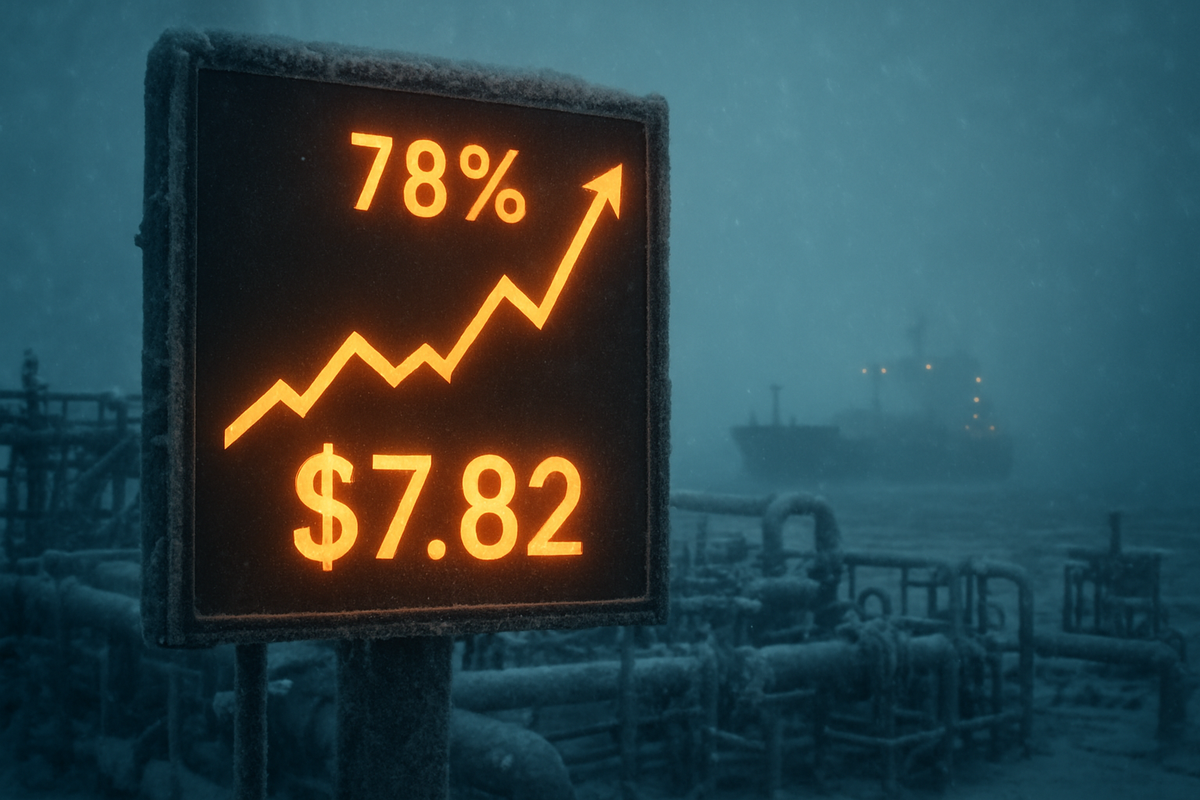
US natural gas prices have undergone a violent transformation in early 2026, with the Henry Hub benchmark surging 78% to reach $7.82 per million British thermal units (MMBtu). This represents the highest sustained price level since the global energy crisis of late 2022, signaling a definitive end to the era of ultra-cheap domestic energy. The rally is the result of a "perfect storm" of extreme meteorological events and structural changes in the US energy landscape that have left the market dangerously thin.
The immediate catalyst for the spike was a series of brutal Arctic blasts, most notably "Winter Storm Fern," which paralyzed large swaths of the Northern Hemisphere in late January and early February. The resulting surge in heating demand, coupled with production "freeze-offs" in key basins like the Permian and Appalachia, triggered a record-shattering drawdown of domestic inventories. As of late February 2026, what began as a massive supply surplus at the start of the winter has evaporated into a deficit, leaving the market highly sensitive to every forecast of lingering cold.
The Big Freeze: A Record-Breaking Inventory Drain
The timeline of this price explosion began in mid-January 2026, when a polar vortex displaced Arctic air deep into the United States. During the week ending January 30, the Energy Information Administration (EIA) reported a historic 360 billion cubic feet (Bcf) withdrawal from underground storage—the largest weekly decline ever recorded. This single event erased months of inventory building and shifted the national storage level to roughly 5.6% below the five-year average.
The physical market reacted with immediate panic. At the peak of the freeze, localized spot prices briefly touched double digits in the Northeast and Midwest, while the Henry Hub futures curve for March and April 2026 adjusted upward by nearly $3.50 in a matter of weeks. Industry stakeholders, including grid operators and major utilities, were forced to activate emergency demand-response protocols as residential heating demand jumped 30% overnight. The speed of the transition from a "glut" to a "scarcity" mindset has caught many market participants off guard, particularly after the subdued price environment of 2024 and 2025.
Market Winners and Losers in the New High-Price Environment
The primary beneficiaries of the current price surge are the major domestic producers who had previously been curtailing production to support prices. Expand Energy (NYSE: EXE), the entity formed by the merger of Chesapeake and Southwestern Energy, stands as the largest natural gas producer in the US and is poised to see a significant windfall from its unhedged production volumes. Similarly, EQT Corporation (NYSE: EQT) is seeing its margins expand rapidly as it leverages the recently completed Mountain Valley Pipeline to move gas from the Appalachia basin to high-demand markets in the Southeast.
On the export side, Cheniere Energy (NYSE: LNG) continues to capitalize on the widening spread between domestic and international prices. With its Corpus Christi Stage 3 expansion now fully operational as of early 2026, the company is moving record volumes of liquefied natural gas to European and Asian buyers who are also grappling with extreme winter weather. Conversely, the "losers" in this scenario include energy-intensive industrial companies and US residential consumers. Public utilities are already warning of "fuel adjustment" surcharges on upcoming bills, while industrial groups have renewed their calls for the government to prioritize domestic supply over international exports to protect American manufacturing competitiveness.
A Structural Shift: The Global Reach of US Gas
The 2026 price spike highlights a fundamental evolution in the US gas market: the "internationalization" of domestic supply. For decades, the US market was largely insulated from global trends, but the massive expansion of LNG export capacity has linked Henry Hub directly to global demand. Total US export capacity is on track to exceed 22 Bcf/d by the end of 2026, effectively doubling the "structural demand" for gas compared to five years ago. Projects like the ExxonMobil (NYSE: XOM) and QatarEnergy joint venture at Golden Pass, and the Plaquemines LNG facility, have turned the US into the world's primary energy "swing producer."
This shift has significant regulatory and policy implications. The Industrial Energy Consumers of America (IECA) recently petitioned for an immediate suspension of spot LNG exports, arguing that the current $7.82 price floor creates a "reliability risk" for US factories. This echoes historical precedents from the 2022 energy crisis, but the stakes are higher now given the sheer volume of gas being shipped abroad. As the US becomes more integrated into the global energy web, the days of domestic gas prices decoupling from world events appear to be over.
Looking Ahead: Volatility as the New Normal
In the short term, the market remains on high alert for any signs of a "late-season" cold snap in March. If inventories continue to draw down at their current pace, analysts suggest that $8.00 or even $9.00 MMBtu is within reach before the injection season begins in April. Strategically, this price environment will likely trigger a massive ramp-up in drilling activity across the Haynesville and Marcellus shales, as producers seek to capture these decade-high margins. However, the lead time for new production means that supply relief may not arrive until late 2026 or early 2027.
The long-term challenge for the industry will be balancing the lucrative export market with domestic political pressure. If high prices persist into the 2026 summer cooling season, the "cost to US consumers" narrative will likely become a central theme in the upcoming election cycles. Investors should prepare for increased volatility and potential legislative attempts to cap export volumes or mandate minimum domestic storage levels—a move that would fundamentally alter the investment thesis for the entire midstream and upstream sector.
Conclusion: A New Era for Henry Hub
The 78% surge to $7.82 at Henry Hub marks a watershed moment for the US energy sector. It confirms that the combination of extreme weather volatility and record-high export commitments has permanently tightened the supply-demand balance. While the current price levels are a boon for producers like EQT and Expand Energy, they represent a significant inflationary headwind for the broader US economy and a point of friction for industrial energy users.
Moving forward, the market will transition from watching "surplus" data to monitoring "deficit" risks. Investors should keep a close eye on weekly EIA storage reports and the progress of upcoming LNG terminal commissioning through the end of the year. As the US solidifies its role as the global energy hub, the "fear premium" currently baked into prices may become a permanent fixture of the natural gas market, requiring both consumers and companies to adapt to a higher-cost, high-volatility environment.
This content is intended for informational purposes only and is not financial advice.