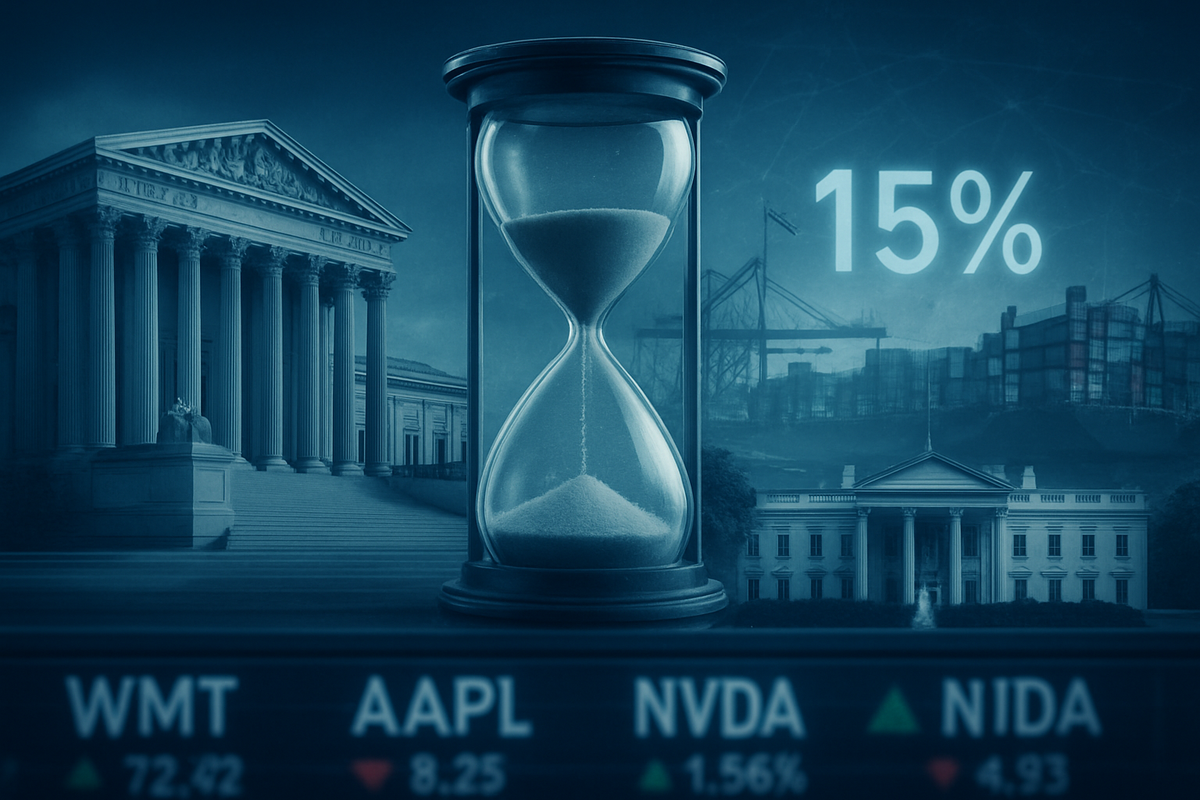
WASHINGTON, D.C. — In a dramatic reshuffling of global trade policy, the Trump administration has officially transitioned its sweeping tariff regime to the "Balance-of-Payments" authority under Section 122 of the Trade Act of 1974. This move, finalized on February 24, 2026, comes as an immediate response to a stinging defeat at the Supreme Court, which late last week invalidated the administration's use of the International Emergency Economic Powers Act (IEEPA) to levy broad import duties. The new policy implements a flat 15% surcharge on all global imports, triggering a high-stakes 150-day countdown for Congress to either codify the measures or watch them expire.
The shift marks a critical tactical evolution for the White House. By invoking Section 122, the President has bypassed the immediate legal vacuum left by the Court’s ruling, but at a significant cost of flexibility. Unlike the previous "reciprocal" tariffs that reached as high as 40% on specific Chinese goods, Section 122 is strictly capped at 15% and carries a mandatory expiration date of July 24, 2026. This "tariff cliff" is already sending shockwaves through the financial markets as corporations scramble to front-load inventory before the statutory window closes.
The Legal Pivot: From Emergency Powers to Balance-of-Payments
The crisis for the administration began on February 20, 2026, when the Supreme Court ruled 6-3 in Learning Resources, Inc. v. Trump that the Executive Branch had overstepped its constitutional authority. Chief Justice John Roberts, writing for the majority, invoked the "Major Questions Doctrine," asserting that the power to tax all global imports is a matter of such vast economic significance that it requires explicit, unambiguous authorization from Congress—something the IEEPA, originally intended for national security sanctions, did not provide. The ruling threatened to dismantle the administration's trade wall overnight, potentially forcing the Treasury to refund billions in collected duties.
Within hours of the decision, the White House pivoted to Section 122, a rarely used 1970s-era statute designed to address "fundamental international payments problems." By declaring the current $1.2 trillion trade deficit a "balance-of-payments crisis," the President was able to unilaterally impose the 15% surcharge effective today. This move serves as a "legal bridge" while the U.S. Trade Representative (USTR) launches more durable—but time-consuming—investigations under Section 301 and Section 232.
The 150-day clock is now the primary focus of lobbyists and lawmakers. Under the statute, these tariffs will automatically terminate in mid-July unless Congress passes a resolution to extend them. This creates a volatile political environment where trade policy will be a central theme of the upcoming mid-term campaigns, forcing a divided Congress to take a definitive stand on protectionism.
Winners and Losers: Retailers, Tech, and Heavy Industry
The immediate market reaction has been bifurcated, with "winners" emerging among domestic commodity producers and "losers" among retailers and tech giants with complex global supply chains.
Retailers: Walmart (NYSE: WMT) has shown surprising resilience, its stock outperforming the broader retail sector. Analysts point to Walmart’s "digital flywheel"—which includes its high-margin advertising and data businesses—as a cushion that allows it to absorb some of the 15% surcharge. Furthermore, as one of the largest filers in the IEEPA litigation, Walmart stands to receive significant refunds from the now-invalidated prior tariffs. In contrast, Target (NYSE: TGT) saw its shares slide 4.2% today, as its higher reliance on imported discretionary goods like apparel and home décor leaves it more exposed to the flat 15% floor with fewer margin-offsetting services.
Technology: The tech sector is navigating a "confusion zone." For Apple (NASDAQ: AAPL), the 15% flat rate is actually a reduction from the 35% duties it faced on certain components in 2025. However, the loss of specific "product exclusions" means its entire hardware stack is now taxed at the 15% level. Nvidia (NASDAQ: NVDA) remains largely insulated; despite a separate 25% Section 232 tariff on high-end AI chips, the 15% global surcharge is expected to be easily absorbed by the company’s massive profit margins and the insatiable global demand for AI infrastructure.
Manufacturing and Automotive: Domestic steel producers like Nucor (NYSE: NUE) are the clear beneficiaries, with shares jumping 6% on the news. The 15% floor provides a guaranteed buffer against foreign competition, which had begun to creep back into the market following rumors of the IEEPA’s legal fragility. However, the automotive sector remains under pressure. General Motors (NYSE: GM) and Ford (NYSE: F) are facing a margin squeeze as the cost of specialized imported electronics and sensors rises, even as they receive some relief from a "non-stacking" rule that prevents the 15% surcharge from being added on top of existing steel and aluminum duties.
Macro Significance: Inflation, the Fed, and Global Trade War 2.0
The macro-economic implications of a flat 15% global tariff are profound. Economists at major institutions are already revising inflation forecasts for the second half of 2026. A 15% floor on all imports is expected to add roughly 0.8% to 1.2% to the Consumer Price Index (CPI), complicating the Federal Reserve’s efforts to maintain a neutral interest rate stance.
This shift also signals a "Global Trade War 2.0." By moving to a flat rate, the U.S. has moved away from surgical strikes against China and toward a "fortress America" approach that affects allies and adversaries alike. The European Union and Japan have already signaled they may challenge the "balance-of-payments" justification at the World Trade Organization (WTO), arguing that a trade deficit in a floating-exchange-rate era does not constitute a "crisis" under international law.
Furthermore, the 150-day limit introduces a new phenomenon: "The July Cliff." Companies are expected to engage in massive front-loading of imports throughout the spring to beat the July 24 expiration date. This will likely cause a temporary spike in GDP and shipping volumes, followed by a potential "demand vacuum" in the third quarter of 2026, creating significant volatility for logistics providers like FedEx (NYSE: FDX) and United Parcel Service (NYSE: UPS).
What Comes Next: The 150-Day Strategic Pivot
As the clock ticks toward July, the administration must decide whether to seek a Congressional extension or rely on the USTR to finalize more targeted Section 301 investigations. Most trade experts expect a "rolling emergency" strategy where the administration attempts to renew the 150-day window by citing new economic stressors, though this would almost certainly face immediate judicial challenges as an end-run around the Learning Resources decision.
In the short term, investors should watch for a surge in "Agentic Commerce" solutions. Many retailers are already deploying advanced AI agents to dynamically price goods and optimize supply routes in real-time, attempting to mitigate the 15% tax through operational efficiency. If these technologies successfully shield consumers from the brunt of the price increases, the political pressure on Congress to extend the tariffs may grow.
Alternatively, if the 15% surcharge leads to a noticeable cooling in consumer spending, we may see a "Grand Bargain" in Congress—where the 15% global tariff is replaced by a lower, permanent "border adjustment tax" that satisfies both the administration's protectionist goals and the market's need for long-term certainty.
Final Wrap-up and Investor Outlook
The transition to Section 122 is a double-edged sword for the Trump administration. While it successfully preserves the tariff wall in the face of a Supreme Court defeat, it places the ultimate fate of U.S. trade policy back in the hands of Congress and the judicial system. The 150-day clock is not just a legal requirement; it is a ticking time bomb for market stability.
Key Takeaways for Investors:
- Watch the July 24 Deadline: The "July Cliff" will dominate inventory cycles and shipping data for the next five months.
- Differentiate by Margin: Companies like Nvidia (NASDAQ: NVDA) and Walmart (NYSE: WMT) with diversified revenue streams or high pricing power are better positioned than margin-thin retailers like Target (NYSE: TGT).
- Monitor IEEPA Refunds: Keep an eye on the Treasury Department's plans for duty refunds; for some companies, the one-time cash infusion from 2025 tariff returns could offset the 2026 cost of the 15% surcharge.
Moving forward, the market will remain highly sensitive to any rhetoric from Capitol Hill regarding a Section 122 extension. For now, the "15% Floor" is the new reality of global commerce, and the "150-day squeeze" has officially begun.
This content is intended for informational purposes only and is not financial advice.