The retail world is currently processing a whirlwind of data after Walmart Inc. (NYSE: WMT) released its fourth-quarter fiscal 2026 earnings on February 19, 2026. The report, which surpassed analyst expectations across nearly every key metric, offers a vital window into the state of the American shopper following a year of economic whiplash. With total revenue hitting a staggering $190.7 billion—a 5.6% increase year-over-year—Walmart has once again solidified its position as the ultimate defensive play in a volatile market. However, the celebration was short-lived, as a landmark Supreme Court ruling on February 20 upended the nation’s trade policy, setting the stage for a new era of "tariff-induced" inflation.
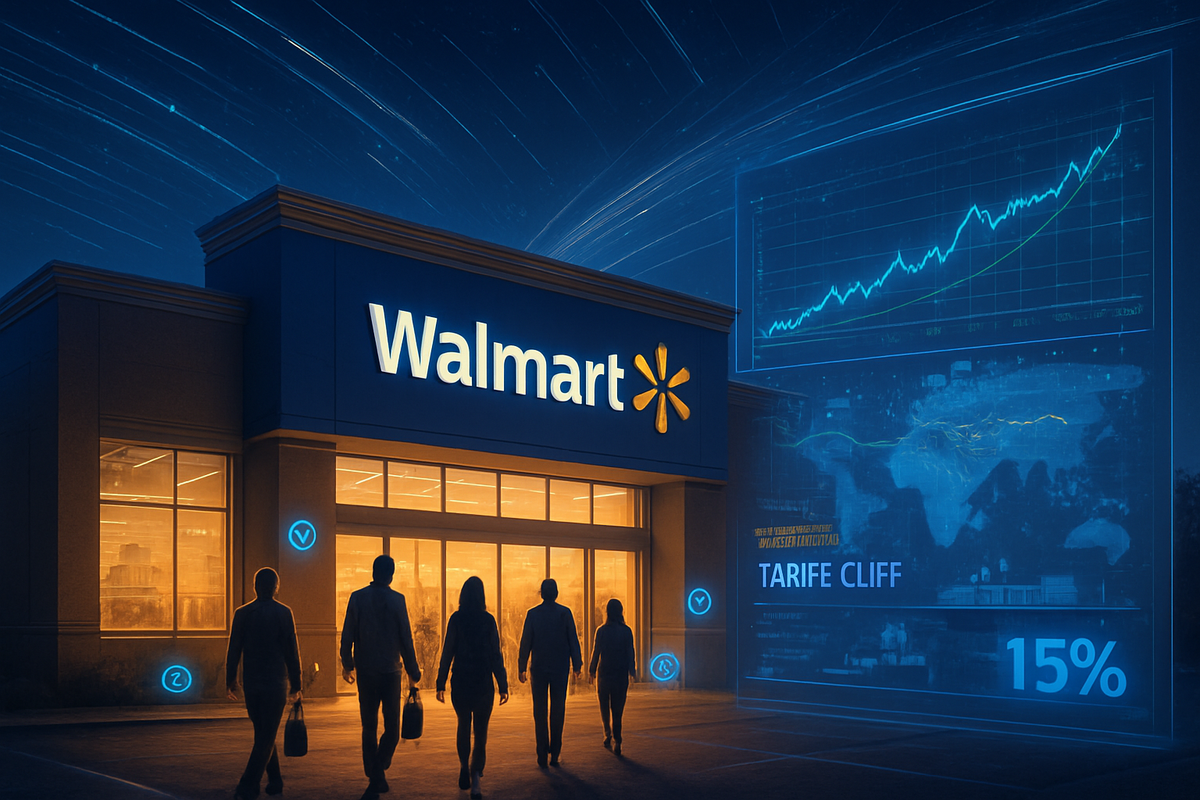
As of February 23, 2026, the markets are bracing for the immediate implementation of a 15% global import surcharge, invoked under Section 122 of the Trade Act of 1974. Walmart’s earnings, while robust, revealed a cautionary tale: general merchandise inflation jumped to over 3% in the final months of 2025. This suggests that even the world’s largest retailer is beginning to exhaust its "pre-tariff" inventory buffers. For the US consumer, the message is clear: the resilience seen throughout the holiday season is about to face its most grueling test yet as the "cost of everything" prepares for another leg up.
Walmart’s Q4 2026 performance was characterized by what CEO John Furner described as a "digital flywheel in full motion." The company reported adjusted earnings per share (EPS) of $0.74, beating the consensus estimate of $0.73. This success was largely driven by a 24% surge in global e-commerce sales, which now account for 23% of the company’s total net sales. US comparable sales grew by 4.6%, excluding fuel, a figure that significantly outperformed rival retailers. The growth was not just from volume but from a notable "flight to value," as high-income households (those earning over $100,000 annually) contributed to more than half of the gains, trading down from specialty grocers to Walmart’s private-label brands.
The timeline leading to this moment has been fraught with legislative and judicial drama. Following a record 43-day federal government shutdown that ended in November 2025, consumer confidence was initially shaken. However, the dispersal of federal backpay in early 2026 provided a temporary "coiled spring" effect for retail spending. Just as the sector began to stabilize, the US Supreme Court struck down the administration’s previous use of the International Emergency Economic Powers Act (IEEPA) for broad tariffs on February 20, 2026. In an immediate retaliatory move to protect domestic interests, the administration invoked Section 122 of the Trade Act of 1974, which takes effect tomorrow, February 24, imposing a 15% surcharge on all imports.
Market reaction to Walmart's "double beat" was initially positive, with the stock seeing a 1.6% pre-market pop. However, those gains were erased by the end of the week as investors weighed the looming 15% surcharge against Walmart’s future margins. While the company announced a record $30 billion share repurchase program to signal long-term confidence, analysts from UBS and other major firms have noted a "valuation disconnect," with Walmart now trading at nearly 50 times forward earnings—a premium that leaves little room for error if the "tariff shock" stalls consumer spending in the second half of the year.
Strategic initiatives also took center stage during the earnings call, specifically the formal rollout of "Agentic Commerce." This AI-driven initiative, developed through deep integrations with OpenAI and Google (NASDAQ: GOOGL), seeks to move beyond traditional search-based shopping. By utilizing proactive AI agents, Walmart aims to handle household restocking and project planning autonomously. This operational shift is part of a broader plan to automate the supply chain, which has already contributed to a 100-basis-point improvement in e-commerce economics this quarter, helping to offset rising labor costs.
The current economic climate has created a stark "K-shaped" divergence among major retailers. Walmart (NYSE: WMT) and Costco Wholesale Corp. (NASDAQ: COST) emerge as the clear winners, benefiting from their massive scale and "defensive" product mixes. Costco, in particular, has maintained steady high-single-digit revenue growth and high membership renewal rates, acting as a secondary sanctuary for consumers looking to bulk-buy ahead of expected price hikes. These "scale machines" have the bargaining power to negotiate with suppliers and the logistics infrastructure to "front-load" inventory before new surcharges take full effect.
Conversely, Target Corp. (NYSE: TGT) continues to face significant headwinds. Wrapping up its third consecutive year of negative or flat sales growth, Target remains overly exposed to discretionary categories like apparel and home décor—the very sectors most sensitive to inflation and tariff-related price hikes. Unlike Walmart, Target’s grocery mix is not large enough to drive the same frequency of "trade-down" foot traffic. Analysts expect Target’s 2026 margins to remain under intense pressure unless it can successfully leverage its new AI licensing agreements to drastically reduce inventory waste and operational overhead.
Other notable losers in this environment include Nike Inc. (NYSE: NKE) and Home Depot Inc. (NYSE: HD). Nike reported a staggering 40% decline in margins due to its heavy reliance on Asian manufacturing and the direct impact of the 15% surcharge on imported footwear. Home Depot, meanwhile, is struggling with a "sluggish housing market" compounded by high interest rates, making it difficult for the retailer to pass on increased costs for imported building materials. Even Amazon.com Inc. (NASDAQ: AMZN) is feeling the squeeze; the e-commerce giant implemented a 10-15% increase in Fulfillment by Amazon (FBA) fees in January 2026 to offset rising logistical costs, placing a heavy burden on its third-party sellers who are most vulnerable to trade volatility.
Walmart’s current status as an economic bellwether is more significant now than perhaps at any point in the last decade. The shift of high-income earners to value-oriented stores is not merely a temporary trend but a structural change in the US economy. As "sticky" inflation persists in non-discretionary sectors like healthcare and housing, even the wealthy are becoming "price-sensitive" shoppers. This migration validates Walmart’s "flywheel" model—where low-margin retail is subsidized by high-margin services like Walmart Connect (advertising) and VIZIO-integrated data services, which grew by 37% this year to nearly $6.4 billion.
The move toward "Agentic Commerce" also marks a pivotal moment in the broader industry trend of AI execution. While 2024 and 2025 were years of AI experimentation, 2026 is the year of implementation. Walmart’s use of the Universal Commerce Protocol (UCP) to standardize AI interactions suggests that the future of retail will be less about "browsing" and more about "curated fulfillment." This has massive ripple effects for competitors who lack the capital to build similar proprietary AI ecosystems, potentially widening the gap between the retail "haves" and "have-nots."
Historically, the invocation of Section 122 of the Trade Act of 1974 is a rare and aggressive move. By providing a 150-day "bridge" (set to expire on July 24, 2026), the administration has essentially dared Congress to act or face a permanent inflationary spiral. This creates a high-stakes environment similar to the "tariff wars" of 2018-2019, but with the added complication of a post-shutdown economy. Retailers are expected to rush imports in the second quarter of 2026 to beat the July "cliff," which could lead to temporary port congestion and a spike in freight rates reminiscent of the 2021 supply chain crisis.
Looking ahead to the remainder of 2026, the retail sector faces a period of high-stakes strategic pivots. Short-term, we are likely to see a "front-loading" of inventory as companies attempt to stockpile goods before the current 15% surcharge is potentially extended or replaced by even higher permanent tariffs in late July. This will likely result in a "pull forward" of revenue for the first half of the year, followed by a potential "demand vacuum" in the third and fourth quarters. For Walmart, the challenge will be maintaining its "Always Low Prices" promise while its own cost of goods sold (COGS) inevitably rises.
In the long term, the emergence of proactive AI agents could fundamentally change the concept of brand loyalty. If a consumer’s AI agent is programmed to find the "best value" based on real-time pricing and tariff adjustments, traditional marketing may become less effective than "algorithmic optimization." Retailers will need to adapt their digital storefronts to be "machine-readable" first and "human-readable" second. This shift presents a significant opportunity for tech-forward companies but poses a terminal threat to legacy retailers who fail to modernize their data infrastructure.
The takeaway from Walmart’s Q4 2026 earnings is that the US consumer remains remarkably resilient, but that resilience is increasingly fueled by a necessity-driven "flight to value." While Walmart’s ability to grow profits faster than sales is a testament to its operational efficiency and AI integration, the looming "tariff shock" represents an exogenous variable that no amount of automation can fully mitigate. The market is entering a "K-shaped" reality where scale, digital advertising, and membership fees are the only reliable buffers against a turbulent global trade environment.
Investors should closely watch the July 24 "tariff cliff" and the subsequent legislative response, as this will determine the trajectory of retail pricing for the 2026 holiday season. Furthermore, the success of "Agentic Commerce" will be a key indicator of whether Walmart can maintain its 50x earnings multiple by evolving from a simple retailer into a tech-driven service provider. As we move deeper into 2026, the resilience of the American consumer will not just be measured by how much they spend, but by how effectively they—and their AI agents—navigate a world of rising costs and shifting trade borders.
This content is intended for informational purposes only and is not financial advice