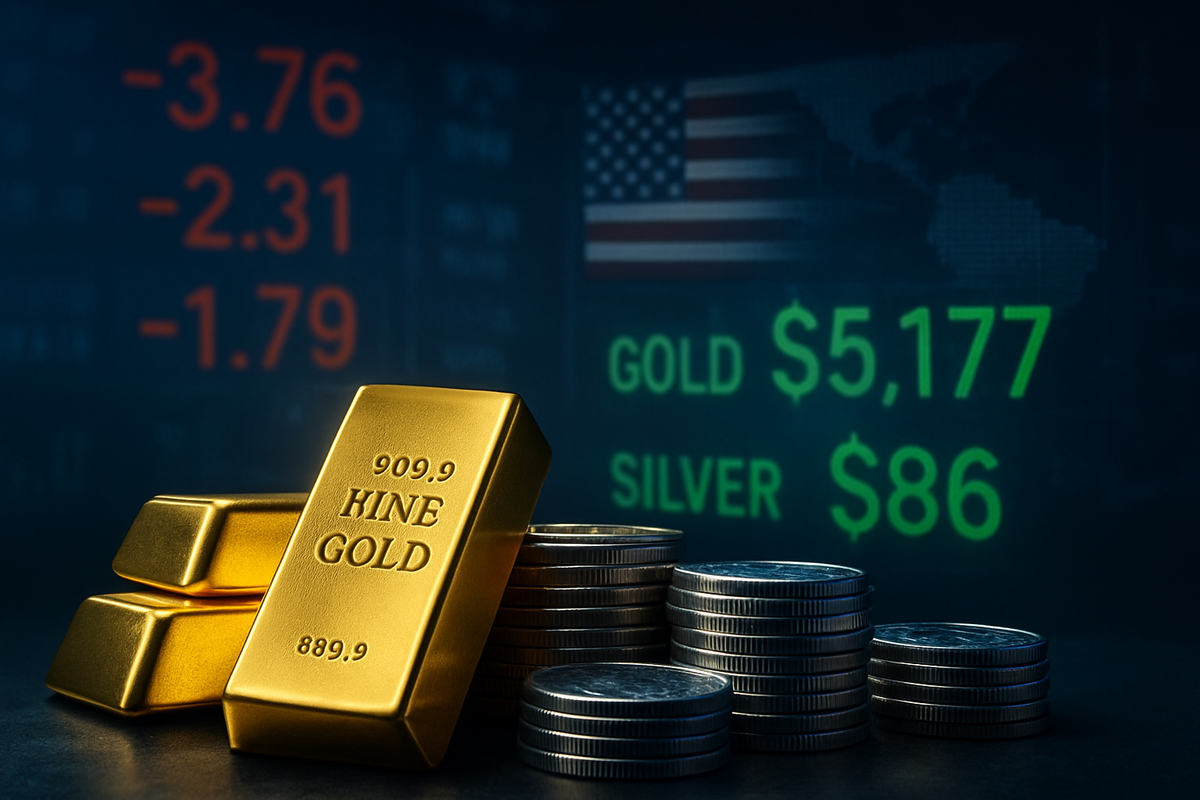
In a day of extraordinary volatility for global financial markets, gold prices have surged 5% to hover near an all-time high of $5,177 per ounce on the Comex, while silver has skyrocketed 10% to cross the $86 per ounce threshold. The massive flight to safe-haven assets follows a weekend of legal and political high drama that saw the U.S. Supreme Court dismantle the administration’s "reciprocal tariff" framework, only for President Trump to immediately exercise a different executive lever to impose a flat 15% global tariff.
The immediate implications for the market are profound, as the prospect of a "reciprocal" trade war has been replaced by a broader, more aggressive global trade wall. Investors, spooked by the sudden shift from a targeted legal battle to a sweeping executive mandate, are dumping equities in favor of hard assets. With the U.S. dollar showing signs of instability against a basket of currencies due to the sudden policy pivot, precious metals are reclaiming their status as the ultimate hedge against geopolitical and inflationary uncertainty.
Legal Whiplash and the Section 122 Pivot
The turmoil began on Friday afternoon when the U.S. Supreme Court, in a 6–3 decision for Learning Resources, Inc. v. Trump, ruled that the administration’s use of the International Emergency Economic Powers Act (IEEPA) to impose "reciprocal tariffs" was unconstitutional. The Court’s majority opinion, rooted in the Major Questions Doctrine, argued that the power to levy taxes and duties rests solely with Congress and requires explicit, non-ambiguous authorization. The ruling effectively invalidated billions of dollars in duties collected since 2025, sending retail and tech stocks briefly higher in late-day trading on Friday as markets anticipated a "tariff-free" reprieve.
However, that optimism was short-lived. Over the weekend, President Trump signed a new executive order citing Section 122 of the Trade Act of 1974. This rarely used statute allows a President to impose a temporary import surcharge of up to 15% for 150 days to address "serious balance-of-payments deficits." By Monday morning, February 23, 2026, the administration had formalized the 15% flat global tariff, claiming it was necessary to protect the American economy from the "legal sabotage" of the court ruling.
The timeline of events has left market participants reeling. Just 72 hours ago, analysts were preparing for a return to traditional trade norms; today, they are modeling for a 15% across-the-board cost increase on virtually all imported goods. The shift has fundamentally altered the risk landscape, forcing a massive rotation into commodities as the 15% surcharge is expected to have an immediate, pass-through inflationary effect on consumer prices.
Winners in the Mine, Losers on the Shelf
The primary beneficiaries of this trade-induced chaos are the precious metals miners, who are seeing their margins expand as bullion prices outpace operational costs. Newmont Corporation (NYSE: NEM), the world's largest gold producer, saw its shares climb in early trading as the metal breached $5,100. Similarly, Barrick Gold (NYSE: GOLD) and Wheaton Precious Metals (NYSE: WPM) are witnessing a surge in institutional demand. In the silver space, Pan American Silver (NASDAQ: PAAS) and Hecla Mining (NYSE: HL) have become focal points for investors looking for "high-beta" exposure to the 10% jump in silver prices.
On the losing end of the spectrum are the large-scale importers and multinational tech firms. Retail giants like Walmart Inc. (NYSE: WMT) and Amazon.com, Inc. (NASDAQ: AMZN), which had initially hoped for a reprieve from the SCOTUS ruling, are now facing the reality of a 15% surcharge on their entire global supply chains. While the potential for refunds from the previous "reciprocal" tariffs offers a temporary balance sheet cushion, the long-term outlook for margins is bleak.
The technology sector is also under significant pressure. Apple Inc. (NASDAQ: AAPL) and Nvidia Corporation (NASDAQ: NVDA) are particularly vulnerable due to their reliance on complex, overseas component manufacturing. Although the administration has hinted at "essential exemptions" for certain high-tech components, the broad-brush nature of the Section 122 order creates a cloud of uncertainty that is driving selling pressure across the Nasdaq.
A New Era of Trade Uncertainty
This event fits into a broader global trend of "economic nationalism" and the erosion of the post-WWII multilateral trading system. By pivoting to Section 122, the Trump administration has effectively bypassed the judicial check on its power, at least in the short term. The move echoes the "Nixon Shock" of 1971, when President Richard Nixon used the same statute to impose a 10% surcharge, a move that eventually led to the end of the Bretton Woods system.
The ripple effects are already being felt internationally. The European Union and China have both signaled that retaliatory measures are "imminent and equivalent." This raises the specter of a multi-front trade war that could disrupt global shipping and logistics for months. For partners like Canada and Mexico, the 15% global tariff creates a legal quagmire regarding USMCA (United States-Mexico-Canada Agreement) protections, potentially jeopardizing North American trade integration.
From a policy perspective, the SCOTUS ruling was a victory for the "Major Questions Doctrine," but the executive response has revealed a "cat-and-mouse" game between the branches of government. This suggests that the regulatory environment for international business will remain highly fragmented and unpredictable through the 2026 mid-term elections and beyond.
The Road Ahead: 150 Days of Volatility
In the short term, the market will focus on the "150-day clock" associated with Section 122. Under the law, the President must consult with Congress if the surcharge is to be extended beyond the initial period. This creates a looming legislative showdown in the summer of 2026. Strategic pivots are already underway at major corporations, with many firms likely to accelerate "near-shoring" efforts to move production to countries that might secure bilateral exemptions.
However, the path to such exemptions is fraught with political difficulty. If the administration uses the 15% tariff as a "bargaining chip" to force new trade deals, we could see extreme swings in market sentiment based on daily headlines. For gold and silver, the path of least resistance remains upward as long as the 15% tariff persists, as it essentially acts as a global tax that debases the purchasing power of the dollar.
Scenario planning for investors now includes a "high-inflation, low-growth" environment, often referred to as stagflation. If the 15% tariff remains in place and leads to a spike in the Consumer Price Index (CPI), the Federal Reserve may be forced into a difficult position: raising rates to fight tariff-induced inflation while the economy slows due to trade friction.
Final Assessment for Investors
The events of February 23, 2026, mark a turning point in the relationship between the U.S. judiciary and executive economic policy. While the Supreme Court successfully asserted its authority over the IEEPA, the administration’s swift pivot to Section 122 has maintained the status quo of trade aggression, albeit under a different legal banner. The resulting 5% rally in gold and 10% surge in silver are clear signals that the market views this as a long-term inflationary and geopolitical risk.
Moving forward, the market will likely remain in a "risk-off" posture until there is more clarity on potential exemptions and the scale of international retaliation. Investors should watch for the first round of retaliatory lists from the EU and China, as well as any signs of a "cooling off" period or diplomatic breakthroughs.
The lasting impact of this day will be the realization that trade policy is no longer a matter of settled law, but a fluid, executive-driven tool of statecraft. For the coming months, the phrase "safe haven" will likely dominate the investment lexicon as the world adjusts to the new 15% global reality.
This content is intended for informational purposes only and is not financial advice.